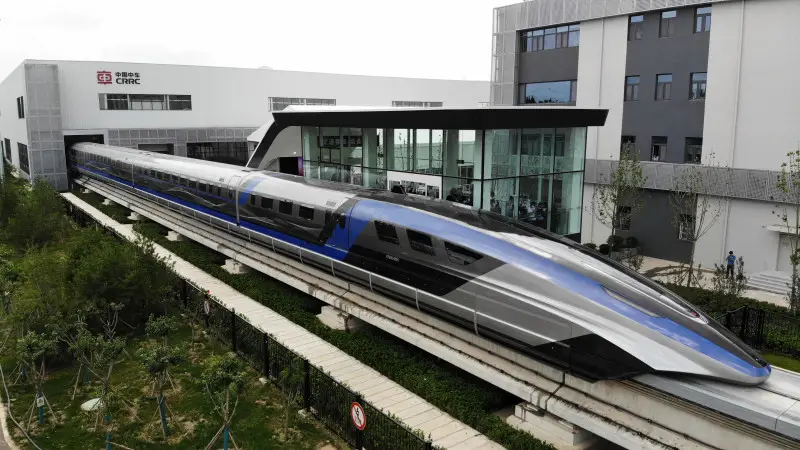
The Ultra-High-Speed (UHS) Low-Vacuum Tube Maglev Transportation System, commonly referred to as the “high-speed flying train” project, is a cutting-edge rail test line located in Yanggao County, Datong City, in North China’s Shanxi Province. Designed to operate in a near-vacuum internal duct to eliminate both frictional drag and air resistance, the superconducting maglev train aims to eventually achieve ground speeds of up to 1,000 kilometers per hour. Co-developed by the China Aerospace Science and Industry Corporation (CASIC) and the Shanxi provincial government, the massive infrastructure project features a planned 60-kilometer full-scale test track built in phases. Following its initial groundbreaking in 2021 and the start of full construction in 2022, the 2-kilometer first phase successfully passed its integrated demonstration and acceptance tests in August 2024, laying the foundation for future ultra-fast commuting between China’s megacity clusters.
This ambition to redefine the limits of transit is further demonstrated by the milestone where China’s deepest undersea high-speed rail tunnel reached 113 metres, as the Shenjiang 1 TBM broke world records on the Pearl River Estuary. A key component of the Shenzhen-Jiangmen high-speed railway, this engineering feat involves navigating extreme water pressures and complex geological conditions, setting a global benchmark for deep-water shield tunneling and high-speed rail connectivity.
Project Overview
Type: Ultra-high-speed (UHS) low-vacuum tube maglev test line
Location: Yanggao County, Datong City, Shanxi Province, North China
Target Capacity/Speed: Designed for travel speeds of up to 1,000 km/h
Total Track Length: 60 kilometers planned (developed in phases, beginning with an initial 2-kilometer section)
Technology: Superconducting magnetic levitation combined with low-vacuum pipeline technology
Construction Start: Groundbreaking in May 2021; full phase-one construction commenced in April 2022
Current Status: The 2-kilometer full-sized test line successfully passed integrated system acceptance and demonstration tests in August 2024.
Strategic Goal: To drastically reduce travel times between mega-city clusters, potentially cutting the Beijing to Shanghai commute to roughly 90 minutes.
Project Team
Co-Developers: China Aerospace Science and Industry Corporation (CASIC) Third Research Institute and the Shanxi Provincial Government
Academic/Research Partner: North University of China
Construction Contractor: China Railway Sixth Bureau Group (Datong high-speed flying train project unit)
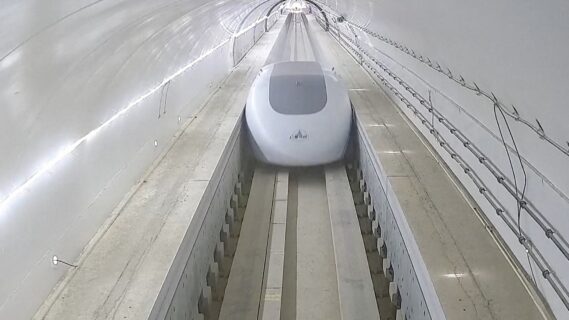
Published 23rd August 2021: Construction is set to begin on the test line for the 1,000 km/h maglev high-speed train in Datong, Shanxi Province, North China. The project for the world’s fastest land vehicle will take place in phases with the first one involving a 2-kilometer line that is scheduled to be completed in June next year. Installation of the equipment and test will begin at the time of completion. Afterward, a 15-kilometer test line will be built within two years. The total plan calls for a rail line of 60 kilometers, as per the announcement made by the municipal government of Datong.
Also Read: China lays tracks for 1,000km/h maglev trains, Hubei.
Low-vacuum magnetic levitation high-speed train uses superconducting magnetic levitation technology to eliminate friction resistance and cut off ground contact, to achieve speeds of more than 622 miles per hour. The country already has the world’s largest high-speed railway network with tracks covering 38,000 kilometers as of last year, serving 95 percent of the cities with a population of more than 1 million. The success of this project will only add to the feats it has made in the world of transportation.
“Hyperloop and maglev systems are only part of the new era of transportation. A route of at least 50 kilometers is necessary to test various aspects, including the vehicle itself, as well as command systems, signals, and routines. Whether such new modes offer economic benefits and environmental protection advantages should also be evaluated further” Wang Dashui, a railway transport engineer. In research and development, the nation holds just under 50% of the world’s maglev patents, ranking first and well above Japan’s 20.57 percent. On the crucial Beijing-Shanghai route, travel time could fall from 5.5 hours by train to just 2.5 to 3.5 hours by maglev, marginally slower than the 2.5 hours it would take to travel by air.




Leave a Reply