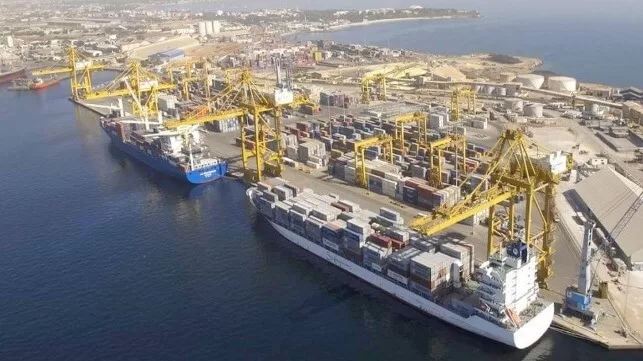
The construction of the Port of Ndayane in Senegal is progressing steadily under a reinforced partnership between the Senegalese government and DP World. Recent reports indicate that significant milestones have been achieved in the dredging phase, with the specialized fleet from Jan De Nul, including the world’s most powerful cutter suction dredger, the Willem van Rubroeck, actively carving out the five-kilometer access channel. This critical dredging work is essential for the port to meet its design goal of an 18-meter draft, which will eventually allow it to accommodate two of the world’s largest container ships simultaneously, a feature that will make it the deepest and most capable maritime hub in West Africa.
The project recently benefited from a strategic amendment signed in late 2025 to accelerate financing and construction, ensuring that Phase 1 remains on track for its scheduled completion by 2027–2028. This initial $837 million investment includes an 840-meter quay and a 300-hectare container terminal designed to handle 1.2 million TEUs annually. Complementing the maritime infrastructure, work has also intensified on the integrated 600-hectare special economic and logistics zone, located just 20 kilometers from Blaise Diagne International Airport. This zone is a cornerstone of the Plan Sénégal Émergent, aimed at transforming the Ndayane-Dakar corridor into a global industrial powerhouse and significantly easing the chronic truck congestion currently saturating the capital’s old port.
In March 2026, DP World celebrated a major milestone by handling its 10 millionth container in Dakar, a record that highlights the urgent need for Ndayane’s expanded capacity. As the Port of Dakar reaches its physical limits, Ndayane is being positioned as the long-term successor that will handle the next century of Senegalese trade. Beyond domestic benefits, the port is increasingly viewed as a vital gateway for the wider Sahel region, particularly for landlocked Mali, with economic forecasts suggesting the new facility will facilitate trade equivalent to 3% of Senegal’s GDP and support over two million jobs nationwide once fully operational.
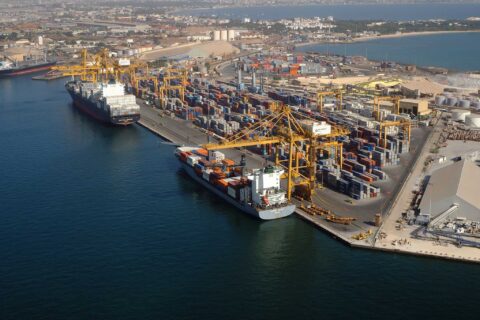
Similarly, Kenya seeks to join the race of maritime superiority in Africa with the expansion of its Port of Mombasa. Recently, Kenya signed a deal with France that will foresee an investment of €700 million for the expansion and renovation of the port.
February 24, 2025
The Belgian construction company, Jan De Nul, made an announcement on Friday on its participation in the construction of Port of Ndayane, West Africa’s Largest Port that is located approximately 50 kilometers Southeast of Senegal’s capital, Dakar. This port construction project is expected to take two and a half years to be completed.
This new port will be located in Ndayane will be instrumental in addressing congestion at the port of Dakar, which has currently attained its maximum capacity. Additionally, the surrounding area is totally saturated according to the information released by the Aalst-based company.
West Africa’s Largest Port Project Factsheet
Location: Ndayane, approximately 50 kilometers southeast of Dakar.
Purpose: The port aims to alleviate congestion at Dakar’s port, which has reached its maximum capacity.
Construction Timeline: The project is expected to take two and a half years to complete.
Dredging: Jan De Nul will dredge a five-kilometer access channel, involving the excavation of ten million cubic meters of sediment.
Platform Development: An 89-hectare platform will be developed for maritime services and container storage.
Capacity: The new deep-water port will be able to simultaneously accommodate two of the world’s largest container ships.
Economic Impact: The port is expected to become the largest in West Africa and drive economic growth in Senegal
What has Jan De Nul been Tasked with?
DP World is the leading developer of this port project. Jan De Nul has been tasked with the dredging works of a five-kilometer access channel. This will entail the excavation of ten million cubic meters of sediments. Furthermore, the company will be developing an 89-hectare platform for both maritime services and container storage.
Jan De Nul will put to use its most powerful dredging vessel, the Willem Van Rubroeck, for this operation. “It will not be an easy task as the seabed of this channel mainly contains hard rock. Additionally, the Atlantic Ocean conditions can be quite challenging at times. Therefore, a powerful dredger that is big enough to operate even in rough conditions is needed,” stated the company’s area manager for Senegal, Dominique Bombaert.
Capacity of the Port of Ndayane
This new port will possess the capacity of being able to accommodate two of the world’s largest container ships. Furthermore, it is set to become the largest port in West Africa, Jan De Nul confirmed.
Also read: Senegal’s Maritime Revolution: The US$1.2 bn Ndayane Port to Reshape Global Trade


Leave a Reply