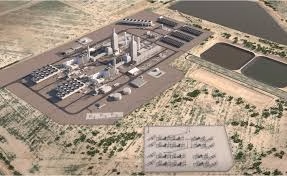
Competitive Power Ventures on Nov. 20, 2025, broke ground on its 1,350-megawatt Basin Ranch Energy Center in the Permian Basin, advancing one of West Texas’ largest new power projects as electricity demand surges.
The project represents an investment of about $2 billion and is expected to generate more than $400 million in local tax revenue over its lifetime. Gemma Power Systems is leading construction, while GE Vernova will supply the facility’s turbines. The plant has also been designed to accommodate a future carbon capture system in later development phases.
Construction follows the announcement made in October 2025 by Texas Governor Greg Abbott, who awarded the project a $1.1 billion loan from the Texas Energy Fund. The financing is the largest issued under the program to date and represents more than 10% of the state’s targeted 10 gigawatts of new dispatchable power generation.
On October 30, 2025, Gemma Power Systems received full notice to proceed on an engineering, procurement, and construction contract from Competitive Power Ventures (CPV).
Project pairs high-efficiency gas turbines with future carbon capture capability
The CPV Basin Ranch Energy Center, which will be situated in Ward County, will utilize GE’s latest 7HA.03 turbines and is being designed with the option to add carbon capture technology capable of trapping up to 95% of its emissions, the companies said. The facility will be a combined-cycle natural gas power plant, meaning it will generate electricity first through gas turbines and then use the waste heat to produce additional power through steam turbines, significantly improving efficiency compared to traditional plants. Once complete, expected in 2028, the project will provide highly efficient, dispatchable power to the Texas grid while incorporating the potential for lower-carbon operations. Also eyeing 2028 completion is Babcock & Wilcox’s $1.5 billion 1GW natural gas facility to power a future data center.
CPV Basin Ranch Energy Center, the largest Texas Energy Fund project
The Texas Energy Fund now finances its largest project through this facility, a program that state lawmakers approved to add 10 gigawatts of dispatchable power to the ERCOT grid after the 2021 crisis. In October 2025, CPV and the Public Utility Commission of Texas finalized a low-interest loan from the fund to support the project.
The Texas Energy Fund, established to expand the state’s dispatchable power capacity, has already backed several major projects. Among them are Calpine’s 460-megawatt natural gas facility in Freestone County, supported by a $278 million loan; the Rock Island Generation Project, the first plant to receive funding under the program; and NRG’s 456-megawatt natural gas plant in Houston, approved for a $216 million loan. These investments highlight the state’s push to strengthen grid reliability with new gas-fired generation.
The River Run Energy Center in North Dakota, newly announced, joins projects like West Texas’s 1,350-MW Basin Ranch Energy Center, highlighting the growing wave of combined-cycle natural gas generation across the U.S. This expansion is largely driven by rising electricity demand from data centers and AI infrastructure, as utilities and developers respond to the need for reliable, dispatchable power to support modern digital-economy growth. Both projects exemplify how efficient combined-cycle gas plants are becoming key components of the nation’s evolving energy landscape.
When Basin Ranch comes online, it will generate enough electricity to power approximately 850,000 homes. Proponents say the facility will help alleviate regional pipeline congestion, meet surging energy demand from industrial expansion and data centers, and provide stability to a grid increasingly reliant on intermittent renewable sources.
“This project highlights our team’s expertise in delivering complex power generation facilities safely and on schedule,” said Charles Collins, chief executive officer of Gemma Power Systems, in a statement. CPV’s president of low-carbon generation, Peter Podurgiel, added the project will bring “much-needed dispatchable generation” to the state and support thousands of construction jobs.
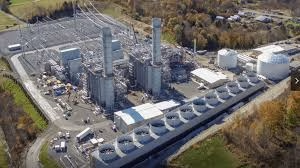
Economic Impact
State filings estimate the project will create approximately 5,200 jobs during its three- to four-year construction phase. And contribute an estimated $410 million in net benefits to local taxing districts.
But while developers have touted the plant’s “cleaner” design, along with a prospective carbon capture system, the project underlines how Texas is continuing to lean on fossil fuels even as it expands its wind and solar capacity. The carbon capture part is optional, and its commercial viability has not been confirmed.
Gemma Power Systems will design and build the CPV Basin Ranch center to meet ERCOT and NERC extreme weather standards. Air-cooling systems will reduce water use. POWER Engineers, Inc. will provide detailed engineering support. If the project meets its 2028 completion schedule, Basin Ranch will rank among the state’s most modern gas-fired power plants. And contribute more than 10% of the Texas Energy Fund’s total capacity goal.
CPV Basin Ranch Energy Center Project Factsheet
Project Overview
Location: Ward County, West Texas
Capacity: 1,350 megawatts
Technology: GE 7HA.03 natural gas turbines
Expected Completion: 2028
Estimated Cost: Financed via Texas Energy Fund low-interest loan (October 2025)
Key Players
Developer: Competitive Power Ventures (CPV)
EPC Contractor: Gemma Power Systems (notice to proceed received)
Engineering Support: POWER Engineers, Inc.
Project Significance
Largest project financed under the Texas Energy Fund program
Represents 13.5% of the fund’s 10 GW dispatchable generation goal
Created to address grid reliability following Texas’s 2021 power crisis
Will power approximately 850,000 homes when operational
Environmental Features
Designed with optional carbon capture capability (up to 95% emission reduction potential)
Air-cooling systems to minimize water consumption
Built to meet ERCOT and NERC extreme weather standards
Note: Carbon capture system not yet confirmed for implementation
Projected Economic Impact
5,200 construction jobs during 3-4 year build phase
$410 million estimated net benefit to local tax districts
Supports regional industrial expansion and data center growth
Construction Timeline
Start: Fall 2025
Duration: 3-4 years
Completion: 2028
Leave a Reply