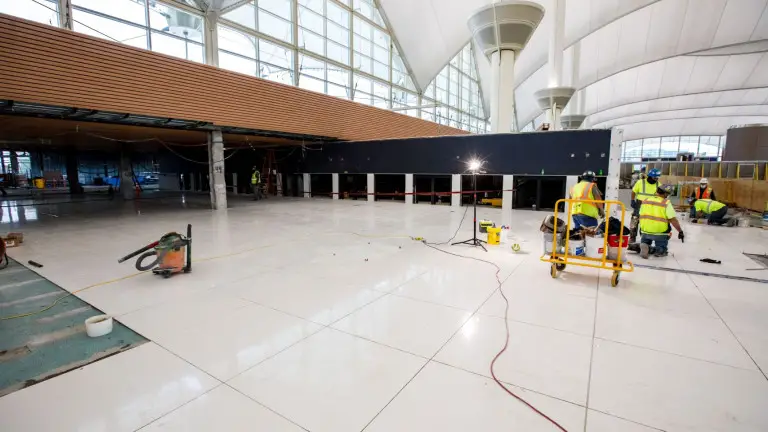
Birmingham Airport expansion project continues to advance in 2026 as the UK regional aviation hub accelerates its long-term infrastructure transformation programme aimed at increasing capacity, improving passenger experience, and supporting rising traffic demand across the Midlands. The development is unfolding alongside broader UK aviation expansion policies, which are shaping how airports modernize terminals, airside infrastructure, and sustainability systems. Additionally, the project aligns with national efforts to strengthen regional connectivity and reduce pressure on London airports through phased, multi-year construction works.
Passenger throughput in 2017 exceeded 12.9 million, ranking Birmingham as the seventh busiest airport in the United Kingdom. The airport is expected to exceed 18 million passengers by 2033. Thus, in line with the expected growth, the new passenger search area project will include a number of amenities. These include a new roof, new lifts and circulation core, refurbishment of the existing atrium, and new office space for staff.
Birmingham Airport expansion project advances terminal and airside works
Birmingham Airport is progressing with a multi-phase capital investment programme designed to support growth toward 18 million passengers annually by 2033. Moreover, the airport is implementing terminal reconfiguration works, retail expansion, and upgraded passenger processing systems under its broader transformation strategy. The programme also includes airfield enhancements, baggage system improvements, and stand capacity expansion to accommodate increasing flight frequencies.
Furthermore, the airport has already completed several early-stage upgrades across its departure and arrivals facilities. These works form part of a wider £300 million investment pipeline supporting operational efficiency and sustainability goals. Consequently, the airport continues to position itself as a key regional aviation gateway serving both domestic and international markets.
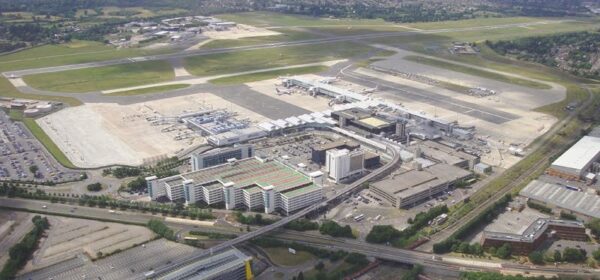
Birmingham Airport expansion project linked to long-term UK aviation capacity strategy
The expansion project is closely aligned with the UK government’s wider aviation infrastructure strategy, which encourages regional airport development to balance national passenger flows. In addition, Birmingham Airport’s masterplan focuses on long-term scalability through phased construction, ensuring minimal disruption during ongoing operations.
Meanwhile, planning and design frameworks continue to evolve, with consultants supporting updated master planning expected to guide development decisions through the late 2020s. The airport’s strategy also incorporates sustainability targets, including emissions reduction, energy efficiency improvements, and enhanced surface transport integration.
Birmingham Airport expansion project current status (2026 update)
The Birmingham Airport expansion project continues to progress in 2026 as part of the UK’s broader regional aviation capacity strategy, which is increasingly influencing how major airport infrastructure is planned, financed, and delivered. Moreover, the project is unfolding at a time when the UK aviation sector is reassessing procurement models, especially for large-scale developments that require phased construction and long-term operational integration.
In addition, Birmingham Airport’s expansion programme highlights the government’s preference for structured, cost-controlled airport upgrades outside London. This approach is now directly shaping national aviation policy discussions, particularly as regulators push for greater competition and efficiency in major hub developments.
Notably, similar regulatory thinking is now being applied to the Heathrow third runway construction project, where authorities are considering opening core works to rival bidders in order to reduce costs and improve delivery outcomes. This parallel shift in procurement strategy across both regional and hub airports signals a coordinated move toward competitive infrastructure delivery models in the UK aviation sector.
Read Also: Contract awarded for an Aldermanbury Square development in London
Refurbishment of Birmingham Airport
Passengers are expected to use the new security lanes by mid-2024, thanks to the innovative use of existing structures. “We are anticipating the start of work on this important project for the Airport,” said Simon Butler, Managing Director of Building Central at Tilbury Douglas.
“We will be supporting various Solihull-based education and career initiatives as part of the plan. Additionally, we will be assisting in the refurbishment of the Airport’s own Education Centre.”
Birmingham Airport officially opened as Elmdon Airport on 8 July 1939. During WWII, the airport was requisitioned by the Air Ministry and used by both the Royal Air Force (RAF) and the Royal Navy as RAF Elmdon. At the time, it was mainly used for flight training and wartime production.
Project Fact Sheet
Project name: Birmingham Airport expansion project
Location: Birmingham Airport, West Midlands, United Kingdom
Estimated investment value: Approximately $67 million–$500 million phased programme (combined masterplan scope)
Capacity target: 18 million passengers annually by 2033
Current passenger base: 13–14 million annually (2025/2026 estimates)
Project scope:
- Terminal expansion and reconfiguration
- Retail and hospitality upgrades
- Airfield and taxiway improvements
- Baggage handling system upgrades
- Security and passenger processing enhancements
- Stand and gate capacity expansion
Development model: Phased capital investment programme
Masterplan horizon: 2033 (long-term expansion framework)
Environmental targets: Net zero pathway by 2033
Delivery approach: Live operational airport upgrades with staged construction
Key constraint: Maintain full airport operations during expansion
Project Team
Project owner: Birmingham Airport Ltd
Lead planners and consultants: Arup (masterplanning and technical advisory)
Main construction contractor (various packages): VINCI Building and multiple UK-based contractors
Regulatory oversight: UK Civil Aviation Authority (CAA)
Government stakeholders: UK Department for Transport (DfT), West Midlands Combined Authority
Strategic investors: Macquarie Asset Management (partial ownership stake)
Infrastructure partners: HS2 integration planners (future connectivity link support)
Sustainability and environmental advisors: Airport-appointed ESG and climate consultants
Air service stakeholders: Airline operators and cargo service partners




Leave a Reply