
The Lisbon-Porto High-Speed Railway is Portugal’s first high-speed train infrastructure, aiming to drastically cut travel times between the country’s two largest cities from three hours to just 75 minutes. The European Investment Bank (EIB) recently signed an initial €875 million financing agreement to support the first phase of the project, representing the first tranche of a broader €3 billion funding package. Delivered under a public-private partnership model, the 30-year concession for the initial 71-kilometer stretch between Porto-Campanhã and Oiã was awarded to the Avan Norte consortium. Set to handle roughly 10 million passengers annually once the full network is operational, the €2.3 billion Porto-Oiã section will encompass a new bridge over the Douro River and extensive station upgrades, marking one of Portugal’s largest infrastructure investments of the century.
This effort to modernize European rail corridors is also progressing in the Mediterranean, where Croatia’s vital Hrvatski Leskovac–Karlovac rail corridor has signed COMSA Corporación for a 44km section. Following years of procurement delays and the termination of a previous contract with STRABAG, the state-owned HŽ Infrastruktura has awarded the €348.5 million (VAT included) project to the Spanish infrastructure group. The works—expected to begin in the summer of 2026—will involve doubling the track and electrifying the line to support speeds of up to 160 km/h. As a key segment of the Mediterranean TEN-T Corridor, this project will significantly enhance freight and passenger capacity between Zagreb and the Port of Rijeka, mirroring the broader continental push for high-speed, low-carbon connectivity.
Project Overview
Type: High-speed rail line (Public-Private Partnership)
Location: Portugal (Phase 1, Section 1 connects Porto-Campanhã and Oiã in the Aveiro district)
Passenger Capacity: Expected to serve approximately 10 million passengers per year
Track Length: 71 kilometers (First section); 143 kilometers (Total Phase 1 extending to Soure)
Travel Time Reduction: Will reduce the Lisbon to Porto journey from nearly 3 hours to 1 hour 15 minutes (upon full network completion)
Financing: €875 million first-tranche loan from the EIB, part of a €3 billion overall approved package. The specific Porto-Oiã concession represents a total investment of €2.3 billion.
Key Infrastructure: A new bridge over the Douro River, a new underground station at Santo Ovídio (Vila Nova de Gaia), and major capacity adaptations to Porto’s Campanhã station
Contract Details: 30-year concession for design, construction, financing, and maintenance
Project Team
Client / National Infrastructure Manager: Infraestruturas de Portugal (IP)
Concessionaire: Avan Norte – Gestão da Ferrovia de Alta Velocidade (comprising the LusoLAV consortium: Mota-Engil, Serena Industrial Partners, Teixeira Duarte, Casais, Alves Ribeiro, Conduril, and Gabriel Couto)
Key Financier: European Investment Bank (EIB), backed by the EU’s InvestEU programme and Connecting Europe Facility
Additional Financial Partners: Novo Banco, Millennium BCP, Caixa Geral de Depósitos, Natixis, BBVA, Deutsche Bank, and various global insurance entities
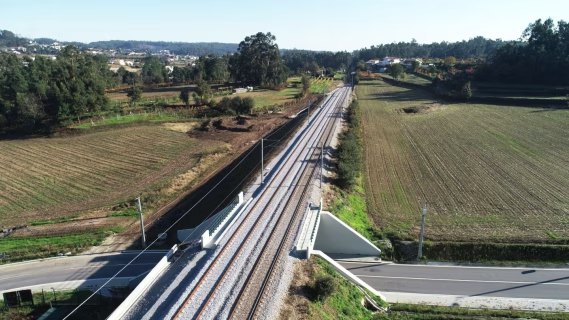
Reported 31st July 2025: This week, the European Investment Bank (EIB) disbursed an initial €875 million in funding to jumpstart the first high-speed railway in Portugal. The project’s first 71-kilometre section connects Porto’s Campanhã station to Oiã in the Aveiro district, forming phase one of the much-anticipated Porto–Lisbon corridor. Once complete, the high-speed line will dramatically reduce travel time between Portugal’s two largest cities. Notably, this tranche is the largest single contract ever signed under the EU’s InvestEU programme, underscoring the strategic importance of the investment for regional development and EU-wide connectivity.
Public-Private Partnership Secures Delivery
In tandem with the EIB funding, national rail network manager Infraestruturas de Portugal (IP) signed a 30-year public-private partnership (PPP) concession with Avan Norte, a consortium of prominent Portuguese companies, including Mota‑Engil, Teixeira Duarte, Casais, Alves Ribeiro, Conduril Engenharia, and Gabriel Couto. Under the agreement, Avan Norte will handle the design, construction, financing, and maintenance of the Porto–Oiã segment. Critical infrastructure elements include a new rail-road bridge over the Douro River, a subterranean station at Santo Ovídio in Vila Nova de Gaia, and major upgrades to the existing Campanhã rail hub to support high-speed operations.
Also Read Energy Vault’s Cross Trails BESS Project Secures $18 Million in New Financing
Transforming National Mobility and Sustainability
When completed, the Porto–Lisbon line will cut current travel time from three hours to just 1 hour and 15 minutes. Furthermore, it will serve up to 10 million passengers annually. The financing comprises of a comprehensive €3 billion financing package from the EIB, supplemented by €900 million from additional lenders, €480 million in EU grants via the Connecting Europe Facility (CEF), and €150 million from IP. Further, Portugal’s Infrastructure Minister Miguel Pinto Luz called the railway and the new Lisbon Airport the most transformative infrastructure projects of the century, critical to enhancing national cohesion and stimulating long-term economic growth.
A Strategic Milestone with Far-Reaching Impact
According to EIB Director General Jean-Christophe Laloux, the high-speed railway will boost sustainable transport, strengthen territorial unity, and advance Portugal’s climate transition. Carlos Mota Santos, CEO of Mota‑Engil, emphasized that the selection of Avan Norte, composed entirely of Portuguese firms, reflects both domestic expertise and international investor confidence.
Also Read Federal Funding Cut Threatens to Derail California High-Speed Rail Project (CHSR)
Interestingly, the rail line’s development is divided into three phases: Porto–Oiã, Oiã–Soure, and Soure–Carregado, with the Lisbon extension scheduled after 2030. This structure allows adaptive planning while aligning with the broader goals of the EU’s Trans-European Transport Network (TEN-T) Atlantic Corridor. The integration of urban design elements, such as the Douro bridge and underground stations, adds complexity but ensures long-term resilience. Ultimately, this project represents a transformative leap forward for Portugal’s transportation infrastructure.



Leave a Reply