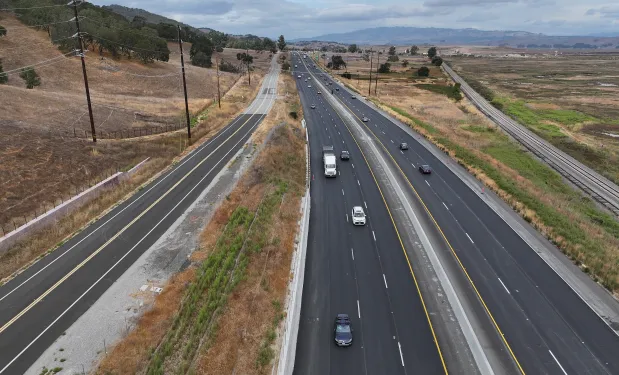
The final phase of the Highway 101 widening project in Santa Barbara County represents a landmark achievement in inter-agency cooperation. Beyond the engineering complexity of the Santa Barbara North Segment, the project serves as a premier case study in how state, regional, and municipal authorities—including Caltrans, the Santa Barbara County Association of Governments (SBCAG), the County of Santa Barbara, and the Cities of Carpinteria and Santa Barbara—can align disparate funding and policy goals into a single, cohesive infrastructure delivery.
-
The Partnership Model: Collaborative Governance
A project of this magnitude, spanning 10.9 miles of sensitive coastal corridor, requires more than just technical expertise; it requires a unified administrative front.
- State & Regional Alignment: Caltrans and SBCAG provide the primary oversight, balancing state highway standards with regional mobility goals.
- Municipal Integration: The active involvement of the Cities of Carpinteria and Santa Barbara, alongside the County, ensures that the freeway improvements integrate seamlessly with local arterials and community aesthetics. This partnership was essential in finalizing the redesign of the Cabrillo Boulevard interchange to meet both high-speed safety requirements and local urban flow.
-
Geometric Improvements and Interchange Redesign
The centerpiece of the North Segment is the total reconstruction of the Cabrillo Boulevard Interchange. The legacy infrastructure featured “left-hand” ramps—a design now considered obsolete in modern highway engineering due to the requirement for merging traffic to enter the high-speed lane.
- Right-Hand Realignment: All new on- and off-ramps are being moved to the “slow lane” (right side), drastically reducing weaving maneuvers and improving the Level of Service (LOS) for the segment.
- The Teardrop Roundabout: To manage the transition from high-speed freeway traffic to the urban arterial of Santa Barbara, a teardrop-shaped roundabout is being implemented. This geometry handles unbalanced flow patterns while minimizing the physical footprint near the coast.
-
Pavement Engineering: Noise Mitigation and Longevity
In a significant departure from standard asphalt overlays, the partnership for the Highway 101, Santa Barbara County Project has opted for Continuously Reinforced Concrete Pavement (CRCP).
Unlike traditional Jointed Plain Concrete (JPC), CRCP is constructed with longitudinal steel reinforcement and no transverse contraction joints. For this high-traffic corridor, this provides two critical advantages:
- Acoustic Management: The absence of joints eliminates the “thump-thump” tire noise, creating a significantly quieter travel surface for nearby neighborhoods—a priority for the local city and county stakeholders.
- Life-Cycle Cost: CRCP is designed for a 40- to 50-year lifespan with minimal maintenance, reducing the long-term economic burden of lane closures on the region.
-
The “Measure A” Funding Architecture
The Highway 101, Santa Barbara County project is a hallmark of the “Local-Match” strategy, where regional tax initiatives are used to leverage state and federal grants. The ~$700 million total investment is a patchwork of four distinct funding streams, managed through the multi-agency framework:
| Source | Contribution | Strategic Role |
| Senate Bill 1 (SB1) | $295M | Primary state infrastructure grant. |
| State Gas Tax | $265M | Baseline highway maintenance funds. |
| Measure A | $128M | Local sales tax (SBCAG) providing “seed” capital. |
| Federal Sources | $12M | Targeted safety and environmental grants. |
-
Logistical Constraints and Urban Realities
The North Segment faces unique spatial challenges, primarily the narrow corridor between the Pacific coastline and the Union Pacific Railroad (UPRR) tracks.
- Structural Clearances: The permanent closure of the Los Patos Way off-ramp was a technical necessity driven by the low clearance of the existing railroad bridge, a decision coordinated across the partner agencies to ensure the safest long-term traffic pattern.
- Traffic Integrity: A “Two-Lane Guarantee” protocol ensures that daytime capacity remains at 100%, utilizing temporary shoulder strengthening and strategic lane shifts to keep 45,000+ Average Daily Traffic (ADT) moving through the construction zone.
Conclusion
The Highway 101 North Segment is more than a widening project; it is a testament to the power of a multi-agency effort. By combining the resources of Caltrans, SBCAG, the County, and the Cities of Carpinteria and Santa Barbara, the region is delivering a resilient, 21st-century transportation backbone that honors both state-level engineering standards and local community priorities.




Leave a Reply