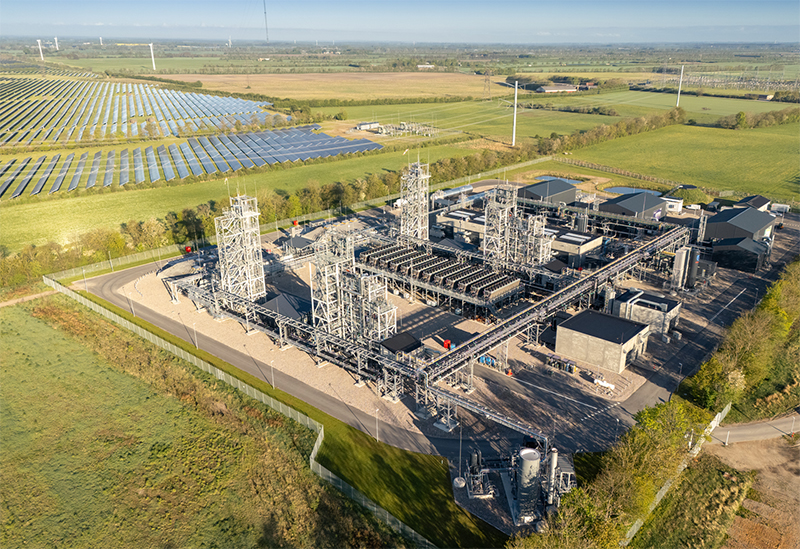
European Energy’s Kvosted Energy Park, located in Viborg Municipality, Denmark, has been confirmed as Northern Europe’s largest combined solar and battery facility, while the Danish developer simultaneously secured €228 million in German federal funding to expand hydrogen production at its Kassø Power-to-X site. Together, these developments mark the clearest signal yet that European Energy has completed its transformation from a conventional renewables developer into a fully integrated hybrid energy and renewable fuels company. The Kvosted park pairs approximately 100MW of utility-scale solar generation, which has been operational since 2022, with a newly commissioned 50MW/200MWh battery energy storage system built on containerised lithium iron phosphate chemistry. The battery addition, commissioned in December 2025 and inaugurated in February 2026, enables flexible dispatch, participation in system services markets, and a diversified revenue base that insulates the project from curtailment and wholesale price risk. Long-term financing of €64.5 million, provided jointly by Ringkjøbing Landbobank and the Nordic Investment Bank, was secured in February 2026 and reflects lender confidence in the hybrid asset structure as a replicable model for the wider portfolio.
That model is already being exported. In Australia, European Energy’s Winton North hybrid solar and battery project reached financial close in July 2026, backed by Amazon power purchase agreements covering both its 130MW solar array and its 100MW/220MWh battery, with completion due this year — the same solar-plus-storage template that underpins Kvosted, applied in a market with very different resource fundamentals.
A Corridor of Clean Energy Taking Shape Between Denmark and Germany
The German government’s funding award under the European Hydrogen Bank’s competitive auction framework adds a cross-border dimension to European Energy’s Danish operations that will define the company’s trajectory for the rest of the decade. The €228 million allocation — one of only three projects selected in the auction round — will finance 150MW of additional electrolysis capacity connected to the Kassø site, which already hosts Europe’s only operational e-methanol plant producing fuel compliant with the EU’s Renewable Fuels of Non-Biological Origin regulations. Kassø, developed in joint venture with Mitsui & Co. using electrolyzers supplied by Siemens Energy, began supplying e-methanol to commercial customers under existing agreements in early 2026, with Maersk contracted to receive up to 300,000 tonnes annually. Germany’s legislative roadmap, which mandates rising blending targets for non-biological renewable fuels in road transport from 0.1% in 2026 to 10% by 2040, gives this corridor genuine structural permanence. A comparable model is emerging in the Netherlands, where projects connecting North Sea wind generation to Rotterdam’s industrial hydrogen demand via the Delta Corridor pipeline are expected to compete directly for the same German offtake market. European Energy’s call for Danish infrastructure investment to support a physical pipeline connecting its production sites to German consumers reflects how quickly the commercial logic of hydrogen export is outpacing the physical infrastructure available to support it. The same theme of industrial decarbonisation at scale is evident elsewhere in Denmark through projects such as Ørsted’s Kalundborg CO₂ Hub carbon capture and storage facility, which is designed to capture and manage large volumes of industrial emissions while helping establish the infrastructure backbone needed for a broader low-carbon economy. Together, these investments illustrate Denmark’s emergence as a testing ground for interconnected clean-energy systems spanning renewable fuels, hydrogen production, carbon capture, and cross-border energy trade.
European Energy Kassø Expansion Wins €228 Million German Hydrogen Award as Kvosted Park Goes Online
Project Fact Sheet
- Project Name: Kvosted Hybrid Energy Park and Kassø PTX Expansion
- Location: Kvosted, Viborg Municipality (solar+BESS); Kassø, Southern Denmark (hydrogen/e-methanol)
- Project Value: €64.5 million long-term financing secured for Kvosted; up to €228 million German EHB funding for Kassø expansion
- Developer/Owner: European Energy A/S, Copenhagen, Denmark
- Kvosted Solar Capacity: Approximately 100MW (operational since 2022)
- Kvosted Battery System: 50MW/200MWh BESS, containerised LFP chemistry, commissioned December 2025
- Kassø PTX Expansion: 150MW additional green hydrogen production capacity
- Kassø E-Methanol Status: Fully operational; first commercial deliveries underway in 2026
- BESS Portfolio FID (Q1 2026): Approximately 400MW / 1,100MWh across Denmark, Lithuania, UK, Australia and Poland
- Full-Year EBITDA Guidance: €200 million to €300 million (2026)
- Households Served (Kvosted): Equivalent daily consumption of approximately 18,000 Danish households
- Strategic Target: More than 1GWh of battery storage across European markets by 2027
Project Team
- Developer and Owner: European Energy A/S
- Joint Venture Partner (Kassø PTX): Mitsui & Co., Ltd.
- Electrolyzer Supplier (Kassø): Siemens Energy
- Long-term Debt Financiers (Kvosted): Ringkjøbing Landbobank; Nordic Investment Bank (NIB)
- Funding Authority (Kassø Expansion): German Federal Government via the European Hydrogen Bank (EHB), European Commission
- Anchor Offtake Partner (e-methanol): A.P. Moller Maersk (contracted for up to 300,000 tonnes per year)
- BESS Integration Contractor (Kvosted): Not publicly confirmed at time of publication

Leave a Reply