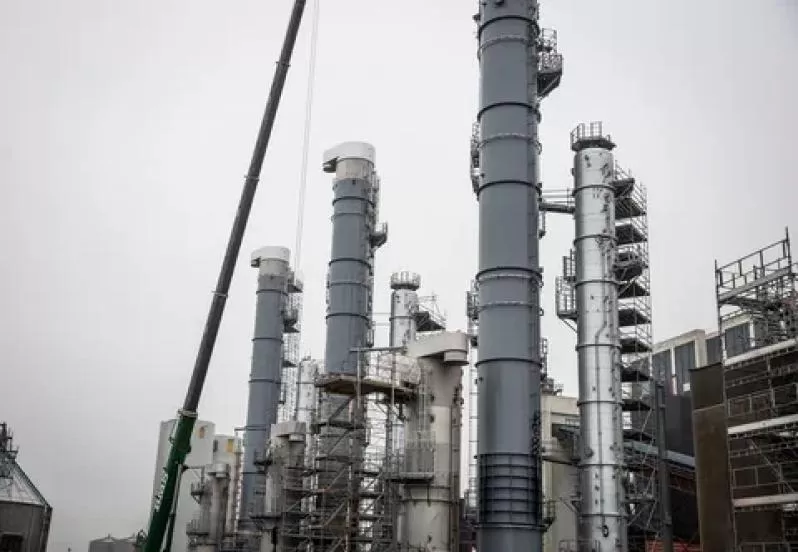
The Ørsted Kalundborg CO2 Hub project is Denmark’s first full-scale carbon capture and storage value chain, designed to capture 430,000 tonnes of biogenic CO2 annually from biomass-fired power stations at Asnæs and Avedøre. Following the installation of the five column sets confirmed in February 2025, Ørsted has since received the dedicated CO2 storage tanks at the Asnæs site, which will hold captured and compressed carbon dioxide ahead of shipment to the Northern Lights storage reservoir in the Norwegian North Sea under a ten-year transportation agreement effective from January 2026.
Onshore Storage Permit Widens the Kalundborg Carbon Corridor
Beyond the offshore storage route via Norway, a parallel development has extended the project’s long-term footprint. Equinor, Ørsted, and Nordsøfonden have been awarded a joint exploration permit for the CO₂ Storage Kalundborg licence, covering a reservoir approximately 1,400 metres below ground in North West Zealand with a potential storage capacity of up to 12 million tonnes of CO₂ per year. If surveys confirm suitability and Danish authorities approve the facility, onshore storage could commence before the end of the decade, transforming Kalundborg into a dual-route carbon management hub with both marine export and domestic geological sequestration capabilities. The development aligns with a broader trend of cross-border clean-energy integration highlighted by European Energy’s Kassø expansion and German hydrogen funding award, alongside the commissioning of the Kvosted Park renewable energy project. Both initiatives underscore Denmark’s growing role as a strategic hub for Europe’s energy transition, linking renewable power generation, hydrogen production, carbon capture, and long-term carbon storage infrastructure into a single industrial ecosystem capable of serving both domestic and continental decarbonisation goals.
Project Overview
- Project Name: Ørsted Kalundborg CO2 Hub
- Location: Asnæs Power Station, Kalundborg, western Zealand and Avedøre Power Station, Greater Copenhagen, Denmark
- Developer/Owner: Ørsted
- Total Cost/Value: Not disclosed (SLB Capturi equipment and technology contract valued at over €200 million)
- Scale/Capacity: 430,000 tonnes of biogenic CO2 captured annually; five Just Catch 100 modular capture units
- Construction Start: December 2023
- Expected Completion: Early 2026 (full operations)
- Funding/Financing: 20-year subsidy contract awarded by the Danish Energy Agency, May 2023
- Current Status: Key capture column components installed; CO2 storage tanks received at Asnæs; piping and interconnection works ongoing
- Key Milestone: All five absorber, desorber and direct contact cooler sets lifted into place at both power stations; CO2 tanks on site; Northern Lights transport agreement effective January 2026
Project Team
- Ørsted — Project Developer, Owner and CCS Value Chain Operator
- SLB Capturi (formerly Aker Carbon Capture) — Carbon Capture Technology Provider; supplier of five Just Catch 100 modular capture plants, liquefaction systems, and temporary CO2 storage and loading facilities
- MT Group — EPC Contractor
- Northern Lights JV (Equinor, Shell, TotalEnergies) — CO2 Transport and Offshore Storage Provider (Norwegian North Sea)
- Equinor — Operator of CO2 Storage Kalundborg onshore exploration permit
- Nordsøfonden — Partner in CO2 Storage Kalundborg onshore exploration permit
- Danish Energy Agency — Contracting and Regulatory Authority
- Microsoft — Carbon Removal Offtake Partner (3.67 million tonnes of certified removal from Avedøre straw-fired unit)
Reported 25th February 2025: Ørsted’s carbon capture and storage facility at the Ørsted Kalundborg CO2 Hub has revealed insights on progress made so far. The first carbon capture and storage value chain project in Denmark has now seen the installation of five sets of column needed for operations at the facility’s hub. These include two at Avedøre Power Station and the remaining at Asnæs Power Station.
The columns play an integral role in the capturing of CO2. Each of the five sets of columns installed by Ørsted at their carbon capture facility at the Ørsted Kalundborg CO2 Hub in Denmark has three main parts, and have been described as the “heart of the site”. Currently, the company is working towards installing connecting pipes for the columns. These will allow for communication with the rest of the plant.
Ørsted Kalundborg CO2 Hub Project Factsheet
Location: Denmark
Developer: Ørsted
Utility: Carbon Capture and Storage (CCS)
Carbon capture technology provider: SLB Capturi
EPC contractor: MT Group
Completion and Operational date: 2026
Annual CO2 capacity: 430,000 tonnes
A look at the five sets of column installed at Ørsted’s CCS facility in Denmark
The columns have a direct contact cooler (DCC). Here, water is directly sprayed to the fuel gas to cool it. The cooled gas now becomes more easier to capture and have its impurities removed.
The other component of the column is the absorber. The cooled fuel gas from the DCC will be passes through a chemically-binding liquid in this part of the column. CO2 is separated from the fuel gas at this point; after-which the CO2-rich liquid is then passes to the third column component for further processing.
The desorber forms the third segment of the column. Here, the CO2-rich liquid is heated. This releases the trapped CO2 gas. The CO2 is then collected and compressed for storage in tanks. Transportation to the Northern Lights storage reservoir in the Norwegian part of the North Sea will then immediately follow suit.
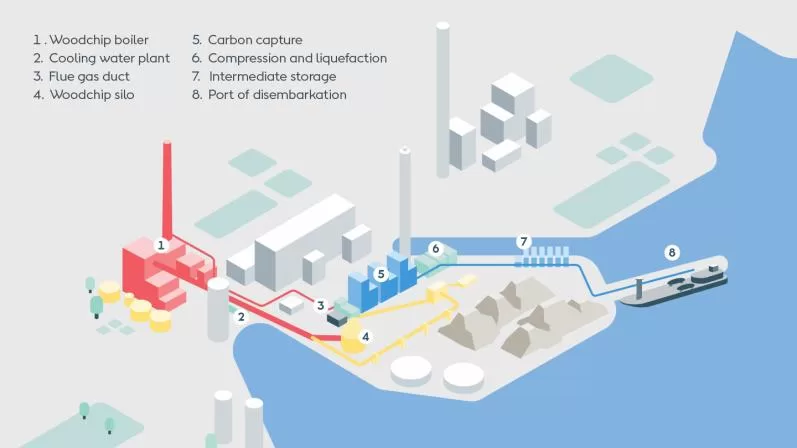
What to expect of Denmark’s first full-scale carbon capture and storage value chain project
The Ørsted Kalundborg CO2 Hub expects completion by 2026. Upon starting operations, Ørsted’s carbon capture and storage facility in Denmark will scrape about 430,000 tonnes of CO2 annually. This has been equated to halting engines of roughly 200,000 petrol-powered cars in Europe in the same time frame.
Also of interest is the use of straw- and woodchip as fuel for the heat and power plants implicated in the capture and storage of atmospheric CO2. According to the company, the biomass used at the facility’s plants are waste and residue, instead of fossil fuel. The straw-powered unit, Avedøre Power Station, will handle about 150,000 tonnes of CO2, while the wood-chip powered unit, Asnæs Power Station, handles the remaining 230,000 tonnes.
Activities at the facility in Denmark will cover a 20-year contract awarded to Ørsted Kalundborg CO2 Hub in mid-2023. The Danish Energy Agency made the contract award.
Ole Thomsen, Senior VP and Head of Bioenergy at the company whose vision is a world that runs entirely on green energy had the following to say. “[…] The absorbers, desorbers, and direct contact coolers are essential components that enable the facility to capture and store CO2. With those in place, we’ve taken a great leap forward towards realisation of our project.”



Leave a Reply