After decades of redesigns, stalled plans and changing market conditions, construction officially begins on the final commercial skyscraper at the rebuilt World Trade Center campus.
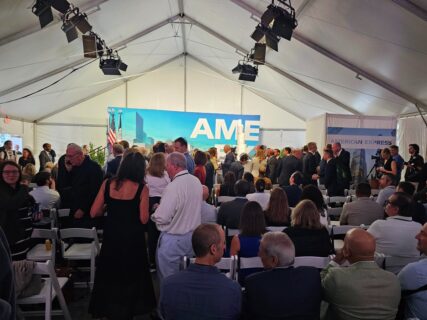
NEW YORK — Nearly 25 years after the September 11 terrorist attacks transformed Lower Manhattan forever, construction officially began Thursday on the final commercial office tower at the rebuilt World Trade Center, marking the last major chapter in one of the most ambitious urban redevelopment projects in American history.
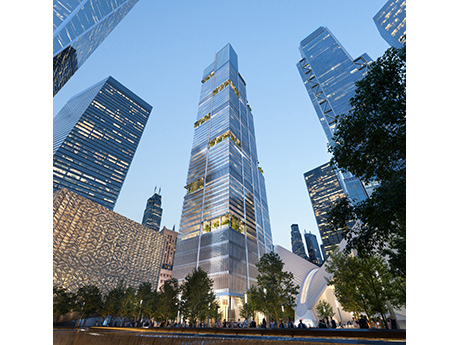
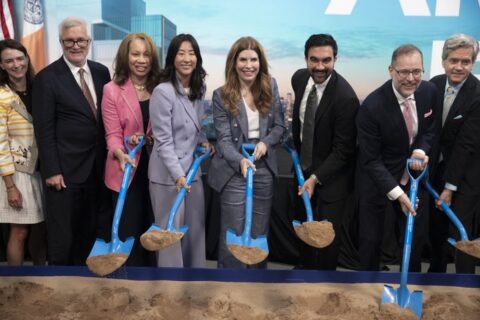
American Express, alongside developer Silverstein Properties, broke ground on 2 World Trade Center, a 55-story, 1,226-foot skyscraper that will become the company’s new global headquarters while completing the commercial redevelopment of the 16-acre World Trade Center campus.
The project ends more than a decade of uncertainty surrounding the site, which remained the only undeveloped office parcel at the rebuilt complex despite billions of dollars invested in new skyscrapers, transportation infrastructure, memorials and public spaces across Lower Manhattan.
For New York City, Thursday’s ceremony represents far more than the start of another high-rise construction project. It symbolizes the completion of a vision first conceived in the aftermath of one of the darkest days in American history—a vision that required nearly a quarter-century of planning, engineering, political negotiations, financial commitments and perseverance to become reality.
The missing piece of the World Trade Center
Situated at 200 Greenwich Street, immediately north of the Oculus transportation hub and adjacent to the Perelman Performing Arts Center, 2 World Trade Center has long been considered the final missing piece of the rebuilt World Trade Center.
While One World Trade Center, Three World Trade Center, Four World Trade Center and surrounding infrastructure opened years ago, the northeastern corner of the campus remained largely dormant, its completed underground foundation serving as a reminder of a project that repeatedly struggled to attract a major corporate tenant.
Unlike the other towers that gradually reshaped Lower Manhattan’s skyline, 2 World Trade Center spent years existing only as concrete foundations beneath street level.
Today’s groundbreaking changes that.
The tower now enters full-scale vertical construction after American Express finalized an agreement earlier this year to develop and fully occupy the building as its future global headquarters, providing the long-awaited commitment that developers had sought for more than a decade.
When completed in 2031, the building will officially conclude the commercial redevelopment envisioned in the World Trade Center master plan following the destruction of the original towers in 2001.
American Express bets on Lower Manhattan’s future
American Express’ decision to relocate its headquarters represents one of the largest corporate real estate commitments made in New York City in recent years.
The financial services giant will become the sole owner and occupant of the nearly 2-million-square-foot skyscraper, relocating approximately 10,000 employees from its longtime headquarters at 200 Vesey Street, where the company has operated since 1986.
Rather than simply moving across the street, American Express is investing in a workplace designed around the changing nature of office work.
The headquarters has been planned as a next-generation corporate campus featuring flexible workspaces, collaboration zones, wellness-focused environments and expansive outdoor terraces intended to blur the traditional boundaries between indoor offices and open public space.
The decision also reinforces confidence in Lower Manhattan’s long-term future at a time when many companies continue reassessing their office footprints following the COVID-19 pandemic.
A skyscraper designed for the next generation
Designed by internationally renowned architecture firm Foster + Partners, the new tower represents a dramatic evolution from the building originally envisioned nearly two decades ago.
Standing 1,226 feet above Manhattan, the skyscraper will rise across 55 floors, making it one of New York City’s tallest office buildings.
Its defining architectural feature is a series of cascading landscaped terraces that climb the tower’s exterior, replacing the uninterrupted glass façades typical of traditional office skyscrapers with more than an acre of outdoor gathering spaces.
Six exposed loggia gardens and multiple sky terraces provide employees with open-air workspaces while visually breaking the tower into a series of stepped volumes overlooking Lower Manhattan.
Beyond aesthetics, the building has been engineered as an all-electric office tower targeting high environmental performance and LEED certification.
Mechanical systems designed by Jaros Baum & Bolles will eliminate on-site fossil fuel use while maximizing energy efficiency, indoor environmental quality and long-term operational sustainability.
Structural engineering is being led by WSP Cantor Seinuk, whose team is responsible for designing the tower’s steel framing and reinforced concrete core to withstand Manhattan’s demanding wind loads while maintaining large, flexible floor plates for office use.
Turner Construction will oversee construction of the tower’s core and shell, while AAI Architects serves as Architect of Record, translating Foster + Partners’ design vision into construction-ready documentation.
A project delayed for more than a decade
Although Thursday’s groundbreaking marks the beginning of visible construction, the story of 2 World Trade Center stretches back more than two decades.
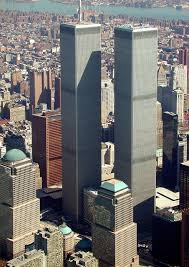
The tower was originally included in Daniel Libeskind’s master plan for rebuilding the World Trade Center following the September 11 attacks.
In 2005, Foster + Partners unveiled an ambitious 80-story design distinguished by four diamond-shaped roof forms descending toward the National September 11 Memorial.
Construction progressed only as far as excavation, foundation work and the below-grade structure before economic uncertainty and the absence of an anchor tenant halted further development.
Hope briefly returned in 2015 when media companies News Corp. and 21st Century Fox considered relocating their headquarters to the site.
To accommodate their needs, Silverstein Properties commissioned Danish architect Bjarke Ingels to redesign the skyscraper as a series of stacked glass volumes resembling giant urban blocks.
When those negotiations ultimately collapsed, so did the redesigned tower.
For years afterward, the site remained little more than a completed foundation awaiting the tenant capable of bringing it to life.
The COVID-19 pandemic introduced another layer of uncertainty as remote work fundamentally reshaped demand for office space.
Rather than abandoning the project, Silverstein Properties returned to Foster + Partners, asking the firm to rethink the building for a post-pandemic world.
The resulting design placed greater emphasis on natural light, outdoor space, sustainability and employee well-being—features increasingly viewed as essential by major corporate occupiers.
American Express ultimately became the tenant capable of transforming those revised plans into reality.
Built without public subsidies
Unlike several earlier phases of the World Trade Center redevelopment, officials have confirmed that 2 World Trade Center is proceeding without state, city or Port Authority financing incentives.
Instead, the project is being delivered as a privately financed investment supported by American Express’ long-term commitment to occupy the entire building.
That commitment not only unlocked construction but also demonstrated continued confidence in New York City’s commercial office market despite ongoing uncertainty across the sector.
Economic impact
The project will generate more than 3,200 jobs and contribute approximately $5.9 billion to New York City’s economy and $6.3 billion across New York State.
Thousands of union workers will build the tower over the coming years as crews erect steel, pour concrete, install mechanical systems and complete the building’s interiors above one of the nation’s busiest transportation hubs.
Structural steel is scheduled to begin rising in late 2027.
Construction is expected to top out in 2029, with substantial completion targeted for 2030 and American Express set to occupy the tower in 2031.
More than another skyscraper
For generations of New Yorkers, the significance of 2 World Trade Center extends beyond architecture or commercial real estate.
It represents the final commercial expression of a rebuilding effort that has reshaped Lower Manhattan through transportation infrastructure, public memorials, cultural institutions and millions of square feet of office development.
What remained unfinished for years was the final office tower—the project that would complete the skyline originally imagined after September 11.
Thursday’s groundbreaking transforms that vision from unfinished promise into active construction.
When workers eventually place the final beam atop the tower later this decade, it will mark not only another milestone in New York City’s skyline, but the completion of a rebuilding journey that began nearly 25 years ago.
Additionally, the groundbreaking also comes as New York City prepares for another major commercial development. Across Manhattan, plans are advancing for Gansevoort Square in the Meatpacking District, a mixed-use project that will transform a former sanitation site into new office space, retail, housing and public amenities. Together, the two developments highlight a new wave of large-scale investment reshaping Manhattan’s commercial landscape, from Lower Manhattan’s historic financial district to the city’s rapidly evolving West Side.
Project Snapshot: Final World Trade Center Tower
- Project: 2 World Trade Center
- Project Type: Commercial office skyscraper
- Purpose: Future global headquarters for American Express
- Location: 200 Greenwich Street, Lower Manhattan, New York City
- Developer: Silverstein Properties
- Property Owner: Port Authority of New York and New Jersey
- Lead Tenant: American Express (sole occupant)
- Architect: Foster + Partners
- General Contractor: Turner Construction
- Height: 1,226 feet (374 meters)
- Floors: 55
- Gross Floor Area: Nearly 2 million square feet
- Workforce Capacity: Up to 10,000 employees
- Building Features: All-electric design, six landscaped sky gardens, three outdoor terraces and more than one acre of outdoor space
- Construction Jobs: More than 3,200
- Estimated Economic Impact: $5.9 billion for New York City and $6.3 billion for New York State
- Construction Start: July 9, 2026
- Steel Erection: Expected to begin in late 2027
- Topping Out: Expected in late 2029
- Target Completion: 2031
- Historic Importance: Final commercial office tower in the World Trade Center redevelopment, completing the site’s post-9/11 commercial rebuilding.

Leave a Reply