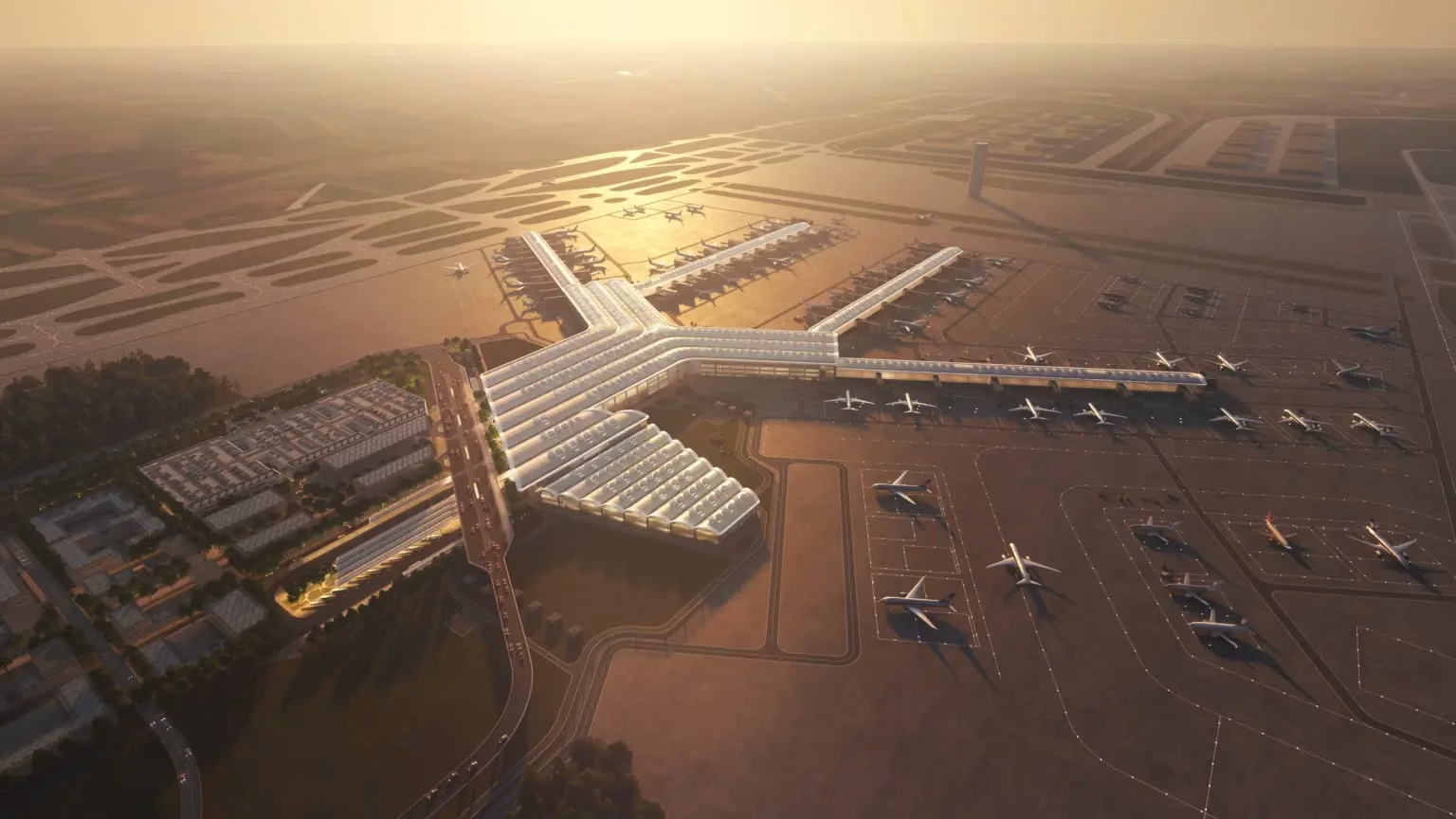
The Centralny Port Komunikacyjny (CPK) is a planned mega-airport and nationwide high-speed rail hub located approximately 40 kilometers west of Warsaw, Poland, designed to serve as the country’s primary transportation center and replace Warsaw Chopin Airport. Following a comprehensive reassessment by the Polish government, the project has officially been greenlit to proceed with a revised timeline and scope. As of early 2026, the €30.7 billion (PLN 131 billion) combined air and rail hub has cleared its final environmental approvals and finalized its 450,000-square-meter terminal design. Additionally, the project’s voluntary land acquisition program proved highly successful, securing nearly 65% of the required 6,400-acre footprint without the need for forced expropriations. While the originally proposed 2028 opening date has been pushed back, full construction is now set to commence in 2026. The first phase of the airport, along with the connecting “Y line” high-speed rail network, is scheduled to become fully operational by the end of 2032, initially handling up to 34 million passengers annually.
This focus on future-proofing massive aviation infrastructure is shared by Norway’s main gateway, as the Oslo Airport expansion plan has been unveiled, setting a course for a new cargo hub and passenger capacity overhaul. Targeted for full completion by 2040, the masterplan begins with a major strategic shift: relocating the cargo area to the west side of the airport. This move will allow the airport to repurpose its existing footprint for much-needed aircraft parking and passenger infrastructure, while providing dedicated, temperature-controlled facilities for Norway’s critical seafood export industry, which currently airfreights over 650 tonnes of salmon and trout daily. By optimizing its existing two-runway system to defer the need for a third, Oslo Airport aims to maintain its status as the largest full-freighter hub in the Nordic region while navigating the complex balance between commercial growth and environmental sustainability.
Project Overview
Type: Mega-airport and nationwide high-speed rail hub
Location: Baranów, Teresin, and Wiskitki municipalities (approx. 40 km west of Warsaw, Poland)
Total Estimated Cost: €30.7 billion (PLN 131 billion) for the combined airport and rail infrastructure
Phase 1 Capacity: 34 million passengers annually (featuring a three-level terminal capable of handling up to 11,000 passengers per hour)
Land Acquisition: Nearly 65% of the site and 76% of residential buildings secured via a voluntary acquisition scheme as of early 2026
Key Rail Infrastructure: Launching alongside the “Y line,” connecting Warsaw, Łódź, Poznań, and Wrocław with trains running at speeds up to 320 km/h
Construction Start: Scheduled for 2026 (Environmental decision and terminal designs approved)
Target Opening: End of 2032
Project Team
Client / Developer: Centralny Port Komunikacyjny (CPK) / Port Polska
Government Oversight: Ministry of Infrastructure, Poland
Master Architect: Foster + Partners and Buro Happold (Responsible for the terminal building and interchange design)
Master Civil Engineer: Dar Al-Handasah (Responsible for runways, taxiways, and technical infrastructure)
Master Planner: Arup
Strategic Advisor: Incheon International Airport Corporation (IIAC)
General Contract Engineer / Delivery Partner: Tender launched in late 2025 to oversee overarching project management, construction management, and integration.

Published 7th August 2025: Poland is on the brink of a major transportation revolution, with the Centralny Port Komunikacyjny (CPK) project making remarkable progress. Recently, the terminal’s construction design was officially greenlit by the lead architects Foster + Partners and Buro Happold, working alongside over 30 specialist subcontractors and more than 400 designers. This milestone marks a critical step forward for the multi-modal mega-hub. With the design now approved, the next phase involves submitting documentation to the Mazovian Voivode for building permits. If the timeline remains on track, the futuristic airport and railway station could be fully operational by 2032.
A Future-Proof Terminal Designed for Scale
The airport’s terminal, in its initial phase, is expected to cover a massive 450,000 square metres, setting a new benchmark in Poland’s aviation infrastructure. Spread across three operational levels, the terminal will cater to both Schengen and Non-Schengen passengers with streamlined efficiency. It is designed to facilitate seamless movement between various modes of transport, thanks to features such as direct boarding pier access, state-of-the-art luggage systems, and ample check-in areas. Beginning with 140 check-in desks, the terminal has room to grow to 170. Its modular nature allows passenger capacity to start at 34 million annually and scale up to 44 million as demand increases, ensuring long-term viability.
Integrated Transport at Its Best
More than just an airport, CPK aims to become a national and regional transport hub by integrating air, rail, and road travel. A key part of the plan includes a subterranean railway station and long-distance coach terminal, designed for effortless transfers. Notably, it is projected that up to 50% of all passengers will arrive by train or bus, significantly easing road congestion. High-speed rail development is well underway, with nearly 500 kilometres of new lines in advanced stages of planning and the critical Łódź tunnel already under construction. These links will reduce travel times dramatically, connecting key Polish cities such as Warsaw, Poznań, and Wrocław within 2.5 hours.
Building a Legacy Beyond Transit
Architecturally, the CPK terminal is set to impress with its minimalist vertical layout, abundance of natural light, and intuitive navigation. These design choices not only enhance the passenger experience but also promote sustainability and energy efficiency. Furthermore, the project carries deep cultural resonance: dubbed the “Solidarity Transport Hub,” it pays homage to Poland’s historic movement for freedom and unity. As the country moves closer to breaking ground, the CPK Airport is emerging as more than just a travel hub, it’s a symbol of national progress, vision, and identity for generations to come.
Also Read Poland to construct its longest single transport tunnel of any kind
Project Overview
Goal: Build a new mega airport and integrated transport hub.
Size: 450,000 sqm terminal in the first phase.
Design: By Foster + Partners and Buro Happold.
Capacity: Will serve 34 to 44 million passengers annually.
Features: Rail, road, and air transport all under one roof.
Check-in: 140 desks at launch, expandable to 170.
Timeline: First phase expected to open before end of 2032.
Flexibility: Modular design for easy future expansions.
Significance: Named “Solidarity Transport Hub” to honor Polish unity.
About Foster+Partners
Foster + Partners is a global studio for architecture, urbanism and design, rooted in sustainability. Founded in 1967 by Norman Foster, it has a worldwide reputation for integrating architecture with engineering and other allied disciplines to establish an innovative approach to the design of buildings, spaces and cities.

Leave a Reply