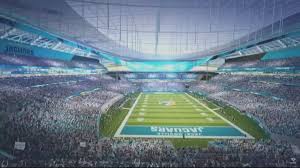
Construction on the “Stadium of the Future” at EverBank Stadium accelerated immediately following the conclusion of the 2025 season, according to an official project update released by the Jacksonville Jaguars on February 25, 2026. The team confirmed that expanded exterior work is now underway and partial in-bowl demolition has begun, marking a visible shift from preparatory phases into sustained structural transformation.
The update detailed active construction of the expanded main concourse — a central component of the stadium’s 2028 reopening plan — alongside the installation of steel trusses around the exterior. Those trusses will support the permanent canopy structure designed to shade and cool the open-air facility, one of the signature engineering elements of the redevelopment.
In the northwest quadrant, crews are advancing Grand Staircase Two, which is scheduled for completion early in the upcoming 2026 football season. Inside the bowl, demolition has started to clear space for new corner scenic lookout decks, upper-bowl renovations and future field-level seating, signaling that the multi-billion-dollar transformation is now physically reshaping the stadium’s footprint in Jacksonville.
How Jacksonville Got Here: Negotiations, Approvals and Political Timeline
The transformation of EverBank Stadium did not emerge overnight. Opened in 1995, the stadium was built as part of Jacksonville’s successful bid to secure an NFL expansion franchise. For decades it served largely in its original configuration, with incremental upgrades but no comprehensive modernization.
By the early 2020s, league-wide stadium economics had shifted. Across the NFL, franchises were moving toward fully enclosed or canopy-covered facilities with expanded premium seating, climate control systems and mixed-use district integration. In that context, the Jacksonville Jaguars began formal discussions with the City of Jacksonville about long-term viability, lease stability and revenue competitiveness.
Negotiations accelerated through 2023 and 2024, culminating in a public-private framework that avoided full demolition in favor of structural reinvestment. City Council approvals established the financing mechanism, extended the team’s commitment to Jacksonville and set the 2028 reopening target.
The February 25, 2026 construction update marked the clearest physical sign yet that planning had transitioned into execution.
Project Team and Delivery Structure
The redevelopment of EverBank Stadium is being delivered through a multi-firm structure combining architectural design, construction management, cost control, environmental review and municipal oversight.
Architectural leadership for the Stadium of the Future is provided by HOK, which developed the renovation concept and is responsible for integrating the canopy structure, reconfigured concourses and seating modernization into the existing stadium framework. HOK’s role extends beyond visual design to coordination of structural and spatial modifications required to retrofit a 1990s-era facility to contemporary NFL standards.
Construction Team
Construction is being managed through a joint venture between AECOM Hunt and Barton Malow, two firms with extensive experience in large-scale sports infrastructure delivery. The joint venture oversees phased construction sequencing, structural steel installation, demolition operations and coordination of specialty trades, while maintaining operational continuity during active NFL seasons.
Owner-side oversight is supported by Impact Development Management, serving as development advisor and representative for the Jaguars organization. Cost control and financial monitoring functions are provided by Rider Levett Bucknall, reflecting the scale and inflation sensitivity of a $1.4 billion phased renovation.
Technical and environmental components involve several specialist firms. Langan Engineering & Environmental Services provides geotechnical engineering support, while Terracon Consultants has conducted environmental site assessments. Surveying and subsurface coordination services have been performed by ETM Surveying & Mapping, and structural connection design has included work by W.P. Moore. Technology and systems integration services are supported by ME Engineers.
Permitting authority remains with the City of Jacksonville, whose Planning and Development and Building Inspection divisions have issued phased construction permits, including foundation, demolition and structural alteration approvals tied to the current construction stage.
The delivery structure reflects a renovation model rather than a ground-up stadium build. That distinction requires continuous coordination between design engineers and construction managers to integrate new structural loads, canopy systems and concourse expansions into an existing structural shell — a more technically complex undertaking than conventional new construction.
Financing Architecture: How the $1.4 Billion Is Structured
The $1.4 billion redevelopment of EverBank Stadium is structured as a public-private partnership between the Jacksonville Jaguars and the City of Jacksonville, with the city committing approximately $775 million and the team contributing roughly $625 million.
City participation was authorized through municipal legislation in 2024, permitting the issuance of long-term bonds backed primarily by stadium-related revenues and designated local funding streams rather than a broad-based tax increase. Debt service is structured over multiple decades, aligning repayment with the extended operational life of the facility.
The agreement allocates primary construction cost responsibility to the Jaguars beyond the city’s capped contribution, limiting municipal exposure to cost overruns above the approved public share. The financing framework also incorporates lease extensions securing the franchise’s long-term presence in Jacksonville, along with capital maintenance obligations designed to prevent deferred infrastructure risk.
Compared with recent NFL projects exceeding $2 billion for full replacement stadiums, Jacksonville’s approach reduces capital intensity by preserving the structural shell while modernizing revenue-generating assets such as premium seating and climate-mitigation systems.
Engineering the Canopy Era: Structural and Mechanical Transformation
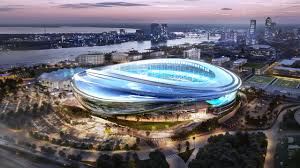
The defining architectural feature of the redevelopment is the permanent canopy structure now taking shape through exterior steel truss installation.
Rather than fully enclosing the stadium, the canopy will:
Provide continuous shade coverage
Reduce direct solar exposure
Lower field and seating temperatures
Enhance spectator comfort
Preserve open-air acoustics
Steel trusses currently being installed form the load-bearing backbone of this system. Once complete, the canopy membrane will span above seating sections, supported by structural reinforcements integrated into the existing stadium frame.
Inside the bowl, phased demolition is creating space for:
Corner scenic lookout decks
Upper-bowl structural modifications
Field-level premium seating expansion
The expanded main concourse will widen circulation paths, improve vertical movement and modernize life-safety compliance. Upgraded mechanical systems are expected to improve airflow and mitigate extreme heat — a long-standing challenge in Florida’s climate.
Construction Phasing: 2025–2028 Roadmap
The project follows a sequenced, multi-year build strategy designed to balance construction intensity with operational continuity.
2025 Post-Season:
Exterior ramp-up, demolition initiation, structural steel staging.
2026 Season:
Partial construction continues. Completion of Grand Staircase Two in the northwest quadrant. Expanded structural framing progresses.
2027:
Canopy installation intensifies. Interior reconfiguration and premium buildout advance.
2028:
Final commissioning, safety inspections and reopening ahead of the NFL season.
This phased model reduces disruption while allowing large-scale structural intervention.
Permitting and Regulatory Pathway
The redevelopment of EverBank Stadium required formal legislative authorization followed by technical permitting through the City of Jacksonville.
Legislative Approval
In 2024, the Jacksonville City Council approved the public-private funding framework authorizing roughly $775 million in municipal participation toward the $1.4 billion project. The legislation permitted bond issuance, extended the Jaguars’ lease commitments, and defined cost-overrun protections and long-term capital obligations.
The vote followed public hearings and committee review, with debate centered on taxpayer exposure and debt servicing. Once approved, the project moved into administrative permitting.
Technical Permits and Code Compliance
Because the redevelopment preserves the stadium’s structural shell rather than replacing it, it was processed as a major alteration under Florida Building Code standards rather than a new-build facility.
Permit review covered:
Structural reinforcement to support the canopy system
Wind-load compliance consistent with hurricane exposure standards
Demolition safety sequencing
Concourse expansion and vertical circulation upgrades
Fire and life-safety modernization
ADA compliance improvements
Given the stadium’s proximity to the St. Johns River, regulators required floodplain and stormwater reviews. However, because the project does not materially expand the footprint or alter elevation, officials limited the environmental review compared with a full reconstruction.
Was the Process Contentious?
Legislative approval drew public debate over funding levels. However, officials have not reported any major permitting denials or regulatory injunctions. By February 2026, the City of Jacksonville issued the structural and demolition permits required for active construction phases, allowing crews to proceed with steel installation and in-bowl demolition.
Urban and Economic Impact
As of early 2026, the redevelopment of EverBank Stadium is approximately 10–15% complete. Structural steel installation, interior demolition, and concourse expansion framing are underway. Project officials have not published a fixed daily on-site workforce count. Labor intensity typically increases during structural and canopy installation phases. Those phases represent some of the most trade-heavy stages of the build.
An economic impact analysis commissioned in August 2023 by the Jacksonville Jaguars projects the $1.4 billion redevelopment will support approximately 17,700–18,000 construction-related jobs. That estimate covers the full duration of the project. The figure reflects cumulative employment impact rather than a single-point workforce snapshot. It includes direct labor, subcontracted trades, engineering services, supply chains, and induced activity.
The study estimates roughly $2.4 billion in one-time economic activity during construction. It also projects approximately $70 million in state and local tax revenue from build-phase spending.
Workforce Composition
The project operates under the procurement framework of the City of Jacksonville, which includes participation goals for certified Small and Emerging Businesses (JSEB). Subcontracting scopes have been structured to allow regional firms to participate in:
Concrete and site utilities
Demolition and structural preparation
Surveying and field services
Select specialty trades
However, large-scale structural steel fabrication, engineered canopy systems and certain specialty installations require regional and national contractors with stadium-scale experience. As a result, the workforce reflects a mix of:
Northeast Florida skilled trades
Regional subcontractors
National specialty engineering and fabrication teams
Peak on-site employment is expected to occur during major structural integration phases rather than early demolition or preparatory work.
Broader Development Context
The stadium modernization coincides with broader reinvestment in Jacksonville’s downtown Sports & Entertainment District. That including adjacent mixed-use proposals, riverfront redevelopment efforts and private hospitality projects. In long-term projections, the 2023 economic analysis estimates roughly $26 billion in cumulative economic activity over a 30-year horizon. That is assuming continued NFL tenancy, expanded event programming and sustained visitor spending.
Like the proposed new stadium effort involving the Tampa Bay Rays, Jacksonville’s redevelopment of EverBank Stadium reflects the continued role of public-private financing structures in major Florida sports infrastructure projects.
Risk Factors and Timeline Sensitivities
On June 25, 2024, the Jacksonville City Council approved the $1.4 billion stadium redevelopment framework. Formally locking in a 50/50 public-private funding structure between the City of Jacksonville and the Jacksonville Jaguars. That approval established a target completion window of 2028.
Because the canopy structure represents the most technically complex portion of the renovation, procurement of long-lead structural steel components became a critical path item beginning in late 2024 design phases. Any fabrication delay would directly affect lift sequencing scheduled for 2026–2027.
The city’s financing package, structured through municipal bonds authorized following council approval, ties long-term repayment assumptions to prevailing bond market conditions at the time of issuance. Interest rate volatility during 2024–2026 issuance windows therefore carries fiscal implications beyond construction cost alone.
The 2028 completion target aligns with the NFL’s long-range event planning cycle. Missing that window could affect scheduling assumptions for future major events and revenue modeling embedded in the redevelopment agreement.
Beyond 2028: The Strategic Endgame
Upon completion in 2028, the redevelopment of EverBank Stadium will extend the facility’s usable life by several decades. Delaying the need for a full replacement while aligning the venue with contemporary NFL revenue models.
The most immediate structural impacts will affect premium inventory and climate mitigation. The project expands field-level seating, upgrades hospitality areas and improves concourse circulation to increase per-capita spending and strengthen corporate sponsorship value. It also adds a permanent canopy system that reduces heat exposure, improves late-season attendance comfort and strengthens the stadium’s viability for non-football events.
From a market perspective, the redevelopment strengthens the long-term position of the Jacksonville Jaguars within one of the league’s smaller media markets. By modernizing revenue-generating infrastructure without incurring the cost of a full new build, the project seeks to narrow the facility gap between Jacksonville and franchises operating in recently constructed billion-dollar venues.
For the City of Jacksonville, the investment represents a long-duration civic infrastructure commitment. The city structures the return less around short-term economic windfall and more around franchise retention, event-hosting eligibility, and stabilized downtown activity.
With steel installation underway and in-bowl demolition progressing as of February 2026, the project has entered its most consequential execution phase. The ultimate measure of success will depend on adherence to budget, delivery by the 2028 target, and the facility’s performance in generating incremental revenue and hosting opportunities relative to pre-renovation benchmarks.
Jaguars’ Stadium of the Future — Project Fact Sheet
Project: Renovation and modernization of EverBank Stadium
Location: Jacksonville, Florida
Primary Tenant: Jacksonville Jaguars
Estimated Cost: Approximately $1.4 billion
Funding Structure: Roughly 50/50 public-private split between the Jaguars and the City of Jacksonville
Delivery Model: Phased renovation preserving existing structural shell
Lead Architect: HOK
Construction Management: Joint venture of AECOM Hunt and Barton Malow
Owner’s Representative: Impact Development Management
Core Scope Elements:
Installation of a full stadium canopy system
Reconfigured concourses and circulation
Expanded premium seating inventory
Structural reinforcement of existing framework
Modernized building systems and life-safety upgrades
Permitting Authority: City of Jacksonville Planning and Development & Building Inspection divisions
Construction Status: Exterior structural steel installation underway; interior phased demolition in progress
Target Completion: 2028 NFL season
Leave a Reply