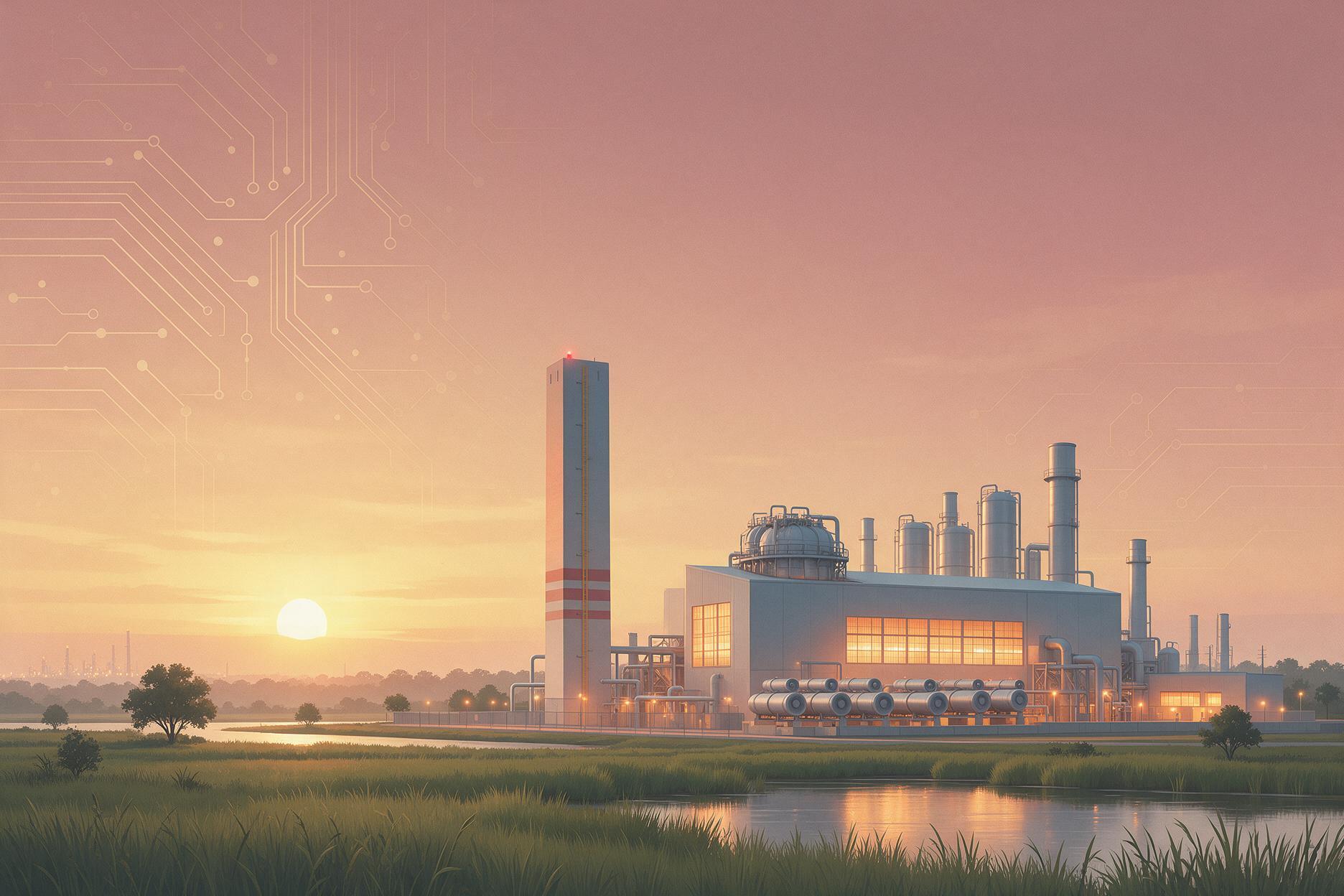
A reported $22.3 billion U.S.–South Korea energy framework to build a 6.3‑gigawatt (GW) natural gas plant in Encinal, Texas, has fueled a market rally as the deal approaches a make‑or‑break legislative window this week — with Seoul saying talks are in the final stretch but nothing is final until signatures are inked.
The timeline sharpened on Sunday, Sept 13, when South Korean Industry Minister Kim Jung-kwan returned to Seoul after concluding final in-person talks with U.S. Commerce Secretary Howard Lutnick and other officials in New York from Sept 10–12. Speaking to reporters at Incheon Airport, Kim said negotiations on the first U.S. investment project are in the final stretch, with some details still to be ironed out via video conference early this week, and added that Seoul aims to wrap up and potentially announce a deal within days if talks conclude successfully.
Designed to combat the explosive electricity demands of artificial intelligence (AI) data centers and semiconductor fabs, the Encinal initiative represents South Korea’s first major deployment under a broader $350 billion U.S. investment framework. However, despite intense market euphoria, officials on both sides are urging caution ahead of two critical milestones scheduled for Thursday, September 17, and Friday, September 18.
The project falls under Seoul’s $200 billion strategic investment fund for U.S. energy and tech — the legally binding vehicle tied to 2025 tariff relief — which caps total commitments at $200 billion and annual outflows at $20 billion.
The Countdown: Thursday Briefing and Friday Signing
The upcoming days will determine the official fate of the megaproject. Following high-level meetings in New York between South Korean Industry Minister Kim Jung-kwan and U.S. Commerce Secretary Howard Lutnick, the focus shifts entirely to formal ratification.
The Thursday Milestone (Sept 17)
Minister Kim is scheduled to present the investment plan in a closed-door session of the National Assembly’s Planning and Finance Committee on the morning of Sept. 17. Meanwhile, parliamentary review will scrutinize the commercial return on investment (ROI), state-backed financing structures, and compliance with the $200 billion cap and $20 billion annual remittance limit.
The Friday Milestone (Sept 18)
If it clears legislative review, officials are targeting Friday for the formal, binding signing of the Bilateral Memorandum of Understanding (MOU) to greenlight Phase One — provided negotiations conclude successfully. Some Korean reports mention an initial ~$2.2 billion+ commitment this year, with a possible announcement Sept 18 and first fund transfer later in September.
Both the White House and the South Korean Ministry of Trade, Industry and Energy have issued statements reminding the public that “nothing is legally binding until the final signatures are inked.”
The Buildup: Why Markets Are Rallying Today
Anticipation of the mid-week briefings has already injected massive volatility into Asian markets. As of Sunday, September 13, the KRX Construction Index in Seoul has surged 9.44% since the start of the month, outperforming the broader KOSPI. Investors are actively positioning themselves in South Korean engineering and construction heavyweights, betting heavily on the multi-billion dollar procurement contracts expected to follow Friday’s signing.
Yet, government ministries are intentionally keeping a low profile to protect negotiations. Seoul has repeatedly said no final agreement has been reached and that the $22.3 billion figure is reported/negotiated, not confirmed.
INVESTOR INDEX: Who’s Moving This Week
As the market anticipates the Thursday parliamentary briefing, institutional capital is flowing into specific engineering and technology firms poised to secure major slices of the $22.3B pie:
- Hyundai Engineering & Construction (Hyundai E&C, 000720.KS): +9.41% Sept 1–11; favored for large civil/energy consortia and government-backed international projects.
- Daewoo Engineering & Construction (Daewoo E&C, 047050.KS): +9.35%; often co-bid on overseas thermal and nuclear EPC contracts.
- Samsung Engineering & Construction (Samsung E&C, 028050.KS): +8.28%; active in domestic and Gulf power projects.
- Doosan Enerbility (034020.KS): Primary candidate to supply major turbine infrastructure for the Encinal gas plant, and would act as the cornerstone supplier if the nuclear initiative is triggered.
- Korea Electric Power Corporation (KEPCO, 015760.KS): The state-backed utility giant is heavily involved in the Special Purpose Vehicle (I-SPV) structure being negotiated, making its long-term yield highly sensitive to Friday’s MOU outcome.
The Multi-Gigawatt Crisis Fueling the Deal
The urgency behind the Encinal project is underscored by staggering data out of Texas. The Electric Reliability Council of Texas (ERCOT) is currently evaluating an unprecedented 474 gigawatts of new grid-connection requests. Roughly 90% of those requests originate from tech conglomerates scrambling to power massive AI infrastructure.
ERCOT has paused new large-load interconnections while it completes an Abbott-ordered audit of roughly 300 data-center projects by December 2026, intensifying pressure for dedicated generation that can bypass the clogged queue.
The Encinal project is uniquely structured to scale alongside this demand:
- Phase One Deployment: Immediate construction of 1.4 gigawatts of gas-turbine capacity to provide rapid grid relief, with initial operations potentially by 2030.
- Full Liquefied Natural Gas (LNG) Capacity: Scaling to a massive 6.3 gigawatts—an energy output equivalent to roughly 4.5 traditional nuclear reactors.
TECH EXPLAINER: The $120B Nuclear Horizon
Energy analysts are keeping a close eye on the framework because it lays the groundwork for an even larger, long-term nuclear infrastructure initiative. Behind closed doors, Washington and Seoul are discussing a follow-up cooperation framework to construct up to eight large-scale nuclear reactors in the U.S., leveraging a mix of two premier designs — a potential $120 billion pipeline if both sides greenlight it, but not yet a formal commitment.
South Korea’s APR-1400: Net power output of ~1,400 MWe (larger capacity per footprint); advanced active and passive hybrid safety systems; fully certified by the U.S. NRC with an active track record in Barakah.
Westinghouse’s AP1000: Net power output of ~1,117 MWe (mid-to-large capacity); fully passive safety relying on gravity and natural circulation; deeply integrated into the U.S. regulatory framework and domestic grid.
With each nuclear unit estimated to cost $15 billion, this broader roadmap represents a potential $120 billion secondary market that will dominate bilateral energy policy for the next decade if the gas framework succeeds this week.
The Encinal gas framework is only one piece of a broader U.S. push to bring large, reliable generation online for AI workloads. In Michigan, Holtec International has begun loading nuclear fuel into the shuttered Palisades plant, moving the facility into “Mode 6” refueling and edging it closer to a potential restart as soon as 2027 — part of a wave of revived nuclear projects aimed at meeting surging data-center demand. Together, new gas builds like Encinal and restarted nuclear assets like Palisades illustrate how Washington and private developers are betting on a mix of fast-to-deploy thermal capacity and long-life nuclear baseload to keep pace with AI’s power hunger.
WHAT TO WATCH: Checklist for the Week
- Sept 17 (Thursday): Closed-door briefing to National Assembly Planning and Finance Committee.
- Sept 18 (Friday): Potential MOU signing if lawmakers are satisfied.
- Market tell: KRX Construction Index vs KOSPI; Hyundai E&C, Daewoo E&C, Samsung E&C moves.
- Policy tell: Any language on the $200 billion cap, $20 billion annual remittance limit, and SPV structure.
- Negotiation range: The $22.3 billion figure reportedly emerged after narrowing from U.S. asks around $25 billion.

Leave a Reply