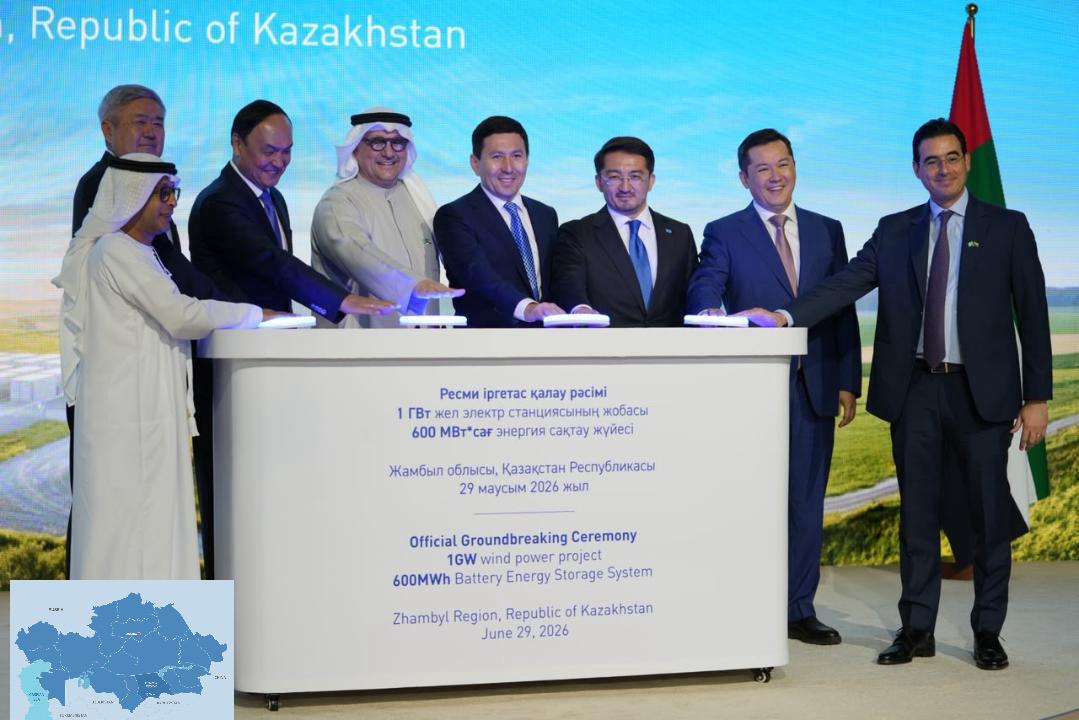
Kazakhstan has officially broken ground on the Mirny wind project, a landmark 1-gigawatt (GW) renewable energy development in the southern Zhambyl Region that combines large-scale wind generation with advanced battery storage. The initiative, valued at an estimated $1.2–$1.4 billion, represents one of the country’s largest foreign-backed energy investments and a key milestone in its push toward a low-carbon power system.
The ceremonial groundbreaking was held in the Moiynkum district and linked virtually with national officials in Astana, underscoring the project’s strategic importance to Kazakhstan’s national energy agenda.
Major international consortium behind the project
The Mirny wind project is being developed by a broad international consortium that includes UAE-based clean energy developer Masdar, alongside partners such as TotalEnergies and Kazakh state-linked entities including subsidiaries of Samruk-Kazyna. Additional participation has been reported from Kazakh and regional energy investment entities involved in renewables expansion.
The project reflects Kazakhstan’s growing reliance on blended public-private financing structures to accelerate renewable deployment while strengthening grid resilience.
1GW wind farm paired with large-scale energy storage
At full scale, Mirny will deliver approximately 1,000 MW of onshore wind capacity, making it one of the largest renewable installations in Central Asia.
A defining feature of the project is its integrated battery energy storage system (BESS), rated at around 300 MW / 600 MWh. The system is designed to store excess electricity generated during periods of high wind output and release it during peak demand hours, particularly in the evening when consumption spikes.
This configuration is intended to address one of Kazakhstan’s long-standing energy challenges: balancing intermittent renewable generation with stable grid supply.
Expanded grid infrastructure to improve national connectivity
In addition to generation and storage assets, the project includes the construction of more than 400 kilometers of high-voltage transmission lines. These upgrades are expected to enhance electricity transfer between Kazakhstan’s energy-rich northern regions and high-demand southern areas, improving overall grid stability and national energy security.
Kazakhstan has been actively pursuing a broad diversification strategy for its energy sector, aiming to reduce long-term dependence on fossil fuels while strengthening domestic power security. In addition to accelerating investment in large-scale renewable projects such as wind and solar, the country is also advancing plans to introduce nuclear power as part of its future energy mix. This dual-track approach reflects Kazakhstan’s effort to balance rapid demand growth with cleaner baseload generation, improve grid stability, and align its power system with global decarbonization trends.
Economic and climate impact
Once operational, the Mirny wind project is expected to generate approximately 3.4–4.0 billion kilowatt-hours (kWh) of electricity annually. This output is sufficient to power around one million households and is projected to reduce carbon dioxide emissions by roughly 2–3 million tons per year compared to coal-based generation.
The project is also expected to significantly increase Kazakhstan’s renewable energy share, helping the country move closer to its target of 15% renewable electricity generation by 2030 and its broader long-term carbon neutrality goals.
During the construction phase, the project is projected to create around 1,000–2,000 jobs, with an additional 100–300 permanent operational roles once the facility becomes fully operational. Developers have also emphasized local content participation and technical training programs to build domestic expertise in advanced renewable energy systems.
Strategic importance for Kazakhstan’s energy transition
Kazakh officials have described the Mirny development as a cornerstone of the country’s energy diversification strategy, particularly as electricity demand rises and industrial consumption expands.
The project is also expected to serve as a model for future hybrid renewable developments in the region, combining wind generation, grid-scale storage, and transmission upgrades into a single integrated system.
Construction is now underway, with phased commissioning expected between 2028 and 2029, depending on equipment delivery schedules, financing milestones, and grid integration progress.

Project Factsheet: Mirny Wind Project (Kazakhstan)
- Location: Zhambyl Region, southern Kazakhstan
- Capacity: 1,000 MW (1 GW) onshore wind
- Storage: 300 MW / 600 MWh Battery Energy Storage System
- Investment: $1.2–$1.4 billion
- Transmission: 400+ km high-voltage lines
- Annual Output: 3.4–4.0 TWh
- CO₂ Reduction: 2–3 million tons annually
- Developers: Masdar, TotalEnergies, Kazakh state-linked partners including Samruk-Kazyna subsidiaries and other regional investors
- Jobs: 1,000–2,000 construction jobs; up to 100–300 permanent roles
- Commissioning: Phased rollout expected 2028–2029




Leave a Reply