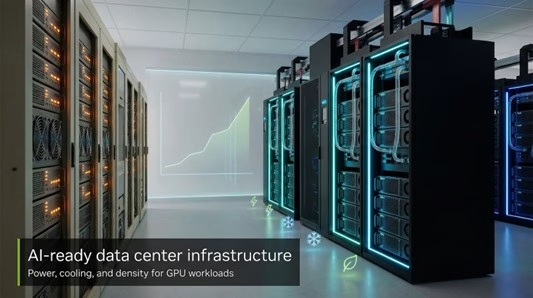
We’re in a compute arms race. In Q1 2025 alone, organisations poured $112 billion into servers—up 61 percent year on year—because every board now has AI on its agenda. (drivers lose about 17 hours each year each year itpro.com)
Those accelerators need a home. Analysts project that a single AI-optimised rack could draw almost one megawatt of power by 2030—energy that once powered an entire facility, according to TechRadar. Cooling, power distribution, floor loading, and financing must evolve—quickly.
In this guide, we spotlight five data center providers that solve different pieces of that puzzle. You’ll see how we scored them, where they shine, and how to weave them into a modernisation plan that balances performance, sustainability, and cost.
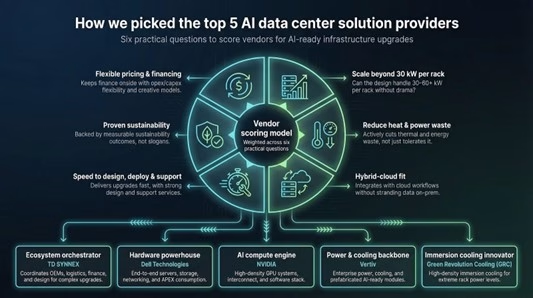
How we picked the top 5
We didn’t chase brand buzz; we chased relevance. First, we mapped each vendor against the real-world hurdles you face when fitting energy-hungry GPUs into rooms built for file servers.
We boiled the test down to six questions:
- Can the solution scale beyond 30 kW per rack without drama?
- Does it curb heat and power waste instead of merely coping with it?
- Will it fit into a hybrid-cloud workflow instead of stranding data on-prem?
- How quickly can teams design, deliver, and support the upgrade?
- What proof exists of genuine sustainability (not just green slogans)?
- Is the pricing or financing model flexible enough to keep finance onside?
Each provider earned a weighted score across those factors. No one company tops every column, but a smart mix covers them all. That’s why our final list blends an ecosystem orchestrator, a hardware powerhouse, the GPU leader, a facilities specialist, and an immersion-cooling innovator. Think of it as a pragmatic toolkit, not a trophy shelf.
1 TD SYNNEX: your ecosystem orchestrator
Think of TD SYNNEX as the traffic controller for complex data-centre upgrades. Its role isn’t to sell one shiny box; instead, it curates the building blocks of modern infrastructure such as servers, racks, cooling kits, network gear and hybrid-cloud platforms and delivers them in the right order through TD SYNNEX IT infrastructure solutions.
From the first scoping call, we tap a catalogue covering hundreds of OEMs. Need Dell liquid-ready GPU servers? Done. Want Vertiv busways sized for 60 kW racks? Already on the quote. A single point of contact means no finger-pointing when timelines slip or parts clash.
The TD SYNNEX Modern Infrastructure team adds brains to that breadth. Solution architects model power draw, cooling loads, and rack weight so facilities and IT stay aligned. Financing specialists fold high-ticket GPU nodes into monthly payments, freeing cash for construction. Logistics crews stage deliveries so you never drown in pallets or wait on a missing PDU.
The payoff is momentum. Design reviews drop from months to weeks, equipment arrives in sequence, and every component stays compatible with next year’s silicon refresh.
When the goal is an AI-ready data centre but the calendar says “yesterday,” an aggregator strong in both product and services is the smartest first call.
2 Dell Technologies: end-to-end hardware powerhouse
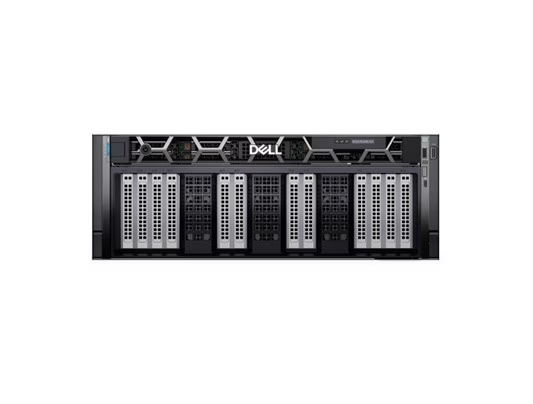
Dell has refined turnkey infrastructure for decades, and its latest AI line shows why that experience matters. The flagship PowerEdge XE family fits up to eight H-series GPUs per chassis, ships with rear-door liquid coolers, and runs comfortably in racks drawing more than 40 kW. You add serious training capacity without risking thermal limits.
Compute is only part of the equation. Dell weaves storage and networking into the same fabric, so data moves from PowerScale arrays to GPU memory at line-rate speed, clearing the bottleneck where models wait on files.
Management stays simple. Through APEX, you consume this gear as a service. Finance approves a predictable monthly payment, operations keeps workloads on-prem for latency or data-sovereignty reasons, and no one debates capex.
Field engineers bridge IT and facilities. They map airflow, check floor loading, and coordinate with cooling vendors before the first crate arrives. The result feels planned, not improvised.
Choose Dell when you want one accountable partner for servers, storage, and support, plus a roadmap that keeps pace with each GPU generation ahead.
3 NVIDIA: the AI compute engine
Few companies illustrate the AI surge like NVIDIA. Its GPUs train models across drug discovery, generative chat, and more. Slide a single DGX H100 node into the rack and you deliver nearly a petaflop of tensor performance; cable 256 of them together and you operate a private supercomputer.
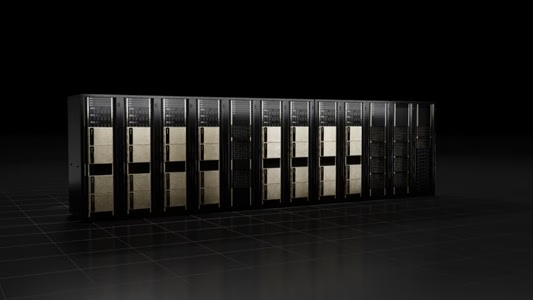
Performance is only part of the story. NVIDIA wraps its silicon in a complete stack: NVLink for fast peer-to-peer traffic, InfiniBand switches for microsecond cluster latency, and software such as Base Command that schedules jobs and tracks utilisation so every watt counts.
Reference designs add practical value by detailing power feeds, cooling loops, and floor loading. They save months of trial and error and keep construction budgets grounded.
NVIDIA also fits hybrid plans. Cloud providers rent DGX instances by the hour, yet the same architecture lands on-prem through partners like Dell and Supermicro. Your data, your latency target, your decision on where the workload lives.
If your mission depends on maximum insight per square foot, NVIDIA supplies the engine room. Just remember: these processors run hot and heavy. Pair them with the right power and cooling. Ideally, lean on the other specialists in this guide to get the most from that investment.
4 Vertiv: power and cooling backbone
AI stalls not when a GPU dies but when the room overheats or the feed line sags. That risk is where Vertiv steps in. The company kept hyperscale clouds online for years, and now those technologies arrive in right-sized modules for enterprise floors.
Start with cooling. Rear-door heat exchangers pull 50 kW of heat straight out of each rack, while liquid-cooling nodes clamp onto cold plates for an even stronger thermal punch. Need speed? Prefabricated 360AI pods arrive with pumps, pipework, and sensors pre-tuned, cutting build times and sparing you dust and downtime.
Power follows suit. High-capacity busways snap together like giant LEGO bricks, delivering clean three-phase juice to every cabinet. Vertiv UPS systems run at better than 97 percent efficiency, shifting to eco-mode when loads ebb so you don’t pay for phantom watts. Add smart PDUs that log per-outlet draw and you gain a live PUE dashboard instead of quarterly guesswork.
Services often tip the balance. Vertiv engineers speak the language of electricians, HVAC techs, and network architects in one meeting. They model short-circuit currents, water flow, and airflow before anyone signs a purchase order, avoiding the “oops” moments that inflate budgets later.
When uptime is non-negotiable and efficiency equals savings, Vertiv supplies the spine that lets AI hardware breathe easy and run flat out.
5 Green Revolution Cooling: immersion cooling made simple
When airflow tops out, GRC lets servers sink into single-phase immersion tanks filled with a safe dielectric fluid that moves heat 1,200 times better than air. Facilities report up to a 90 percent cut in cooling energy and pPUE values near 1.03, according to GRC.
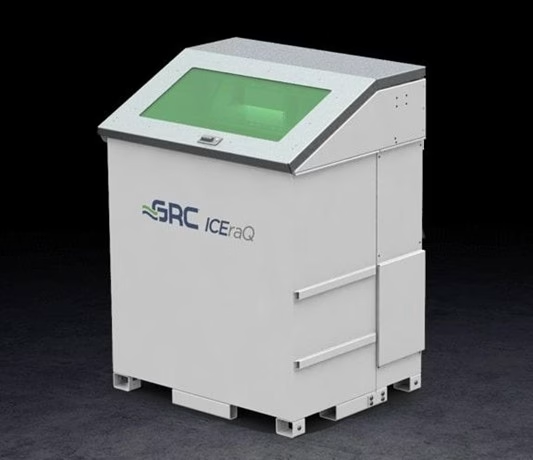
Density climbs too. One ICEraQ module cools well over 100 kW, freeing rack space for extra GPUs instead of fans. Because the servers run without fans, they draw about 10 percent less power and operate quietly, helpful when an AI pod sits next to office space.
Deployment stays simple. Tanks fit through standard double doors and connect to a dry cooler or an existing chilled-water loop. No raised floors, air-path redesign, or CRAC rebalancing required. Many teams park immersion pods beside air-cooled rows, creating an “AI island” without rebuilding the mainland.
Sustainability teams note extra perks. The dielectric fluid contains no water, shrinks the HVAC footprint, and channels waste heat in a tidy liquid stream that can pre-heat domestic water. Finance appreciates lower OpEx and the shift from recurring energy bills to a one-time capital cost.
If your plan calls for 60 kW racks today and triple-digit densities tomorrow, immersion offers a practical exit from the rising costs of air cooling, and in that space, GRC leads.
At-a-glance comparison
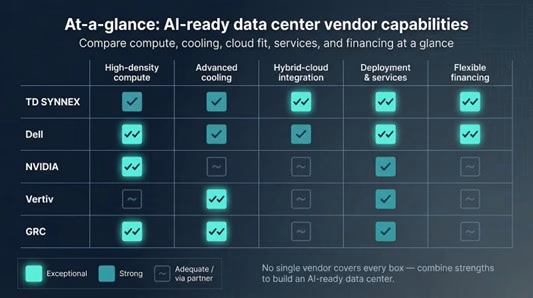
Every provider excels in a different area. The table below distils those strengths so you can spot gaps quickly and mix vendors with purpose.
| Provider | High-density compute | Advanced cooling | Hybrid-cloud integration | Deployment & services | Flexible financing |
| TD SYNNEX | ✔ (via partners) | ✔ (sources best-in-class) | ✔✔ | ✔✔ | ✔✔ |
| Dell | ✔✔ | ✔ | ✔ | ✔✔ | ✔✔ |
| NVIDIA | ✔✔ | ~ (partner solutions) | ~ | ✔ (reference designs) | ~ |
| Vertiv | ~ | ✔✔ | ~ | ✔ | ~ |
| GRC | ✔✔ | ✔✔ | ~ | ✔ | ~ |
Legend: ✔✔ Exceptional | ✔ Strong | ~ Adequate or via partner.
No single vendor covers every cell, yet together they meet all the needs of an AI-ready data centre. Use this matrix as a cheat sheet when you outline your upgrade plan and need to plug capability gaps fast.