
Montgomery’s internet scene is booming. New fiber lines, 5G towers, and nearby data-center builds give you more choice—and more confusion—than ever. We ran speed tests, tracked outages, and compared real prices so you can choose the right plan fast. Whether you’re working from home, streaming in every room, or gaming for the lowest ping, the five picks below show who delivers at your address. Let’s dive in.
How we chose and scored the winners
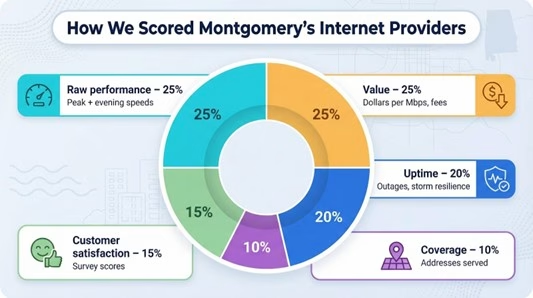
Selecting Montgomery’s best ISPs is about real-world results, not marketing flair. We built a transparent scorecard focused on what you notice every day: steady speed, predictable bills, and service that stays up during summer storms.
Raw performance (25 percent) measures both peak speed and evening consistency. Fiber’s equal-speed uploads earn extra credit over cable and fixed wireless.
Value (25 percent) compares the true monthly cost after promotions with average download speed. Lower dollars per megabit rise in the ranks, while equipment or data fees drag scores down.
Uptime (20 percent) draws on outage trackers, local forums, and each provider’s resiliency reports. Networks with buried fiber or battery-backed nodes earn more points.
Customer satisfaction (15 percent) comes from the latest American Customer Satisfaction Index and J.D. Power surveys; AT&T Fiber’s score of 80 sets the benchmark.
Coverage (10 percent) maps every footprint against Montgomery addresses, because the fastest plan means nothing if you cannot order it.
Add these pillars together and you get one clear number for each contender. The five highest scorers appear next, with details on how they earned their spots.
1. WOW! Internet: best value cable option
Live inside Montgomery’s city limits and you have likely seen the bright red WOW! van. The company passes about 90 percent of city addresses, giving most homes a wired alternative to Spectrum.
The appeal is simple: speed for the dollar. Montgomery, AL home internet provider lists a 300 Mbps tier at $30 per month with equipment included, and upgrades to 600 Mbps or 1 Gbps stay well below rival prices. On a dollars-per-megabit basis, WOW! stretches a budget farther than any other local provider.
Performance matches the marketing. The hybrid fiber-coax network, powered by DOCSIS 3.1, keeps downloads within five percent of the advertised rate during prime time. Uploads land between 20 and 50 Mbps, which covers video calls even if it is not fiber-fast.
Reliability ranks solid thanks to recent node splits and capacity boosts. Storm outages occur because lines ride on poles, yet local crews restore service quickly. Plugging the modem into a small battery backup guards against brief power flickers.
Billing is mostly straightforward. The first-year price stays flat; month 13 rises unless you renegotiate. Set a reminder, call retention, and increases stay modest. There is no data cap or modem-rental fee, saving heavy streamers about 15 to 25 dollars each month.
Choose WOW! if you stream 4K shows, download large games, or rent where fiber is absent. Creators who upload huge files or chase the lowest latency still prefer fiber, but for everyone else WOW! offers Montgomery’s strongest mix of speed, coverage, and cost.
2. AT&T Fiber: fastest speeds and iron-clad reliability
AT&T Fiber sets Montgomery’s speed ceiling. Where the network reaches, a direct glass line delivers up to 5 Gbps both down and up—about ten times more bandwidth than most homes use today, with room for 8 K video, cloud backups, and smart-home traffic.
Coverage is growing but still selective. Allconnect maps show fiber at roughly 40 percent of local addresses, mainly in newer subdivisions and several downtown blocks. Other AT&T lines fall back to DSL and are not part of this ranking, so confirm your exact address.
Performance is almost flawless. Speed tests match the advertised tier with single-digit latency. Buried trunks and battery-backed cabinets keep service steady during storms, and many users report months of uninterrupted uptime.
Customer sentiment echoes the engineering. The 2025 ACSI survey lists AT&T Fiber at an industry-leading score of 80. Installation is professional, equipment fees are included, and service stays contract-free, so you can leave any month without a penalty, though most customers stay.
Pricing stays predictable: $45 for 300 Mbps, $70 for 1 Gbps, and $245 for 5 Gbps. No data caps or promotional jumps mean month one looks the same as month twelve.
Choose AT&T Fiber if you rely on unwavering speed and uptime. Remote work, competitive gaming, multi-camera security, and creative file transfers all benefit. If your street lacks fiber today, check availability each quarter; new segments light up regularly.
3. Spectrum: widest reach, zero contracts
Spectrum is the workhorse of Montgomery broadband. Its cable lines cover about 98 percent of county addresses, so a random ZIP code almost always qualifies.
That blanket coverage eases moves across town; you can transfer service without missing a Netflix episode. Plans start at $30 for 100 Mbps, the popular 500 Mbps tier costs $50, and every package includes unlimited data with no throttling.
The service stays commitment-free. You may cancel any month without an early-termination fee. Expect the bill to rise after the first-year promo; mark the date and call retention, and representatives often trim 10 to 15 dollars.
Downloads reach 1 Gbps citywide and 2 Gbps in a few upgraded areas. Uploads hover near 35 Mbps, adequate for everyday tasks but slower for large cloud backups. Spectrum is testing DOCSIS 4.0 to lift upstream speeds, though no local timeline is set.
Reliability ranks middle of the pack. Aerial coax shares poles with power lines, so severe storms can knock both offline, yet crews restore service within hours. Battery-backed amplifiers keep brief power flickers from cutting internet.
Customer satisfaction scores land near the national average, signaling solid performance with room for support improvements. Choose Spectrum if you want the dependable option that reaches almost every address, offers strong download speeds for streaming and gaming, and lets you leave whenever a better deal appears.
4. T-Mobile 5G home internet: plug-and-play freedom for renters and rural edges
Sometimes the simplest way online is to skip cables. T-Mobile’s 5G Home Internet ships a small gray gateway; plug it into power, and within ten minutes your home broadcasts Wi-Fi pulled from the same mid-band 5G network that fuels their phones.
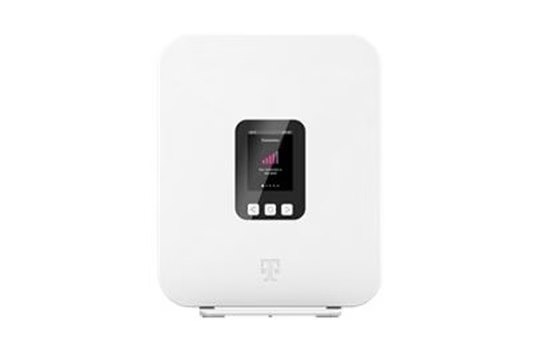
Typical Montgomery speeds range from 100 to 300 Mbps down and 10 to 40 Mbps up. That capacity supports multiple 4K streams, video calls, and console gaming with latency near 30 milliseconds. Data stays unlimited, and the bill remains a flat $50 with AutoPay, month after month.
Coverage reaches farther than expected. Mid-band n41 panels sit on dozens of county towers, bringing service to many rural pockets still waiting for fiber or cable. The companion app guides you to the strongest signal; set the gateway by a window, and setup is complete.
Wireless does introduce variability. Tower congestion during prime-time TV hours can slow throughput, and thunderstorms may add jitter. T-Mobile prioritizes phone traffic first, so home-internet bits occasionally slow during major events. For large video uploads or competitive esports, wired fiber stays superior.
For renters, cord-cutters, and households tired of installation visits, T-Mobile offers one box, one price, and no contract. If you are between apartments, wiring a backyard studio, or waiting for fiber trenching, this 5G option keeps you online without traditional broadband hurdles.
5. C Spire Fiber: local fiber newcomer worth watching
C Spire is the newest name in Montgomery’s broadband mix, yet crews are laying future-proof fiber. After acquiring Troy Cable and investing hundreds of millions in Alabama infrastructure, the company already serves a few east-side neighborhoods and parts of Pike Road. Early speed tests show gigabit service with latency under 5 milliseconds, exactly what a fresh XGS-PON network delivers.
Availability remains limited. About two thousand homes are service-ready, with conduit construction planned for three thousand more. Orange micro-trenches or C Spire yard signs usually indicate that a street sits in the next build zone. Residents can enter an address on C Spire’s site to join a “fiberhood”; streets with the most interest move forward first.
Pricing lands in the premium-fiber sweet spot. A 300 Mbps plan lists at $60, and symmetrical gigabit costs $85. Both include equipment, Wi-Fi 6 mesh, and unlimited data. No contracts or installation fees apply during active promotions, and support comes from Alabama, often trimming hold times.
Because the network is new, congestion is nonexistent. Speed tests at 8 pm look the same as those at 3 am, and uploads match downloads. Buried fiber shrugs off storms better than aerial cable, and multiple upstream carriers add redundancy for remote work peace of mind.
Patience is the trade-off. Addresses outside the current map may wait months for crews. Even without subscribing, C Spire’s presence pressures cable rivals to sharpen pricing in overlapping neighborhoods.
Address checker says “Available”? Sign up for symmetrical gigabit, local support, and a network ready for rising bandwidth demands. Status still reads “Coming soon”? Register interest to nudge your street higher on the list.
Side-by-side snapshot: compare your top options at a glance
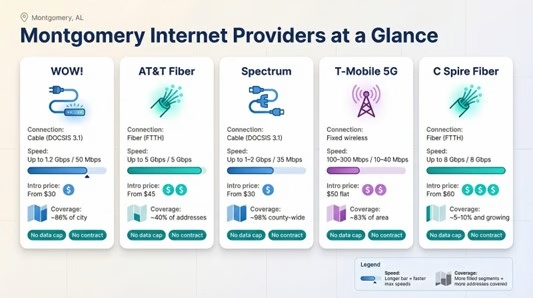
The table below lines up each provider’s core facts—speed, price, data limits, contracts, and reach—so you can spot trade-offs in seconds.
| Provider | Connection | Download / Upload | Intro price* | Standard price | Data cap | Contract | Coverage |
| WOW! | Cable (DOCSIS 3.1) | 1.2 Gbps / 50 Mbps | $30 (300 Mbps) | $55–$85 | None | None | ~86 percent of city |
| AT&T Fiber | Fiber (FTTH) | Up to 5 Gbps / 5 Gbps | $45 (300 Mbps) | $45–$245 | None | None | ~40 percent of addresses |
| Spectrum | Cable (DOCSIS 3.1) | 1 Gbps / 35 Mbps (2 Gbps in select areas) | $30 (100 Mbps) | ~ $80 | None | None | ~98 percent county-wide |
| T-Mobile 5G | Fixed wireless | 100–300 Mbps / 10–40 Mbps | $50 flat | $50 flat | None | None | ~83 percent of area |
| C Spire Fiber | Fiber (FTTH) | Up to 8 Gbps / 8 Gbps | $60 (300 Mbps) | $60–$325 | None | None | ~5–10 percent and growing |
*Intro prices reflect first-year promotional rates where offered.
Smart tips for smoother, cheaper internet
Signing up is only step one. A few easy habits keep that new connection fast and affordable.
Give Wi-Fi proper coverage. The free modem works in a small apartment, but signals fade in a two-story brick house. A Wi-Fi 6 mesh kit costs about $150 and prevents buffering when everyone streams at once.
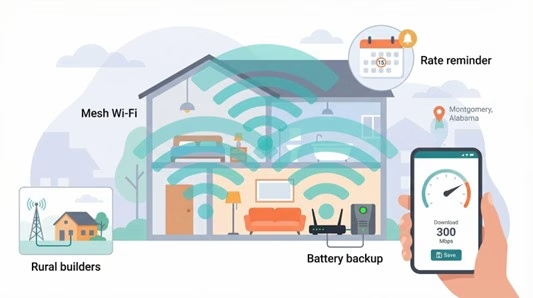
Watch the calendar. Spectrum and WOW! often raise rates after the first year. Set a phone reminder; a quick call to retention usually brings a discount or fresh promo.
Prepare for storms. Fiber stays online if you power the gateway with a small battery backup. Cable nodes and 5 G towers share the power grid, so an inexpensive UPS protects your modem and router during short outages.
Check rural builders. Central Access and Wise Broadband continue to add fixed-wireless and fiber across the county at city-level prices. Reserve satellite as a last resort; it handles email and schoolwork but adds noticeable lag for gaming.
Document performance. Run a speed test the day service starts and save a screenshot. If speeds drop later, that record strengthens your support call.
Follow these steps and your broadband will stay faster, cheaper, and stress-free.
Quick-fire FAQ: answers to questions Montgomery residents ask most

Who has the fastest internet in Montgomery right now?
C Spire currently leads with symmetrical plans up to 8 Gbps, though its footprint is limited. AT&T Fiber reaches more homes and offers up to 5 Gbps.
Is Comcast available here?
No. Montgomery’s cable choices are Spectrum and WOW. Flyers mentioning Xfinity cover other Alabama markets.
What is the absolute cheapest plan I can buy?
Spectrum’s 100 Mbps tier promotes at $30 for the first year. WOW matches the price but delivers 300 Mbps, so long-term value depends on how aggressively you negotiate after promotions expire.
Which provider is best for gaming?
Fiber delivers the lowest ping. AT&T Fiber—and C Spire where available—feel the most responsive. Among cable options, Spectrum holds steadier latency than WOW during peak hours, though both work for most titles.
Is more fiber coming to my neighborhood soon?
Yes. AT&T lights new pockets each quarter, C Spire keeps trenching new fiberhoods, and state grants accelerate both efforts. Check your address monthly because availability can change overnight.
Do I need to bundle TV or phone to get these prices?
No. Every provider reviewed sells standalone internet plans, and none require a landline or cable box to unlock promotional rates.
Conclusion
Still stumped? Drop us a note. We track Montgomery build-outs and gladly steer neighbors toward the latest deals.