Columbus is exploding with semiconductor fabs, data-center expansions, and venture-backed start-ups, and every one of them depends on fast, fail-proof internet. But coverage here shifts block to block: AT&T already reaches about 33 % of business addresses, Spectrum’s coax blankets 55 %, and its newer fiber lights roughly 20 % of buildings (ISP Reports). Picking a provider on brand alone is a gamble. You need hard numbers on speed, uptime, and real humans who answer at 2 am—and that’s exactly what this guide gives you. In the next few minutes we’ll size up six key carriers and show which one fits your growth plans.
How we ranked Columbus fiber providers
Choosing a business ISP is about more than headline download speeds. It’s the pace of nightly backups, the time a crew takes to arrive after a cut cable, and whether your invoice stays steady as you grow.
We built a data-first scorecard to keep those realities front and center.
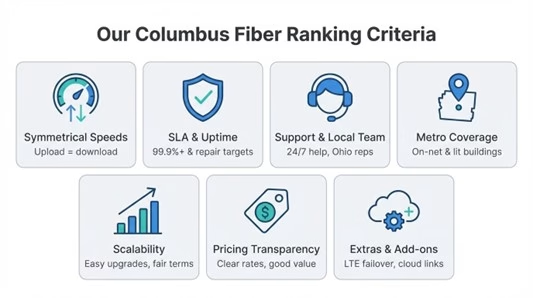
- Symmetrical speed tiers
Upload capacity must equal download capacity. We track the fastest standard plan each provider publicly sells, not lab-only figures. - Service level agreements
We record promised uptime, mean time to repair under four hours, and the credit policy that enforces it. - Customer support and local presence
24/7 phone access, named account reps, and an Ohio-based help desk all earn points. - Network reach inside Franklin County
A 10-gig circuit on paper is useless if the fiber stops two streets away. - Scalability and flexibility
Easy bandwidth upgrades, 30-day install windows, and contracts that won’t trap you in yesterday’s capacity. - Pricing transparency and overall value
Published starter rates, waived install fees, and clear renewal terms matter. - Extras that tip the scales
Managed routers, automatic LTE failover, and direct cloud on-ramps break ties when specs look identical.
Every provider that follows scored above the metro average across this grid. We cross-checked marketing claims against FCC broadband data, public spec sheets, and first-hand customer feedback to deliver a ranking grounded in real-world performance.
WOW! Business: local fiber with personalized support
WOW! started in Ohio, so its engineers answer the phone like neighbors because they are. That home-grown DNA carries from sales calls to on-site installs and shows up when trouble hits at 2 am. A Columbus-based tech grabs the ticket and rolls a truck if needed.
On raw performance, WOW! checks the enterprise boxes. Its Scalable Business Fiber Internet service delivers symmetrical bandwidth from 100 Mbps to 10 Gbps and is built to let you dial up capacity as headcount and cloud traffic grow, all while a written 99.9 percent uptime pledge and a four-hour repair target keep risk in check.
Pricing stays friendly, especially for small offices that want enterprise-grade circuits without an enterprise-sized invoice. Free install promos surface often, and short initial terms let you test before locking in.
The trade-off is footprint. After WOW! sold most residential lines to Breezeline, new builds follow business demand rather than blanket the city. Check address availability early; if your building is already lit—or close enough for a quick extension—you get carrier-class speed plus true hometown support.
AT&T Business Fiber: wide reach, enterprise muscle
AT&T lights more Columbus addresses than any other telco, so your suite likely sits on its map. That coverage cuts projects that once dragged for months down to turn-ups measured in weeks.
Performance matches the pedigree. Standard tiers reach a symmetrical 5 Gbps, and dedicated circuits climb into the double digits for data-hungry campuses. The SLA pledges 99.99 percent uptime with a four-hour restore target. In practice, customers see single-digit-millisecond latency across town and a steady backbone to major cloud regions.
Support feels corporate, with ticket portals, a national NOC, and the occasional phone maze, yet scale brings perks. Need managed firewalls, wireless failover, or a private Azure link? AT&T adds each service to one contract, which streamlines life for lean IT teams.
Pricing rewards commitment. A three-year term unlocks aggressive rates, while month-to-month plans cost more. If you want broad reach, proven reliability, and an à la carte menu of extras, AT&T offers the safest all-round option in the city.
Spectrum Business: fast starts, easy upgrades
When you need service yesterday, Spectrum usually wins on proximity. Its coax network already reaches nearly every commercial building in Franklin County, so a technician can swap a modem and bring you online within days.
Download speeds reach 1 Gbps, plenty for busy point-of-sale lanes and cloud drives. Cable uploads hover around 30 Mbps in most neighborhoods, so content creators may hit a ceiling. At that point Spectrum can move you to enterprise fiber, a symmetrical service up to 10 Gbps with a 99.99 percent uptime pledge.
Contracts stay flexible. Standard plans ship with no term and equipment included, while promo pricing locks in for the first year. If costs climb at renewal, a quick call often resets the rate.
Support is a tale of two desks. Coax customers reach a national hotline that handles routine issues but can be slow on deep diagnostics. Fiber clients get a priority queue and proactive monitoring that rivals larger carriers. Add the option to bundle TV, voice, and cellular, and Spectrum fits neatly into the one-bill-for-everything column.
Lumen: enterprise fiber built for zero downtime
Lumen speaks the language of hospitals, banks, and cloud providers—the organizations that treat every millisecond like money. Its Columbus network traces back to the Level 3 backbone, so traffic jumps onto a top-tier route the moment it leaves your building.
Dedicated internet starts at 100 Mbps and scales to multi-gigabit ports, with wavelength and dark-fiber options for workloads that never sleep. The SLA promises 99.999 percent uptime and a 2–4-hour restoration clock, the tightest pledge in this roundup.
Installation is deliberate rather than fast. Engineers map diverse paths, test redundant power, and document every step before hand-off. That thoroughness pays off when a backhoe cuts a conduit; automatic failover keeps packets flowing while crews splice glass.
Support feels like a partnership. Each account gets a named manager and direct access to a regional NOC that can tweak routing or spin up new circuits on short notice. All of this comes at a premium, yet if one hour of downtime costs more than the bill, Lumen earns its keep.
Everstream: business-only fiber, Midwest mentality
Everstream skips the residential maze and puts every strand of glass toward companies like yours. That focus produces a network engineered for low latency, tight SLAs, and fast upgrades.
According to Everstream, since 2019 the company has added more than 1,300 route miles across Columbus, quadrupling its original plan and lighting office parks from Polaris to New Albany. Speeds range from 100 Mbps to 100 Gbps, and a burst feature lets you exceed contract limits without surprise overages. When you dial the NOC, Ohio-based engineers answer while watching live telemetry of your circuit.

Contracts feel friendly. One- and two-year terms carry competitive pricing, and in-house crews often beat larger incumbents on install timelines because permits and splices stay under one roof.
Coverage keeps expanding, with the strongest presence downtown and along major business corridors. If your address is close but not yet on-net, Everstream can run a feasibility check and often covers construction when you sign a multi-year deal.
For IT teams that want enterprise reliability plus startup-speed service, Everstream offers a compelling middle path.
Cogent Communications: downtown bandwidth on a shoestring
Cogent’s playbook is simple: connect on-net buildings to a Tier 1 backbone and sell large ports for very little cash. If your office sits in a downtown high-rise, the value is hard to miss.
A 1 Gbps port often costs less than some competitors’ 100 Mbps tiers, and upgrades to 10 Gbps or even 100 Gbps require only an optics swap. Because traffic jumps straight onto Cogent’s global network, latency to major cloud regions stays low and jitter remains rare.
Support is lean but effective. Open a ticket with the NOC, and an engineer responds quickly when the issue is inside Cogent’s plant. The provider expects customers to manage their own routing gear, so this option suits teams comfortable with BGP and VLAN tags.
Geography is the catch. Cogent rarely builds for a single tenant, so service concentrates in multi-tenant towers and carrier hotels. Suburban campuses must look elsewhere or budget construction.
When the address lines up, Cogent delivers an unbeatable cost per megabit and headroom you will not outgrow. It is the classic “big pipe, small bill” choice—ideal as a primary for data-heavy shops or a secondary circuit that keeps operations running if the main link fails.
Columbus fiber snapshot: the numbers at a glance
Use this grid when a colleague asks, “Which provider really gives us the best mix of speed and reliability for the money?”
| Provider | Top symmetrical speed | SLA uptime | Metro coverage* | Support style | Starting price trend |
| WOW! Business | 10 Gbps | 99.9 % | Moderate (former WOW footprint now on Breezeline plant) | Local Ohio team + 24/7 NOC | $ |
| AT&T Business | 5 Gbps standard / 10 Gbps+ DIA | 99.99 % | Broad (≈31 % of addresses) | National NOC + dedicated reps | $ |
| Spectrum Business | 1 Gbps (coax) / 10 Gbps (fiber) | n/a (coax) / 99.99 % (fiber) | City-wide coax; 18 % on-net fiber | Tiered: general vs. enterprise desk | $ / $ |
| Lumen | 10 Gbps+ (100 Gbps waves) | 99.999 % | Targeted downtown & carrier hotels | Enterprise NOC + account manager | $$ |
| Everstream | 100 Gbps | 99.99 % | Growing—1,350 route miles in metro | Local engineers, proactive monitoring | $ |
| Cogent | 10 Gbps (100 Gbps available) | 99.99 % | Limited to on-net high-rises | Lean central NOC | $ |
*Coverage reflects existing lit buildings. Most carriers will extend fiber for a contract, but lead times and costs vary.
Scan the columns and notice the patterns:
Spectrum wins instant availability with its coax blanket, while Lumen tops the reliability column for mission-critical workloads. Everstream punches above its weight in both speed and support, and Cogent delivers the lowest cost per megabit if your office sits on its downtown loop. WOW! remains the hometown favorite for small and midsize firms that want a friendly voice on the line.
With the facts in front of you, the next step is matching these strengths to your own priorities.
Buyer FAQ: getting fiber in Columbus without the headaches
How long will installation really take?
If the building is already lit, you can be online in as little as a week, sometimes just two days for Spectrum coax or Cogent on-net fiber. New builds need permits and splicing, so plan for 30–60 days. AT&T and Everstream often land near the low end of that range; Lumen’s dual-path work can stretch toward the high end.
Will crews tear up our parking lot?
Rarely. Most providers pull fiber through existing conduits or lash it to utility poles. When trenching is unavoidable, crews cut narrow slots, drop microduct, and repave the same day. Expect a few locate flags on the lawn, not a construction zone.
How do we confirm a building is lit?
Ask the property manager first. If they do not know, enter the address in the provider’s availability checker or the FCC broadband map. Still unsure? A telecom broker can pull a lit-building report in minutes and save you many sales calls.
Is a backup circuit worth the extra budget?
Calculate the cost of an hour offline. If lost sales or idle payroll exceed $100 per month, add a second path. The most popular combo pairs primary fiber with Spectrum coax or 5G wireless failover. Two diverse routes from two providers cut outage risk to near zero.
What does the SLA actually refund?
Think of credits as accountability rather than revenue. Most carriers refund a day or two of service for an extended outage. The real value is the four-hour repair clock and the leverage to escalate fast.
Can multiple tenants share one large pipe?
Yes, if the landlord bundles internet into the lease or you and a neighbor create a private VLAN. Otherwise each suite orders its own drop. Shared connections save money but need clear rules on bandwidth use.
Conclusion
With these answers in hand, you can push sales reps past buzzwords and lock down the details that keep projects on schedule and teams online.