A quiet but consistent shift is taking shape in the building products market, with engineered compact staircases moving from a niche specification into the mainstream of urban construction. Driven by densification, smaller floor plates, and the steady growth of loft conversion, mezzanine and small-residential pipelines across global markets, compact vertical circulation is increasingly being treated as a category rather than a workaround for difficult plans.
The development is most visible in mature urban markets, the UK, parts of Europe, and dense Asia-Pacific cities but the underlying pressures are global. Wherever floor plates are tightening and conversion projects are growing as a share of the build pipeline, the conventional staircase, with its four-to-five-square-metre footprint, is being re-examined as a specification choice rather than accepted as a fixed cost.
A category-defining product
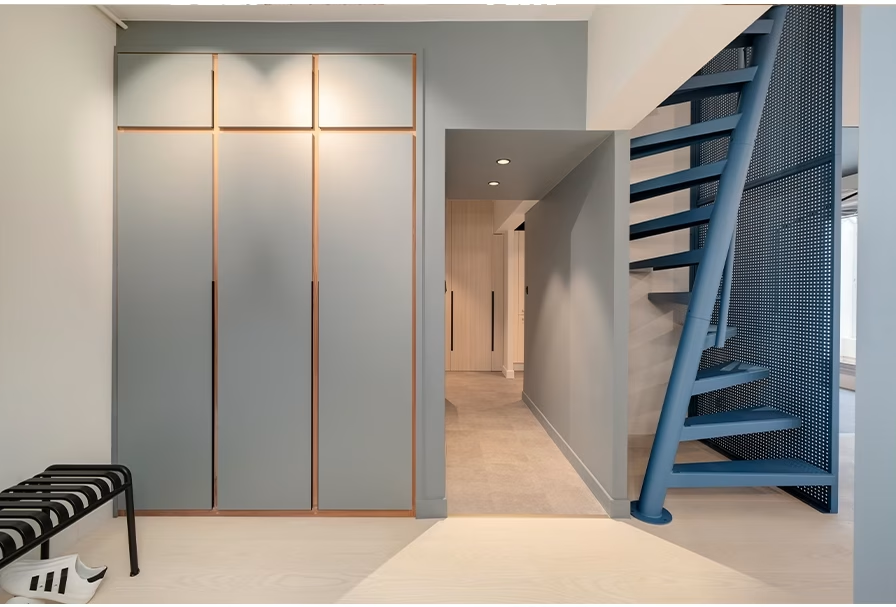
The most fully developed example of the category is the patented 1m² staircase from EeStairs, which compresses a full storey rise into a single square metre of floor and ceiling opening. The product has been in active circulation for several years and has gained ground on small-footprint residential and fit-out projects, where the footprint reduction translates directly into recovered usable area.
The structural engineering centres on a subtly slanted central column, which allows a square spiral configuration to deliver wider treads than a strictly vertical spiral would permit, without breaching the one-square-metre plan envelope. The staircase is built in high-strength steel with a tested load capacity of up to 300 kg and complies with building regulations for secondary access stairs, the regulatory category covering loft conversions, mezzanines and similar applications.
The product is positioned as a response to a defined market need rather than a design statement. “From start to finish, our focus is to deliver something refined and reliable. We are not just building stairs; we are shaping how people use their space,” says Oliver Schneider, Director of EeStairs UK.
A configurator-driven specification model
The product also reflects a broader shift in how building components are being specified across the construction industry. Rather than commissioning bespoke drawings for each project, the 1m² is specified through an online configurator. Architects, designers and experienced installers can input dimensions, generate a 3D model, and produce a costed quotation in a single working session. A technical drawing is issued for approval, with delivery or installation typically following within around five weeks.
For specifiers and procurement teams, the lead-time predictability and configurator-driven workflow represent a measurable departure from the bespoke commissioning model that has historically governed staircase specification. Over 200 RAL colours and finishes are available alongside clockwise or anticlockwise configuration, providing latitude for the unit to align with wider interior schemes without lengthening procurement.
The configurator is a tool that lets clients visualise and personalise the staircase without compromising technical accuracy, a workflow design principle that mirrors how digital specification tools are reshaping product procurement across the wider construction sector.
Site logistics as a specification factor
The installation profile is equally part of the product’s commercial proposition. Two trained installers can assemble the staircase in under two hours using standard tools, with no cranes, no mechanical lifting, and no structural intervention beyond the prepared floor opening. On occupied buildings, finished shells, and tightly sequenced residential programmes, that logistical lightness is often the single most important factor in product selection.
The pattern reflects a broader trend visible across the building products market: products that win specification at the small-footprint end of the construction pipeline often do so by removing site logistics constraints rather than by competing on price or aesthetic alone.
A growing category, not a single product
The wider implication for the construction industry is that compact vertical circulation is moving from a curiosity to a defined product category, with measurable design, regulatory and installation criteria. For construction-industry professionals tracking developments in building products, materials and methods, the engineered compact staircase is a useful indicator of how floor-area pressure on urban projects reshapes product design across categories that had previously been treated as settled. The conventional staircase has had a long run as a fixed element of building design. On a growing share of urban projects, that assumption is no longer holding.