Global infrastructure is currently undergoing a radical transformation. As urbanization accelerates and climate-driven water scarcity becomes a pressing reality, the engineering focus has shifted toward mega-scale water management projects. From massive desalination plants in the Middle East to sophisticated urban water reclamation networks in Southeast Asia, the demand for high-efficiency fluid transport has never been higher.
In these large-scale civil engineering projects, the traditional methods of manual oversight are no longer viable. Modern water infrastructure requires systems capable of handling extreme volumetric flow rates while maintaining precision. Engineers and project managers are now prioritizing automated fluid dynamics to ensure the longevity of the infrastructure and to minimize the massive operational costs associated with manual intervention and leakage.
The Critical Role of Actuated Valves in Automation
The transition from manual isolation to automated regulation represents the most significant leap in piping technology over the last decade. In the context of large-scale infrastructure, the ability to remotely manage pressure gradients and flow velocities is critical for preventing catastrophic failures such as water hammer or pipe bursts.
Modernizing water treatment facilities and industrial piping requires precise automation to handle high-capacity flows. Transitioning from manual to automated fluid control is essential for operational efficiency. Incorporating high-performance VINCER can significantly optimize response times and reduce energy consumption in large-scale piping systems, ensuring consistent fluid regulation under varying pressures. These components serve as the “muscles” of the system, translating digital signals from a centralized control room into physical mechanical action.
Electric vs. Pneumatic Actuators in Piping Systems
Selecting the appropriate actuation method depends heavily on the specific engineering environment and the required torque-to-speed ratio. While both systems aim to automate valve movement, their operational physics differ substantially.
| Feature | Electric Actuators | Pneumatic Actuators |
| Power Source | Electricity (AC/DC) | Compressed Air |
| Response Speed | Moderate/Controlled | Rapid / Immediate |
| Precision | High (Multi-turn / Modulating) | Moderate (Usually On/Off) |
| Fail-Safe | Requires Battery/Spring Return | Simple Spring Return |
| Maintenance | Low (No leaks) | Moderate (Air lines/Seals) |
| Duty Cycle | Limited by Heat | High / Continuous |
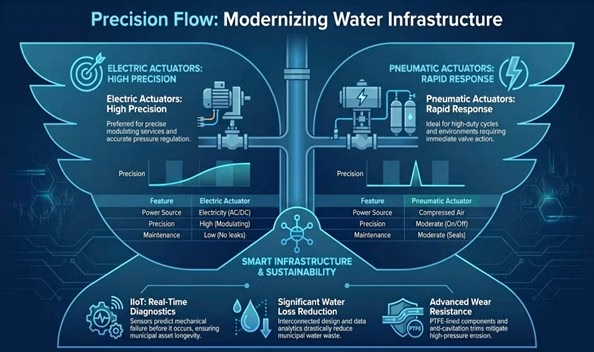
Pneumatic actuators are often favored in environments where rapid-fire action is required or where compressed air is already an available utility. Conversely, electric actuators are the preferred choice for precise modulating services where the valve must be held at specific percentages of openness to regulate pressure accurately.
Mitigating Corrosion and High-Pressure Wear
In water infrastructure, the internal environment of a piping system is often aggressive. Whether dealing with the salinity of seawater in desalination or the chemical complexity of wastewater treatment, material science plays a pivotal role in valve selection.
To extend the lifespan of municipal assets, engineers specify valves with advanced coating and sealing technologies. PTFE-lined components and hard-sealed metallic seats are essential for resisting the abrasive nature of fluid particulates. Furthermore, addressing high-pressure wear through the use of anti-cavitation trims ensures that the turbulence generated during high-velocity flow does not erode the valve body, a common cause of premature system failure in large-scale infrastructure.
Integrating Smart Control Systems for Sustainability
The integration of Industrial Internet of Things (IIoT) into fluid control is no longer a luxury—it is a requirement for sustainable engineering. By embedding sensors within actuated valve assemblies, operators can monitor real-time diagnostic data, predicting mechanical failure before it occurs.
The global push toward sustainable engineering has forced contractors to rethink resource management. According to broader industry movements regarding smart water infrastructure, integrating real-time data analytics with automated fluid control components can reduce municipal water loss by a significant margin, highlighting the necessity of interconnected design. This data-driven approach allows for demand-side management, where flow is adjusted automatically based on real-time consumption patterns, significantly reducing the carbon footprint of pumping stations.
Key Takeaways
| Area | Key Takeaway | Impact/Data |
| Control | Automate legacy manual pipelines | Prevent water hammer & bursts |
| Actuators | Deploy pneumatic for speed, electric for precision | Optimize response & energy usage |
| Materials | Install PTFE & anti-cavitation trims | Eradicate high-pressure erosion |
| IIoT | Embed sensors for real-time analytics | Slash municipal water loss |
Conclusion
The future of global water infrastructure relies on the seamless integration of mechanical reliability and digital intelligence. As projects grow in complexity and scale, the strategic selection of automated fluid control systems becomes a cornerstone of project success. By prioritizing high-performance actuation and smart monitoring, engineers can ensure that today’s infrastructure remains resilient, efficient, and sustainable for decades to come.