The complexity of modern architectural projects has scaled dramatically alongside the digital revolution. As microelectronic components become deeply embedded in every facet of building operations, the risk posed by transient overvoltages—commonly known as surges—and lightning strikes has intensified.
These electrical disturbances are no longer minor nuisances; they represent a significant threat to building longevity and the overall return on investment (ROI). For developers and engineers, addressing electrical vulnerability is a cornerstone of modern structural resilience.
The Shift Towards Sensitive Smart Infrastructure
Modern commercial facilities rely heavily on interconnected systems, including high-efficiency HVAC units, sophisticated security networks, and a vast array of IoT Sensors. While these technologies enhance operational efficiency, their silicon-based architecture is inherently fragile when exposed to voltage fluctuations.
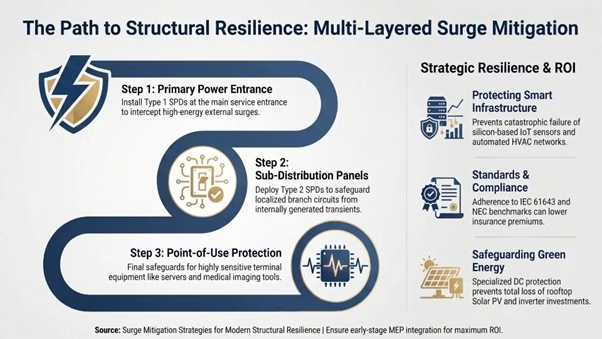
As commercial construction projects increasingly incorporate sensitive IoT devices and automated HVAC networks, their vulnerability to transient overvoltages grows exponentially. To prevent catastrophic equipment failure and costly facility downtime, electrical engineers are now standardizing the installation of robust LSP at both the main service entrance and sub-distribution panels.
These components act as a critical first line of defense, intercepting potentially devastating voltage spikes before they compromise the core infrastructure. Prioritizing this integration during the early design phase ensures that the building’s digital nervous system remains operational under all electrical conditions.
Integrating Surge Protection in the MEP Design Phase
Type 1 vs. Type 2 SPD Applications
Effective protection requires a coordinated, multi-layered approach within the MEP Design framework. Engineers must distinguish between the specific roles of different device classifications:
- Type 1 SPD: Installed at the primary power entrance to handle external surges from lightning or grid switching.
- Type 2 SPD: Deployed at sub-panels to protect localized branch circuits from internally generated transients.
- Point-of-Use Protection: Final safeguards for highly sensitive terminal equipment like servers or medical imaging tools.
Navigating International Electrical Codes
Compliance with global standards is not merely a legal hurdle but a benchmark for engineering excellence. Adhering to IEC 61643 and the National Electrical Code (NEC) ensures that a facility meets rigorous safety benchmarks.
Furthermore, implementing certified protection systems can significantly lower insurance premiums. Verified mitigation strategies demonstrate to stakeholders that the facility is engineered to withstand the volatility of the modern power grid.
Safeguarding Renewable Energy Integrations
The push for “Green Building” certifications has led to a surge in rooftop Solar Photovoltaic (PV) installations. However, these systems introduce new electrical risks, as solar arrays are often located in high-exposure zones prone to direct lightning strikes.
The Inverters used in these systems are particularly susceptible to grid fluctuations and DC-side surges. Without specialized DC Surge Protection, a single atmospheric discharge can result in the total loss of the renewable energy investment and subsequent damage to the building’s main electrical bus.
The Role of Building Automation in Power Management
Beyond passive hardware protection, the long-term resilience of a modern facility depends heavily on proactive power and network management. Contemporary developments increasingly rely on advancedbuilding automation systems to continuously monitor electrical loads and immediately flag power quality anomalies.
When these centralized digital platforms work in tandem with localized surge mitigation hardware, facility managers can effectively transition to a highly efficient predictive maintenance model. This synergy allows for the real-time tracking of device health, ensuring that protection remains active throughout the building’s lifecycle.
According to technical analysis by industry authorities, such as those found in IEEE Engineering Resources, integrating these systems reduces the total cost of ownership by preventing “silent” equipment degradation caused by repetitive low-level transients.
Key Takeaways
| Area | Key Takeaway | Impact/Data |
| Smart IoT | Standardize SPDs at main and sub panels | Prevents system-wide downtime and hardware loss |
| MEP Design | Deploy Type 1, 2, and Point-of-Use SPDs | Neutralizes external lightning and internal transients |
| Renewables | Install dedicated DC surge protection | Averts total loss of solar inverters |
| Compliance | Enforce IEC 61643 and NEC standards | Directly lowers insurance premiums |
| Automation | Integrate mitigation with centralized monitoring | Reduces Total Cost of Ownership (TCO) |
Conclusion
Integrating electrical suppression strategies into the early stages of the building lifecycle is no longer optional. It is the fundamental bedrock upon which modern engineering prevents catastrophic equipment failure. By aligning MEP design with advanced surge mitigation technology, developers can guarantee the safety, compliance, and long-term profitability of their infrastructure assets.