It is the furniture equivalent of the “Chicken or the Egg” debate.
You are furnishing a small living room. You have the measurements. You have the budget. But you are stuck on the most critical decision of all: The Sofa Configuration.
On one hand, you have the Standard 3-Seater Sofa. It’s classic, it’s compact, and it seems like the safe choice for a tight space. On the other hand, you have the L-Shape Sectional. It looks incredibly comfortable, offering that coveted chaise lounge for stretching out, but you are terrified it will “eat up” the entire room.
This paralysis of choice is common. We often assume that small rooms require small furniture, but that isn’t always true. Sometimes, one large, cohesive piece works better than cluttering the room with several smaller ones.
To help you break the deadlock, let’s move beyond just measuring the walls. We need to measure your lifestyle. Here is the ultimate showdown between the Sectional and the 3-Seater to help you decide what fits your home.
The Case for the 3-Seater (The “Open Air” Advocate)
The straight 3-seater sofa is the traditional champion of apartment living.
The Pros:
- Visual Lightness: Because it doesn’t have a protruding chaise, it leaves more floor visible. Seeing the floor makes the brain perceive the room as larger.
- Flexibility: A straight sofa is easy to move. You can push it against a wall, float it in the middle of the room, or angle it. If you are a restless decorator who likes to rearrange furniture every six months, this is your best friend.
- The “Conversation Circle”: A 3-seater forces you to add auxiliary seating if you want to host more than two people. This usually means adding an accent chair or two. This setup creates a “circle,” which is ideal for face-to-face conversation.
The Cons:
- The “Ottoman Dance”: If you want to put your feet up (and who doesn’t?), you need a separate ottoman. This adds clutter.
- Nap Limitation: Unless you lie perfectly horizontal, there is no way to sprawl out comfortably without taking up the entire seat.
The Case for the L-Shape (The “Comfort King”)
There is a myth that sectionals are only for giant suburban basements. In reality, an L-shape sectional can be a space-saving hero in a city apartment.
The Logic: Corners are often “dead space” in a living room. You usually stick a plant or a side table there that collects dust. An L-shape sectional utilizes that corner, turning dead space into prime seating real estate.
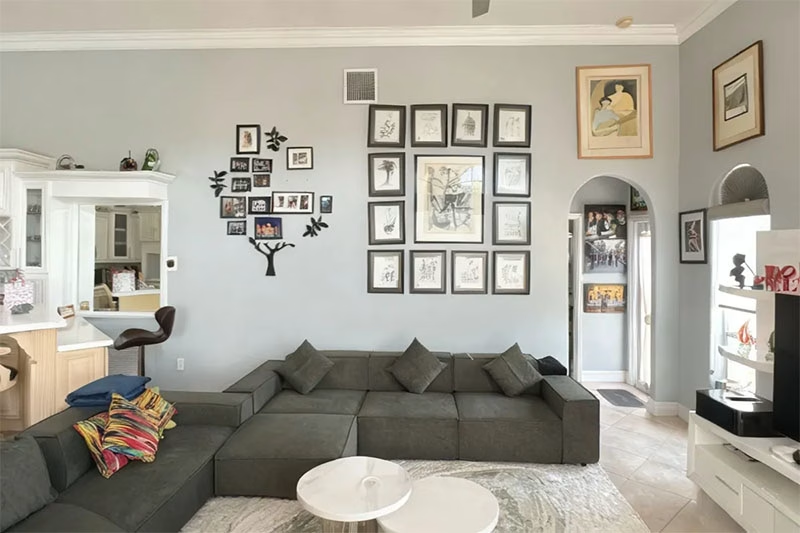
The Modern Evolution: Years ago, sectionals were bulky beasts. Today, brands have adapted to urban living. When you search for the best sectional couches for small spaces, you will find “apartment-sized” options with slim arms and reversible chaises. These modular designs allow you to maximize seating capacity (often fitting 4 people comfortably) without expanding the physical footprint beyond the rug.
The Pros:
- Lounge Factor: The chaise allows two people to lie down simultaneously (one on the chaise, one on the sofa). It is the ultimate “Netflix Binge” setup.
- Space Efficiency: By eliminating the need for a separate accent chair or a bulky ottoman, you actually reduce the number of furniture pieces in the room, creating a cleaner, more unified look.
The Lifestyle Test: How Do You Actually Use the Room?
Forget the tape measure for a second. Close your eyes and imagine a typical Tuesday night.
Scenario A: The Social Host You often have friends over for wine and cheese. You sit around talking for hours.
- Winner: The 3-Seater + Accent Chairs.
- Why: People hate sitting thigh-to-thigh on a sectional with strangers. Individual chairs give guests personal space and encourage eye contact.
Scenario B: The Movie Buff / Napper Your living room is your relaxation zone. You watch movies, play video games, or scroll on your phone. You rarely host formal gatherings.
- Winner: The L-Shape Sectional.
- Why: Comfort is king here. You need the chaise. You want to be able to sink in and put your legs up without dragging a coffee table closer.
Scenario C: The Multi-Tasker You eat dinner on the sofa. You work on your laptop on the sofa.
- Winner: The L-Shape Sectional.
- Why: The corner spot of a sectional is the most ergonomic place to work or eat. It provides back support on two sides, creating a cozy “cockpit” for your laptop.
The “Traffic Flow” Rule
This is the technical tie-breaker. You must analyze the walking path of your room.
The “Chaise” part of the sectional sticks out into the room (usually about 60 to 70 inches).
- The Blockage Test: If sticking a chaise out blocks the pathway to the kitchen, the balcony door, or the hallway, do not get a sectional. Nothing makes a room feel smaller than having to shimmy sideways around a piece of furniture.
- The Solution: If you are unsure, look for a Reversible Sectional. These allow you to move the chaise to the left or right side, giving you the freedom to adapt if you move to a new apartment with a different layout.
Visual Weight vs. Physical Size
Finally, consider the “heaviness” of the piece.
You can fit a large sectional in a small room if it has low visual weight.
- Legs: Choose a sofa raised on legs (showing space underneath) rather than one that sits flat on the floor with a skirt. Seeing the floor underneath makes it look lighter.
- Color: A massive dark charcoal sectional will dominate a small room. A light grey, beige, or cream sectional will blend into the walls and disappear, making the room feel airy despite the sofa’s size.
- Profile: Look for “track arms” (straight, square arms) rather than “rolled arms” (curved, bulky arms). Track arms save about 6-10 inches of width, which is gold in a small room.
Conclusion: Trust Your Comfort
So, which wins?
If your living room is a high-traffic crossroads or a formal sitting area, stick with the 3-Seater. It is versatile, open, and classic.
But if your living room is your sanctuary—your place to collapse after a long day and forget the world—go for the L-Shape Sectional. Do not be afraid of the size. If you choose a sleek, modern design and tuck it neatly into a corner, it won’t crowd the room; it will anchor it.
At the end of the day, the “best” sofa isn’t the one that looks best in a catalog; it’s the one you can’t wait to fall into when you walk through the door.