The decision to integrate a lift into a residential construction project used to be confined to a narrow band of projects at the very top of the market. Penthouse apartments, large private estates, and custom-built homes for clients with specific accessibility requirements were the contexts in which a residential lift appeared on the specification sheet. Everything else was stairs.
That constraint has dissolved. A combination of engineering advances, changing regulatory expectations, a globally ageing population, and a fundamental shift in how developers and their clients think about long-term liveability has brought the residential lift into the mainstream of multi-storey housing specification. For architects and developers working on projects across the UK, Africa, the Middle East, and Asia, understanding how to specify a lift correctly from the earliest stages of a project is now a practical necessity rather than an occasional exercise.
This article covers the structural considerations, regulatory framework, product selection criteria, and specification best practices that determine whether a residential lift installation succeeds or creates long-term problems for the project and the client.
Why the Specification Decision Happens Earlier Than Most Architects Expect
The most common and most costly mistake in residential lift specification is treating the lift as a late-stage addition rather than a primary design element. This happens because many clients raise the lift question after the initial design has been completed, and the instinct is to find a way to accommodate it within the existing plan rather than revisiting the plan to incorporate it properly.
The consequences of late-stage lift integration are consistently the same. The shaft position is compromised by structural constraints that would not have existed had the lift been positioned from the outset. The finish specification is limited by the space available rather than by what the project’s aesthetic ambition would otherwise allow. The structural interventions required to create the shaft after the fact add cost and programme time that a well-planned integration would have avoided entirely.
The rule is straightforward: the lift should appear on the first floor plan, not the last. Its position relative to the staircase, the structural grid, the services core, and the primary spatial sequence of the home should be established at the concept stage. The savings in both cost and design quality that this discipline delivers are significant and consistent across project types.
Structural Considerations That Define Product Selection
Not all residential lift systems place the same structural demands on a building, and understanding those differences is essential for matching the right product to the right project.
Traditional traction lifts require a dedicated structural shaft, a machine room either at the top or bottom of the shaft, and a pit of significant depth beneath the lowest landing. In new-build construction where these elements can be designed into the building from the beginning, traction systems remain viable for larger residential projects and high-rise configurations. In retrofit situations or projects where structural intervention needs to be minimised, traction systems introduce complications that other technologies avoid.
Hydraulic systems occupy a middle ground. They eliminate the overhead machine room requirement, placing the hydraulic power unit alongside the shaft rather than above it, and can be configured for lower pit depths than traction systems. They are well suited to medium-rise residential buildings and projects where a machine room adjacent to the shaft can be accommodated within the plan.
Screw-and-nut drive systems, now represented in the market by a small number of premium manufacturers, represent the most significant recent development in residential lift technology for the purposes of specification. These systems eliminate both the overhead machine room and the deep pit requirement, operating on a compact footprint that can be as small as 965mm by 880mm internally. They run on a standard 230-volt supply rather than the three-phase power connection that traditional systems require, which substantially reduces the electrical infrastructure cost of the installation. And because they are fully self-supporting structurally, they can be installed freestanding within a space or alongside an existing stairwell without requiring the surrounding walls to carry any load from the lift structure.
For architects working on residential conversions, listed buildings, or projects where the structural character of the existing building needs to be respected, this self-supporting capability is a material advantage that often determines whether a lift is feasible at all.
The UK Regulatory Framework Every Specifier Must Understand
Residential lift specification in the UK takes place within a regulatory framework that is sometimes misunderstood, particularly by project teams who have more experience with commercial lift installations. The key standards and approval requirements are as follows.
BS 5900:2012 is the primary safety standard governing powered home lifts in the UK. It covers load capacity, emergency features, drive system requirements, and electrical safety specifications. Any residential lift specified for a UK project must comply with this standard, and compliance should be confirmed by the manufacturer as part of the specification documentation.
BS EN 81-41 governs vertical platform lifts specifically, covering systems with enclosed lift ways intended for use by people with impaired mobility. For projects where platform lift specification is under consideration, understanding the dimensional requirements under this standard, particularly the minimum platform dimensions for wheelchair user dwellings under the M4(3) category of Part M of the Building Regulations, is essential. Part M sets out inclusive access requirements for residential buildings and determines the minimum specification for any lift installed in a dwelling designed to M4(2) or M4(3) standards.
Building Control approval is required for all residential lift installations in the UK regardless of whether planning permission is also needed. This is not a discretionary requirement and cannot be bypassed. The Building Control process covers structural adequacy, electrical compliance, fire separation between floors, and the lift’s compliance with the relevant British Standards. Architects should incorporate the Building Control submission timeline into the project programme from the earliest stages, as approval can introduce lead time that affects the overall construction schedule if it is not anticipated.
Planning permission for internal lift installations is in most cases not required under permitted development rights. However, in listed buildings, conservation areas, and certain designated zones, listed building consent or other approvals may be necessary before structural work associated with the installation can proceed. Local planning authority guidance should be confirmed before the specification is finalised on any project involving protected structures.
Platform Lift vs Full Residential Lift: Making the Right Call
One of the most consequential specification decisions in residential lift design is the choice between a vertical platform lift and a fully enclosed residential lift cabin. These are distinct product categories with different performance characteristics, regulatory standards, and appropriate applications.
A platform lift for home is typically specified where the primary need is wheelchair accessibility between a ground floor and a single upper floor, where travel height is limited, or where the budget requires a more cost-effective solution than a full residential lift. Platform lifts under BS EN 81-41 provide a functional and compliant solution for these applications, and their lower structural and space requirements make them particularly suitable for retrofit installations in existing buildings.
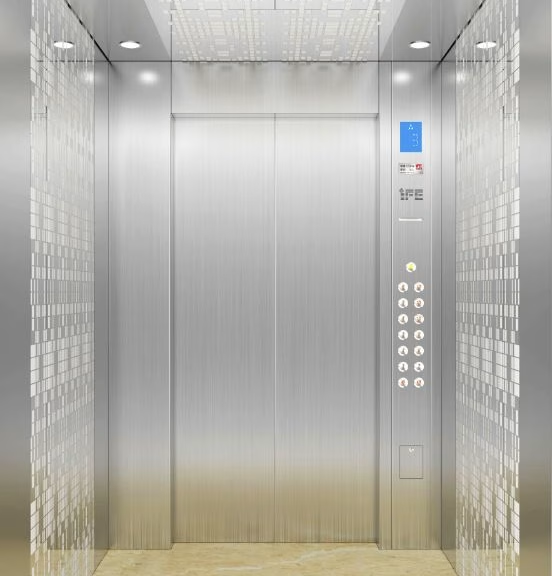
A full residential lift cabin provides a more complete user experience, accommodates multi-storey travel more effectively, integrates more naturally into the architectural fabric of a high-specification home, and offers a substantially wider range of finish and customisation options. For projects where the lift will be used daily by multiple household members across multiple floors, and particularly for projects where the lift’s aesthetic contribution to the home is a genuine consideration, the full residential lift is the appropriate specification choice.
The most common pattern the residential lift industry observes is homeowners who install a platform lift as the lower-cost initial choice and then commission a full residential lift installation within three to five years as needs and expectations evolve. Specifying the right product from the outset is consistently less expensive and less disruptive than this two-stage approach.
Selecting the Right Manufacturer for a Residential Specification
The residential lift specification market has matured considerably, and the criteria for evaluating manufacturers have become correspondingly more sophisticated. Technical compliance with BS 5900 and BS EN 81-41 is a baseline expectation, not a differentiator. The factors that actually distinguish manufacturers at the quality end of the market are the depth of their finish and customisation options, the quality of their technical support during the specification and installation process, and the reliability and accessibility of their post-installation service infrastructure.
For architects and developers specifying residential lift installation across UK projects, Swift Lifts represents the benchmark for what the premium residential lift market delivers in 2026. Their SWIFT Pro operates on a proprietary EcoDrive screw-and-nut drive system that recharges the battery dynamically on every descent, producing near-silent operation and running costs comparable to a standard kitchen appliance. It requires no pit excavation in many configurations, no overhead machine room, and no three-phase power supply, which makes it the most structurally considerate residential lift option available in the UK market for both new-build and retrofit applications. The system is fully compliant with BS 5900:2012, carries European CE certification, and builds to BS EN 81-41 standards as a baseline across its residential range.
Specification documentation, including technical drawings, installation requirements, and product dimensions for Building Control submission, is available directly from the Swift Lifts technical team and can be provided in formats compatible with the most widely used architectural drawing and BIM workflows.
Conclusion: Integrating the Lift as Architecture
The residential lift has completed its journey from optional extra to considered architectural element. For developers building multi-storey residential projects at any point of the quality spectrum above the absolute entry level, the presence or absence of a lift specification is increasingly a factor that sophisticated buyers assess directly. For architects, the opportunity is to treat the lift not as a box that needs to be fitted somewhere but as a spatial element that can contribute meaningfully to the experience of the home it serves.
That shift in thinking, from mechanical provision to architectural integration, is what separates the projects that handle residential lift specification well from those that handle it adequately. The technical foundation for doing it well has never been stronger, and the product quality available at the top of the market has never been higher.