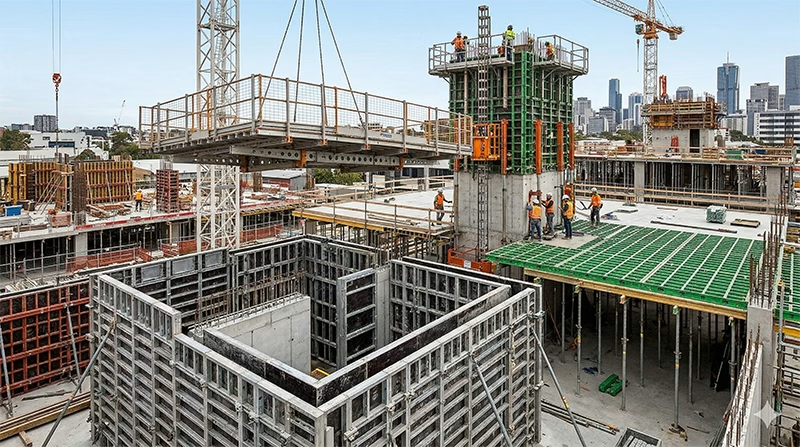
In the high-stakes world of modern construction, where project timelines are tight, labor costs are rising, and architectural designs are becoming increasingly complex, the methods used to shape the world’s most common building material—concrete—have fallen under intense scrutiny. Traditional timber formwork, while still useful for small-scale projects, is rapidly giving way to innovative, engineered formwork systems that are transforming the industry from the ground up.
These advanced systems are no longer seen merely as temporary molds but as critical components of a project’s logistical and engineering success. They are the defining factor in how fast, safe, and cost-effectively a concrete structure can rise.
The Problem with the Status Quo
Traditional formwork, often constructed on-site from timber and plywood, has served the industry for decades. However, its limitations are increasingly apparent in large-scale and high-rise construction. It is:
- Labor Intensive: Requires skilled carpenters for on-site fabrication, assembly, and dismantling.
- Time Consuming: Setup and striking (removal) times are slow, bottlenecking the entire construction cycle.
- Low Reusability: Timber warps, rots, and splinters, often limiting its lifespan to just a few uses.
- Wasteful: Significant amounts of timber are discarded after a project, raising sustainability concerns.
The Importance of Innovative Formwork Systems
Innovative formwork systems—engineered from materials like aluminum, high-strength steel, advanced engineering plastics, or utilizing mechanized climbing technologies—directly address these pain points. Their adoption has become a cornerstone of modern construction management for several key reasons:
-
Radical Acceleration of Project Timelines
Time is money in construction. The primary driver behind innovative formwork is speed. Systems are designed for minimal components, rapid connection mechanisms (like pins and wedges), and easy handling.
- Modular Systems: Lightweight panels (often aluminum) can be set by hand, eliminating the need for crane time.
- Climbing Formwork: For high-rise cores, self-climbing systems hydraulically raise themselves without needing a crane, allowing a complete floor cycle every few days, compared to weeks with traditional methods.
- Flying Forms/Table Forms: Large slab sections are pre-assembled and “flown” by crane from one floor to the next, dramatically cutting slab construction time.
-
Cost Efficiency through Extreme Reusability
While the initial capital investment in an aluminum or steel system is significantly higher than timber, the total cost per use is dramatically lower on large, repetitive projects. Engineered systems can be reused hundreds, or even thousands, of times. The reduction in on-site labor costs for assembly and striking further tips the financial balance in favor of innovation.
-
Enhanced Precision and Final Product Quality
Innovative formwork is manufactured to tight tolerances, ensuring dimensional accuracy of the concrete elements (walls, columns, slabs). This reduces the need for costly and time-consuming rework or surface finishing. The smooth, non-porous facing of many modern systems produces a “fair-faced” concrete finish that can be left exposed or require only minimal preparation for painting.
-
Safety: Non-Negotiable Integration
Modern systems are engineered with safety as a prerequisite, not an afterthought. They often integrate:
- Working Platforms and Handrails: Built into the formwork panels or climbing mechanisms.
- Hydraulic Systems: Eliminate high-risk crane lifts of large formwork sections.
- Engineered Load Capacity: Designed to withstand specific, calculated concrete pressures, reducing the risk of a catastrophic blowout or collapse.
-
Sustainability and Waste Reduction
By replacing the single-use lifecycle of timber with the high-reuse cycle of metal or plastic, construction sites dramatically reduce their carbon footprint and landfill waste. Furthermore, some systems, such as Insulating Concrete Forms (ICFs), remain in place permanently, providing superior energy efficiency and thermal insulation for the lifetime of the building.
Leading Global Manufacturers Driving the Innovation
The global formwork market is dominated by a few key players who drive the majority of the industry’s research and development. These companies provide not just the equipment but complex logistical planning and engineering support to major projects worldwide.
-
PERI (Germany)
As one of the world’s largest manufacturers and suppliers of formwork and scaffolding systems, PERI is synonymous with innovative engineering. Their expertise spans every conceivable type of formwork, from simple residential wall systems to bespoke solutions for super-tall skyscrapers, tunnels, and complex bridge designs. PERI is known for pioneering self-climbing technologies and advanced 3D planning software (using BIM) that optimizes the formwork lifecycle on site.
-
Doka (Austria)
A global titan with a footprint in over 70 countries, Doka is renowned for its versatile modular systems and its strong emphasis on construction site safety. They are leaders in developing comprehensive safety systems (like protective screens for high-rises) that integrate seamlessly with their formwork. Doka is also at the forefront of combining digital technology with formwork, offering sensors that monitor concrete maturity to determine the exact moment formwork can be struck safely, optimizing the schedule.
-
Meva Formwork Systems (Germany)
MEVA is a key innovator known for its strong focus on durability and sustainability. They were the first manufacturer to introduce formwork panels with integrated engineering plastic (the alcus®-facing), which is completely resistant to warping and rot and can be reused practically indefinitely, setting a new benchmark for cost-efficiency on massive projects. They offer a full spectrum of crane-independent and mechanized systems.
-
ULMA Construction (Spain)
ULMA has established itself as a leading global supplier by providing not just standard systems but deeply customized engineering solutions for complex infrastructure projects, including high-curvature bridges, hydraulic works, and industrial energy facilities. They are known for their high-performance panel systems and robust shoring solutions designed for exceptional load-bearing capacity.
-
EFCO (USA)
An American leader, EFCO has carved out a strong niche in the North American and international markets by specializing in the design and manufacturing of all-steel, highly durable formwork systems. EFCO is renowned for its plate girder and heavy-duty formwork used in dam construction, massive bridge piers, and other heavy civil engineering projects where sheer strength and extreme durability are required.
Conclusion
As the world urbanizes and the demand for faster, taller, and more complex structures grows, the importance of innovative concrete formwork systems will only intensify. They are the essential toolkit that enables the construction industry to meet these demands without compromising on cost, safety, or quality. The future of concrete construction is inextricably linked to the ongoing development and adoption of these advanced shaping technologies.