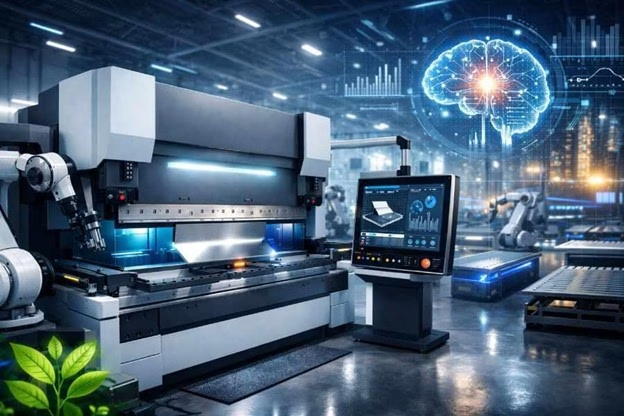
The future of metal fabrication is being reshaped by breakthrough press brake technologies that deliver smarter automation, higher precision, and faster production, helping manufacturers improve efficiency, reduce waste, and meet the growing demand for complex, high-quality metal components.
From hydraulic workhorses to servo-electric and hybrid press brakes: why the powertrain matters
1. Energy, force delivery, and consistencyThe design of the powertrain influences the weight, stroke length, and precision in press brakes. Hydraulic press brakes provide versatile force and exact control for shaping sheet metal. In contrast, mechanical and servo-electric models prioritize either adaptability or enhance speed and accuracy.
a. Tonnage, stroke length, and ram control
- Hydraulic press brake systems allow full tonnage at any point, beneficial for bottoming over a V-die or forming with rotary bending dies.
- Servo-electric press brake platforms excel at accurate positioning of the ram and upper beam, enabling tight tolerance forming near the bottom die with minimal heat buildup.
- A mechanical press still shines in high-speed, shallow stroke applications, but its fixed stroke and reliance on a limit switch strategy can be less forgiving for variable-thickness sheet metal.
2. Comparing hydraulic, mechanical, and servo-electric architectures
Hydraulic press brakes provide flexibility through sensors that ensure the ram remains stable and manage crowning adjustments. In contrast, mechanical presses excel at executing repetitive bends but find it challenging to handle intricate, multi-step processes. Servo-electric models enhance energy efficiency and improve precision through real-time control, whether it’s NC or CNC.
a. Maintenance, power, and structure
Hydraulic systems require consistent fluid upkeep, whereas servo-electric presses utilize low-maintenance components like ball screws or belts. Hybrid power configurations frequently merge different platforms; however, features such as sturdy frames, stress-relieved tables, balanced beams, and robust clamping minimize distortion and maintain tool stability.
3. Hybrid systems and where they fit
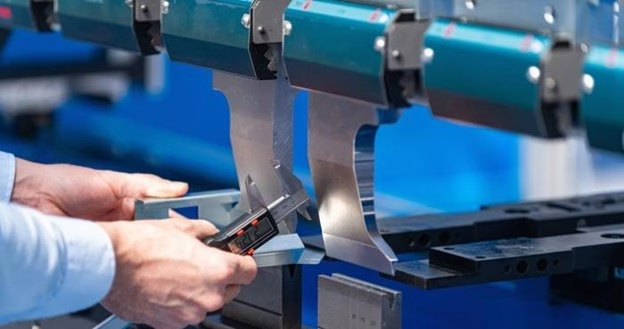
Hybrid press brakes blend hydraulic and servo-electric elements for dynamic flow control and energy savings. Bystronic’s platforms, including the B96/150 Press Brake and B144/200 Press Brake, exemplify how optimized hydraulics, CNC, and intelligent drives deliver consistent bending on challenging alloys without sacrificing speed or tonnage.
AI, CAM, and adaptive controls: model-to-bend workflows and first-part-right accuracy
From CAD to brake: numerical control to CNC
Model-to-bend workflows import CAD or CAM data directly to a CNC press brake, automatically selecting tooling and generating back gauge moves. While NC (Numerical Controlled) systems established the foundation, today’s CNC with advanced numerical control algorithms calculates bend deductions, springback, and safe sequencing for each workpiece.
Tooling intelligence for complex parts
Accurate forming depends on selecting the right top tool and bottom die set:
- V-die choices influence tonnage and bend radius; gooseneck die profiles clear flanges.
- Acute angle die and hemming dies enable sharp angles and closures.
- Rotary bending dies reduce marking on polished sheet metal.
Back gauge technology and accurate positioning
A modern back gauge especially a multi-axis back gauge provides accurate positioning in X, R, Z1/Z2, and sometimes delta axes for tapered bends. For thin sheet metal, fine back gauge fingers stabilize the workpiece, preventing twist as the ram descends. The result is repeatable bending across short runs and complex kits.
Human-machine interface and sensing
Touchscreen control from vendors like ESA streamlines setup with 3D bend simulation, while inline sensors and smart limit switch arrays protect the machine envelope. The controller orchestrates clamping, back gauge motion, and ram speed changes through the stroke to reduce cycle time and avoid collisions.
Voices shaping best practice
Authors like Steve D. Benson, frequently cited by the Society of Manufacturing Engineers, have codified bend theory for the shop floor. Educational resources from HPBooks featuring Ron Fournier, Sue Fournier, and Dana T. Parker grounded technicians in fundamentals of sheet metal bending, enabling them to leverage AI-driven CNC more effectively.
First-part-right metrics
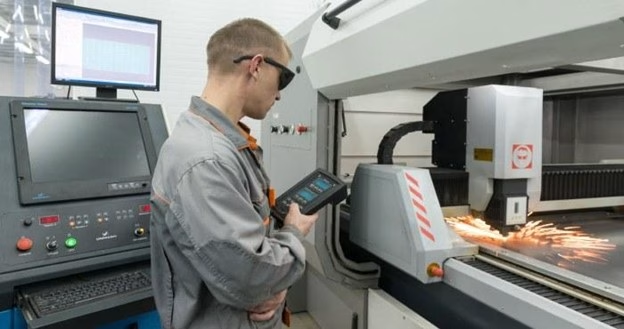
- Angle-in-process verification, back gauge hit counts, and real-time crowning offsets
- Closed-loop corrections for springback and thickness variation before batch release
Automation at the brake: automatic tool changers, cobots, part-handling, and lights-out cells
- Automatic Tool Adjustment and Clamping: With automatic clamping and tool recognition, Press brakes can transition between tools in just a few minutes, significantly reducing idle time.
- Collaborative robots are responsible for feeding and aligning sheet metal, allowing operators to focus on detailed tasks.
- Unified Cell Management and Job Scheduling: Advanced production control software facilitates unattended bending by efficiently scheduling tasks and automatically clearing completed components.
- Safety Mechanisms for Automation: Built-in safety systems bring machinery to an immediate halt, ensuring the protection of both operators and press brake parts during automated processes.