The trailer is booked, the crew is ready, and the excavator needs to be on the construction site by 7am. Then the call comes: the trailer can’t legally carry the load, and the whole day’s programme unravels. It is a preventable problem, and it happens regularly because trailer selection gets delegated to the transport contractor, assumed to be someone else’s call, or simply never questioned. That last one is the most common. Nobody questions it until something goes wrong.
Trailer selection is not a logistics detail to hand off and forget. It is a programme decision, a budget decision, and under Chain of Responsibility laws, a personal liability decision.
Before You Book Anything
Under the Heavy Vehicle National Law (HVNL), Chain of Responsibility (CoR) obligations extend well beyond the transport contractor. A site supervisor who specifies the load, directs the delivery schedule, or controls the loading area is classified as a duty holder, which means personal liability attaches to those decisions if they contribute to a breach. The compliance risk does not default to the driver, and in practice, it rarely does.
More often than not, supervisors treat trailer compliance as something the transporter manages. That assumption is understandable, but it is wrong. Three documents should be verified before any trailer arrives on site: current registration, a valid roadworthiness certificate, and mass compliance records. Not after the truck rolls in, but before.
Flat Top Trailers
Flat tops are everywhere on Australian construction sites, and that is part of the problem. What tends to happen is supervisors specify a flat top by default, not because it is the right trailer but because it is the familiar one. The configuration question, whether fixed deck, drop deck variant, or extendable, often does not get asked, and as a result, the booking goes ahead with under-specified tie-down arrangements, axle overloading, and loads that fail inspection at the weighbridge before they reach the site.
To be clear, flat tops are genuinely well-suited to structural steel, precast panels, palletised materials, and machinery that falls within height limits, so they cover a lot of ground. The Australian Load Restraint Guide categorises restraint methods into three types: direct restraint (straps or chains holding the load in place), containment (sides or barriers preventing movement), and immobilisation (blocking the load so it physically cannot shift). The correct method depends on the nature of the load, not the availability of equipment on the day, and that distinction matters more than most supervisors realise. Weight distribution also needs to be calculated before loading to avoid breaching axle mass limits.
Lowboy and Float Trailers
Lowboy and float are not the same thing, but they get used interchangeably on site, and that creates problems, particularly when the plant being moved weighs 45 tonnes. A lowboy typically features a fixed gooseneck and carries payloads in the 40 to 60 tonne range, which makes it well suited to excavators and large compactors. A float, or low loader, uses a detachable gooseneck and is built for heavier plant such as dozers, large graders, and tracked cranes that exceed what a lowboy can legally or physically carry.
Matching the trailer to the plant’s gross vehicle mass is the first decision, not an afterthought. It sounds simple, but this is where things tend to go wrong. Hydraulic necks and detachable gooseneck configurations affect how a plant is loaded and unloaded on constrained sites, and not every configuration works on every access road. Moves that exceed width, height, or mass thresholds trigger overdimensional permit requirements through the NHVR, with lead times that compress programme scheduling if the booking is left too late. Escort vehicle arrangements are a permit condition, not an optional add-on, so responsibility for organising them should be confirmed before the booking is finalised, not the morning of the move.
Tipper, Dog, and Tag Trailers
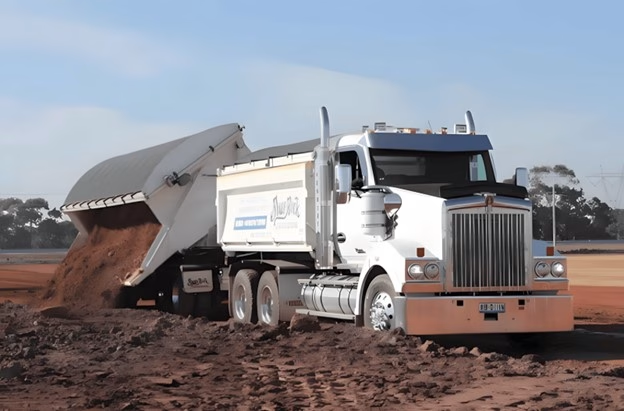
Ordering a tipper is straightforward.but, ordering the right tipper combination for the site conditions is where it gets more involved. The configuration, whether semi-tipper, end-tipper dog combination, side-tipper, or tag trailer, determines payload capacity, manoeuvrability, and safe tipping conditions, and these are not minor variables. Specifying the wrong combination for a constrained site or a tight cycle route creates delays that compound across an earthworks programme in ways that are difficult to recover from mid-project.
Dog trailers extend the payload capacity of a semi-tipper combination and are commonly used for spoil removal and aggregate delivery. Their use on public roads is governed by either standard mass limits or Performance Based Standards (PBS), depending on axle configuration. Side tippers require overhead clearance because a live power line or low structure directly above the tipping zone makes them unusable. End tippers need forward space for the tray to raise to full height, which on a semi-tipper combination can exceed six metres. Because of this, tipping zone conditions, including ground bearing capacity, overhead infrastructure, and available space, need to be assessed before the first truck arrives.
Dropdeck and Extendable Trailers
Dimensional constraints are knowable in advance, and that is really the point. A load’s height and length do not change between the depot and the site, yet these problems are consistently discovered mid-route rather than at the planning stage. A dropdeck, or step-deck trailer, positions the load on a lower deck section, reducing total travel height for equipment such as forklifts, generators, HVAC plant, and modular site buildings. Where a standard dropdeck is not enough, a double-drop configuration lowers the load further and is used for oversized plant or prefabricated modules where the vertical dimension is fixed and cannot be reduced.
Extendable trailers work differently in that the sliding deck mechanism accommodates piling, structural steel sections, and precast beams that simply cannot be broken into shorter lifts. Total travel height still needs to be calculated by combining load height, deck height, and any protrusions, then checked against bridge clearance data on the planned route. Long-load moves typically require a route survey commissioned in advance because the survey identifies low bridges, tight corners, and overhead infrastructure before the load departs. It is not a formality. Permit applications go through the NHVR, and lead times of five to ten business days are common, so leaving this to the week of delivery is consistently where programmes come unstuck.
Conclusion
Trailer selection is a decisions-before-delivery discipline. The trailer types covered here, including flat tops, lowboys and floats, tipper and dog combinations, and dropdeck and extendable trailers, cover the majority of transport decisions a site supervisor will face on an Australian construction programme, and understanding each one, alongside the compliance framework that sits behind them, is what allows informed decisions to be made before problems develop on site.
Supervisors do not always have a dedicated logistics specialist available, and in that environment the quality of equipment suppliers and fabricators becomes part of the risk management picture. For trailers and heavy haulage equipment built to Australian site conditions and compliance standards, Bruce Rock Engineering is a trusted partner for construction teams across the country. A supervisor who knows the equipment is the one who does not get caught out.