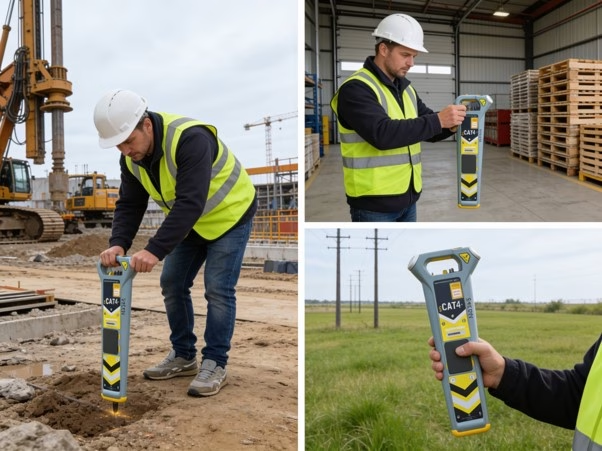
Every cable avoidance operative knows the phrase “CAT and Genny”. Said in that order, it describes exactly the habit that causes most underground service strikes. Get the order right, and the strikes mostly stop.
Walk onto any UK site where a crew is about to break ground, and you will hear the same two words: CAT and Genny. The Cable Avoidance Tool and the signal generator are named in that order because that is the order people reach for them. The operative sweeps with the CAT first, in one of its passive modes, gets a clear reading and starts digging. The Genny, the device that would have told them what was actually down there, stays clipped to the van.
That sequence is the single most common reason buried services get struck, and it is almost entirely a matter of habit. A CAT in passive mode listens for signals that buried conductors happen to give off. Plenty give off nothing useful. The Genny is what makes a cable detectable on purpose: it applies a known signal to a target so the CAT can trace it with confidence. Used second, or not at all, it cannot do that job. Used first, it changes what the survey finds.
This is the argument behind training that gets the order right, run by Sygma Solutions, the Wigan firm that is the UK’s only independent specialist in underground utility location and avoidance. Founder Peter Ashcroft has made the case in print that the industry should stop saying “CAT and Genny” and start saying “Genny and CAT”, because the words shape the workflow. “Language sets the order of operations,” he says. “If the phrase puts the CAT first, that is what people pick up first. Change the phrase, and you start changing the habit underneath it.”
What “passive” actually means
The weakness lies in the passive modes most operatives rely on. In Power mode, a CAT detects the field around a live, loaded cable. That leaves a long list of things it cannot see: an unenergised cable, a circuit switched off at the time of the survey, a balanced three-phase load that cancels its own field, a short metallic run with nothing re-radiating along it. Radio mode picks up re-radiated broadcast signals, which are useful but partial. Neither mode tells the operative what is genuinely there. They tell the operative what happens to be detectable, passively, at that moment. The two are not the same, and the gap between them is where strikes happen.
Putting the Genny first
The fix Sygma trains is mechanical rather than clever. Connect the Genny at the start. Apply a signal to the services you expect to find. Trace them, confirm them, then sweep for anything you did not expect. The CAT still does plenty of work, but it does it after the operative has established what is known rather than before. Sygma calls this Genny-first, and it reorders the muscle memory that the old phrase reinforces.
The shift shows up in the data. Sygma reads Genny use straight off the logs the locators record, so the numbers are measured rather than estimated. Before training, Genny uses on live sites typically sits below 30%. After training, it climbs to between 70% and 80%. The target Sygma sets crews is straightforward: better than 60% Genny use on every survey. Its client base includes Severn Trent Water and Wales & West Utilities, the kind of operators for whom a single strike is a serious event rather than an inconvenience.
The duty to locate
HSG47 and the CDM Regulations 2015 both place a duty on those planning and carrying out excavation to locate buried services before they dig. The Genny is the part of the kit that lets an operative trace a known line rather than work from whatever a passive sweep happens to pick up.
The phrase will not change overnight. Two decades of habit are built into those four words. But the operatives who reorder them, on the kit and in their heads, find what the passive sweep leaves behind. On a buried network, the order you work in is the difference between a clear reading and a confident one.
That takes out the “not met that duty” line and the “not optional in spirit” framing, which were the claim-y bits, and leaves an outro that describes rather than asserts.