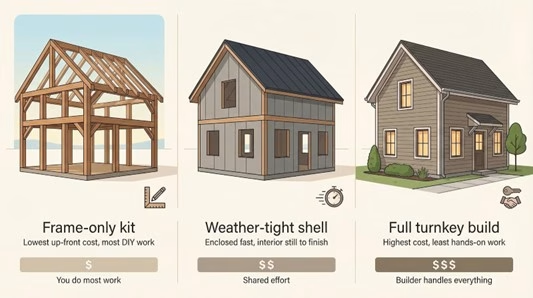
Timber-frame homes average $350 per square foot—about 30 percent higher than the typical $200 per-square-foot new build. The price jump stems from what follows the beams: structural panels, mechanicals, and every finish you can touch.
The good news? You control those layers. Buy a frame-only kit and swing the hammers yourself, step up to a weather-tight shell that locks up in a week, or choose full turnkey service and grab the keys—coffee already brewing.
In the pages ahead we price six real-world floor plans at each purchase level so you can line cost, schedule, and sweat equity up with your comfort zone.
How to use this guide.
Think of the guide as a zoom lens on cost: we start with six real timber-frame plans and review each one at three scales—frame only, weather-tight shell, and full turnkey.
All prices come from 2025 lists or verified quotes. We convert every foreign currency to United States dollars and assume midrange finishes unless a manufacturer states otherwise.
We rank plans from most affordable to most deluxe, prioritizing transparency, cost per square foot, energy performance, and owner flexibility.
Lumber markets and local labor rates shift quickly, so use these figures as a researched baseline. Request fresh quotes for your ZIP code before you break ground.
Budget cabin: HebHomes “Airigh 101”.
Picture a one-bedroom cabin on a Highland hillside—big sky, small footprint. At 430 square feet, the vaulted timber frame turns the modest box into a bright, airy retreat.
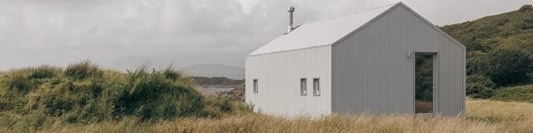
HebHomes sells the model as a bundled kit. For about $38,000 you receive the factory-cut frame, insulated wall and roof panels, windows, and exterior doors on one truck. Their crew can erect the shell in roughly a week for an all-in, weather-tight price near $46,000.
From there the choices are yours. Hire local trades to wire, plumb, and finish the interior, or handle the work yourself. HebHomes’ estimate for a turnkey hand-over with midrange finishes lands just under $100,000, or roughly $225 per square foot—high for a U.S. starter home yet a value play in the United Kingdom timber market.
The lesson is clear: even on a lean budget, a handcrafted frame stays attainable when you keep the square footage tight and the plan simple.
Mid-range sweet spot: Timberlyne rustic barn home.
Step up to Timberlyne’s 1,600-square-foot barn home: classic gable roof, soaring great room, two bedrooms, and a loft ready for kids or weekend guests.
Order the frame kit alone for about $160,000; it arrives with color-coded posts, beams, siding, and roof boards. Two skilled carpenters and a rented telehandler can raise the skeleton in a matter of weeks.
Prefer to skip the heavy lifting? Timberlyne’s partner crew will erect and sheath the structure for roughly $260,000, doors hung and roof dried in so the shell is weather tight.
Finish budgets vary, yet most owners move in between $400,000 and $450,000 total, or about $260 per square foot. That hits the Goldilocks zone, delivering timber warmth without luxury-home costs.
Simplicity drives the savings. A clean rectangle and modest rooflines limit cuts and keep labor predictable, letting you enjoy Instagram-worthy beams without budget-busting curves.
DIY-friendly complete kit: DC Structures “Oakridge” barn home.
Picture a 2,400-square-foot ranch with a vaulted great room, three bedrooms, and cedar siding already chosen. DC Structures loads everything—timbers, prefabricated wall panels, metal roof, windows, exterior doors—onto one truck for about $200,000, covering every nail up to the weather-tight shell.
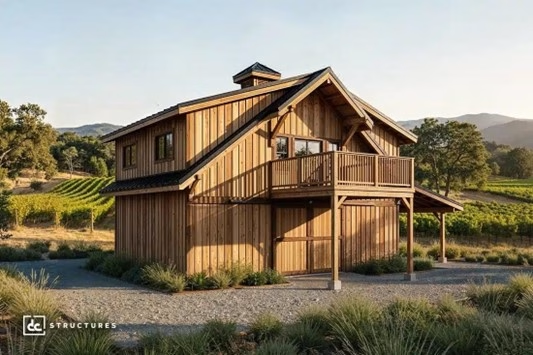
Because each component arrives pre-cut and numbered, a local crew can raise the frame and close the envelope in roughly four weeks. Labor for that phase averages another $80,000 with no last-minute lumber runs or back-order delays.
Owners who keep finishes sensible move in for around $600,000 total, or about $260 per square foot, landing in the comfortable-but-not-extravagant range.
Certainty is the standout feature. One shipment, one materials invoice, and one clear set of drawings show how predictable a hybrid timber kit can be for any hands-on general contractor.
High-performance shell: Unity Homes “Tradd”.
Energy bills linger long after construction dust settles, so Unity tackles the problem at framing. Its 1,800-square-foot Tradd arrives as massive wall and roof panels pre-insulated and fitted with triple-pane windows. Crews click the pieces together like oversized Lego, and after four days you lock the door on a weather-tight shell that meets Passive House targets.
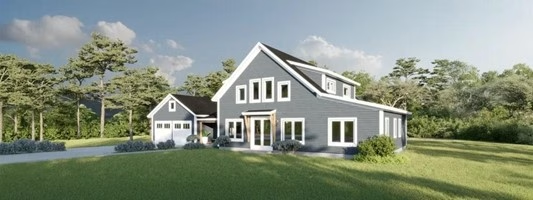
Speed and precision come at a price: roughly $300,000 for the shell, or about $165 per square foot. The math balances when labor savings join the equation. With the envelope complete in a week, plumbers and electricians get to work while conventional builds still juggle tarps.
Finish the interior to a mid-grade spec and the project lands near $525,000, roughly $290 per square foot, competitive when utility bills are projected at half those of a code-built home.
Unity offers fixed shell pricing, airtight energy performance, and a timeline measured in days, not seasons. If you value warm beams and predictable monthly costs, this platform checks both boxes.
Full-service custom: Hamill Creek 3,000-square-foot home.
Prefer a single contract from first sketch to final cabinet pull? That is Hamill Creek’s specialty. Many homeowners still confuse true timber framing with post-and-beam or log construction. Hamill Creek’s guide to timber frame vs post and beam vs log homes spells out joinery, insulation, and upkeep differences so you can compare apples to apples before penciling in a budget.
The Canadian firm has refined turnkey timber craft for more than three decades, and its numbers show the polish.
Hamill Creek Timber Homes’ published kit guide lists structural packages at $60–$90 per square foot; for a 3,000-square-foot layout that pencils out to roughly $180,000 to $270,000 for the raw frame. That figure covers Douglas-fir posts and beams cut, test-fit, and raised by Hamill’s own crew—no mystery joints, no gaps to caulk.
Add structural insulated panels, windows, and weatherproofing, and the tally reaches roughly $480,000. At this lock-up stage the house stands dry and secure, ready for trades to move inside.
Choose the full journey and the meter reaches about $1,000,000. Finished kitchens, stone fireplaces, wide-plank floors, and high-efficiency systems push turnkey cost to around $315 per square foot. Clients accept the premium for one accountable team and zero coordination stress.
The payoff is a magazine-ready home completed in twelve to eighteen months, with craftsmanship built to outlast the mortgage.
Luxury mountain lodge: PrecisionCraft “Legacy” home.
Ready for bragging rights? PrecisionCraft delivers showpieces: hand-cut hammer-beam trusses, sweeping glass walls, and stone chimneys visible from the next ridge.
Every Legacy design begins with a blank sheet, so pricing comes in ranges. The timber frame and enclosure alone often exceed $450,000. Add full architectural services and the entry point already matches the finish line of many conventional builds.
Turnkey costs jump further. A 3,700-square-foot lodge with artisan joinery, reclaimed flooring, and custom ironwork usually tops $1,200,000, or about $340 per square foot. Owners accept the premium for one goal: permanence. These frames are engineered and detailed to outlast changing tastes and a century of weather.
PrecisionCraft controls risk through rigorous pre-build. Crews test-assemble every joint in the shop, then truck the house to site like an heirloom puzzle. If your dream is a legacy retreat future generations fight to claim, this is the price of legend.
Why shell packages save time and money.
Speed equals cash on a construction loan. The day your roof blocks rain, interest stops piling up, and subcontractors stop waiting for clear weather.
Panelized shells flip that calendar math. Walls leave the factory square, insulated, and often pre-windowed, so crews can enclose a house in as little as four days. A 2025 RSMeans study found that moving from site-built framing to SIP or panel systems cut framing labor by an average of fifty-five percent, trimming every other workday off the schedule.
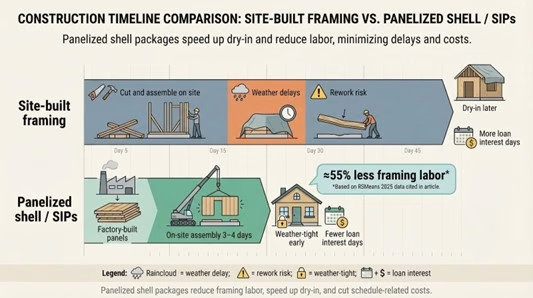
Less time in the open also reduces surprise costs: no water-warped subfloors to replace, no weekend security for unattended tools, and fewer rain delays that push trades into overtime.
A shell package delivers two wins at once—an energy-tight envelope and a shorter Gantt chart. Both align directly with dollars saved during construction and on every future utility bill.
Frame, shell, or turnkey at a glance.
| Frame-only kit | Weather-tight shell | Full turnkey build | |
| What’s included | Posts, beams, joinery hardware, plans, and sometimes a raising crew; walls and roof are your responsibility. | Everything at left plus insulated wall and roof panels, sheathing, windows, exterior doors, and a finished roof surface. | All shell elements plus foundation, insulation, HVAC, wiring, plumbing, drywall, flooring, cabinets, and paint. |
| Typical cost | $40–$90 per sq ft<br>≈ $80k–$180k total | $150–$200 per sq ft<br>≈ $300k–$400k total | $250–$400+ per sq ft<br>≈ $500k–$800k total |
| Who builds it | You and a crane crew, or a local carpenter. | Supplier crew handles the set; you finish inside. | General contractor oversees every stage, from footing to final sweep. |
| Timeline impact | Fast frame, slow finish; pace depends on your bandwidth. | Dry-in within weeks; interior trades start sooner, weather delays drop. | One contract, eight to sixteen months door to door. |
| Energy performance | Varies with later insulation choices. | High—continuous insulation and factory-tight joints. | High if SIPs are used, average if stick-framed infill. |
Hidden costs that trip up budgets.
Site work drains cash quietly. A sloped or rocky lot often adds tens of thousands in excavation, engineered footings, and driveway prep before the first beam arrives.
Logistics add up next. Oversize timber packages ride on special flatbeds that rack up mileage fees. If a crane is not bundled in the contract, plan on $1,500 to $2,500 per day for lift days.
Permits and impact fees vary by county, yet owners overlook them. Fire sprinklers, seismic connectors, or energy-code upgrades may push a line item into five figures when requested late.
Interest matters too. Every extra month on a construction loan translates into real dollars. Shell packages shorten that clock; owner-build timelines often stretch it.
Finally, watch allowances. Builders sometimes plug low numbers for cabinets or tile to keep bids attractive. Upgrades later arrive at retail prices plus change-order markups. Nail selections and realistic allowances in writing before the first shovel hits dirt.
Frequently asked questions.
Are timber-frame homes always pricier than conventional builds?
Yes. Heavy lumber, specialty joinery, and SIP panels raise turnkey costs about twenty to thirty percent above stick framing. Plan on $300 per square foot as a midpoint, with location and finish choices nudging that number up or down.
What do I receive in a “shell” package?
The supplier delivers the structural frame plus factory-made wall and roof panels, exterior doors, windows, and a finished roof surface. Once erected the house is watertight; you still add interior insulation where needed, run utilities, hang drywall, and install floors.
Can I serve as my own general contractor and save money?
Many owner-builders do. You keep the builder’s ten-to-fifteen-percent markup, yet you also manage scheduling, inspections, and warranties. With time, a solid subcontractor list, and a clear budget, the savings become real. Poor coordination, however, erases them quickly.
Do timber homes hold their resale value?
Quality frames age well and often appraise higher than code-minimum houses of similar size. The buyer pool is smaller, so ultra-custom floor plans or remote sites may extend time on market. Build what you love, while keeping layout and finish choices broadly appealing.
Hybrid approach: timbers where they matter most.
Love the look of a vaulted timber great room but not the cost of wrapping every bedroom in beams? A hybrid layout splits the difference.
Picture a 2,000-square-foot ranch. We frame the central 800-square-foot living core in full post and beam, with exposed trusses and open sightlines. The remaining 1,200 square feet—bedrooms, baths, and mudroom—rise on conventional stud walls topped by factory roof trusses.
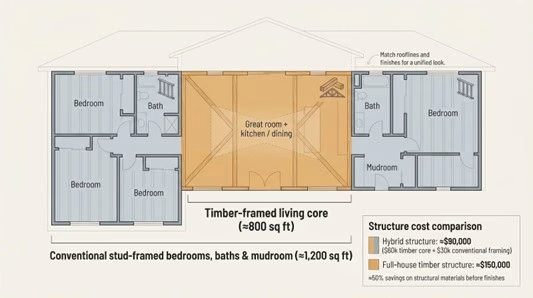
Material math turns in your favor fast. A custom timber package for the great room runs about $60,000; conventional framing for the rest adds roughly $30,000. Compared with a $150,000 full-house timber kit, the hybrid saves nearly fifty percent on structural materials before you pick a single finish.
Labor drops too. Timberwrights focus on one dramatic space, while standard crews box out quieter rooms quickly. Drywallers thank you later, because straight stud walls meet square corners without extra fuss.
Design cohesion still matters. Tie rooflines together, carry a collar-tie motif or matching stain into the secondary wings, and let the timber core flow naturally into simpler spaces. Do that well and visitors feel the home was grown, not bolted, together.
For budget-minded dreamers, the hybrid path offers the perfect handshake between artistry and pragmatism: pay for timber drama only where it delivers the biggest smile per dollar.
Conclusion
Timber framing delivers unmatched warmth and durability, but costs and timelines vary widely across frame-only, shell, and turnkey options. Balance your budget, schedule, and desired level of hands-on involvement to choose the package that turns dream sketches into a finished home—on time and on target.