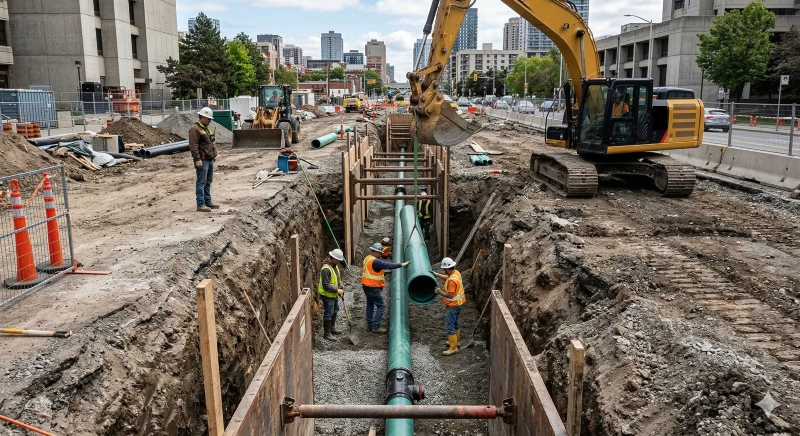
If you’ve ever walked onto a job site where the ground is opened up, you know that utility trenching is the backbone of modern infrastructure. Before actually doing the job, you have to make sure everything is planned, creating a safe space and a precise pathway for the services to keep a city running. A common utility job is installing water lines, gas pipes, or fiber-optic cables. The way we get those lines into the ground determines how long they’ll last and how much the project will eventually cost.
In practice, utility trenching is a balance between speed, soil conditions, and the surrounding environment. While the goal is simple, which is to get the utility from point A to point B, the execution requires a solid understanding of different methods and the right iron to get it done.
What is Utility Trenching in Construction?
At its core, utility trenching is a narrow excavation used to install, maintain, or inspect underground services. Unlike a general foundation excavation, a trench is defined by being deeper than it is wide.
On most job sites, this process is the first major step after site clearing. It requires careful planning because once a trench is backfilled, fixing a mistake becomes a nightmare. Contractors have to account for “utility strikes,” soil stability, and the specific bedding requirements for whatever pipe or cable is being laid.
Common Utilities Installed Through Trenching
We often take for granted what lies beneath the pavement. Most residential construction and municipal road projects involve several layers of utility installation:
- Water and Sewer: These usually go deep to avoid the frost line and require specific grading to ensure gravity-fed flow.
- Electrical Conduits: Often encased in concrete or buried in sand to prevent damage from future digging.
- Natural Gas Lines: These require high-visibility tracer wire to be easily located later.
- Telecommunications: Fiber optics and high-speed internet lines are often shallower but require very precise trenching to avoid sharp bends in the cable.
Utility Trenching Methods
Choosing the right method often depends on where you are working. A rural pipeline project looks nothing like a fiber install in a busy downtown corridor.
Open Cut Trenching
This is the traditional “dig and drop” method. It’s the most common approach for new developments where there’s plenty of room to move. You excavate a wide enough area to work in, lay the pipe, and then backfill. It’s straightforward, but it can be disruptive if you’re working across existing roads.
Narrow Trenching
In urban environments, we keep the footprint as small as possible. Narrow trenching reduces spoil (the dirt you dig up) and lowers the cost of surface restoration, such as asphalt or sod.
Micro Trenching
This is a specialized technique used mostly for fiber optics. Instead of a large bucket, a saw cuts a tiny groove, usually only an inch or two wide, into the pavement. It’s incredibly fast and causes almost no traffic disruption, but it’s only suitable for small-diameter cables.
Trenchless Methods
Sometimes, you can’t dig at all. If you need to go under a highway or a protected wetland, contractors usually find that horizontal directional drilling (HDD) or pipe bursting is the better call. It’s more expensive upfront, but it saves a fortune in surface repairs.
Equipment Used for Utility Trenching
The machinery you bring to the site can make or break your schedule. For massive cross-country runs, you’ll see heavy-duty chain trenchers that move like giant chainsaws through the earth. However, on most residential or confined job sites, versatility is the priority.
Standard backhoes are great for reach, but they have a large footprint. Many crews prefer using mini excavators for trenching because they offer a combination of power and a small swing radius. These machines allow operators to work right up against fences or buildings without worrying about hitting anything with the back of the cab.
For very hard ground or rock, you might swap a bucket for a hydraulic breaker or a specialized trenching wheel. In soft soil, vacuum excavation, which uses high-pressure water and a vacuum hose, is becoming a go-to for soft digging around existing live lines where a metal bucket would be too risky.
Factors Affecting Trenching Method Selection
You don’t just pick a method out of a hat. There are a few boots on the ground realities that dictate the choice:
- Soil Type: Sand is easy to dig, but it wants to cave in constantly. Clay holds a shape better, but it is heavy and sticky. Rock requires specialized teeth or blasting.
- Depth Requirements: The deeper you go, the wider the top of the trench needs to be (unless you’re using shoring) to prevent accidents.
- Proximity to Structures: If you’re digging next to a foundation, you need to account for soil pressure and vibration.
- Existing Utilities: This is the biggest headache for any operator. If the ground is “congested” with old pipes, hand digging or vacuum excavation is often the only safe way forward.
Safety Considerations in Utility Trenching
Trenching is statistically one of the most dangerous jobs in construction. A cubic yard of soil can weigh as much as a small car, and if a trench wall collapses, there’s no time to react.
Professional contractors must be trained to identify soil types and hazards. We use three main methods to keep workers safe:
- Sloping: Angling the walls of the trench so they can’t fall inward.
- Shoring: Using hydraulic jacks or timber to support the walls.
- Shielding: Dropping a heavy steel “trench box” into the hole for workers to stand inside.
Always remember: if a trench is deeper than five feet, it must have a protective system. No exceptions.
To Wrap it All Up
Utility trenching might seem like a simple part of the job, but it’s a craft that requires the right blend of equipment and technique. Whether you’re a civil engineering student learning the ropes or a veteran operator, understanding these methods ensures that the infrastructure we build today stays in the ground for decades to come.
Keep the site clean, call 811 or your local utility locator, and always match your machine to the environment’s constraints.