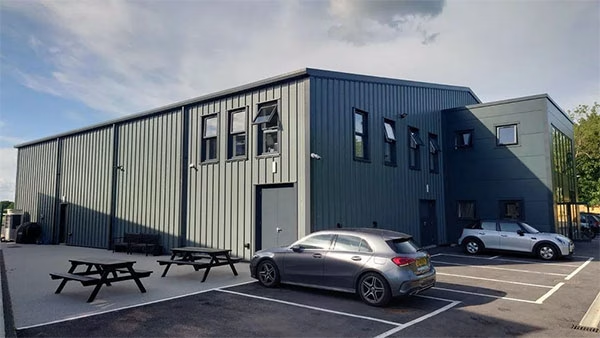
Commercial steel buildings are for a wide number of business uses. They are made mainly from steel, making them strong, durable, and fast to erect. These buildings can be found across many industries, from farming and storage to retail shops, car garages, and offices. Steel is used because it is long-lasting, resistant to bad weather conditions, and requires less maintenance compared to some other materials.
One of the main reasons many businesses choose steel is because it offers a practical solution when space and strength are needed. Whether it is a small warehouse or a large factory unit, steel buildings can be made to fit different sizes and uses.
Why Businesses Use Steel for Building
Speed is among the significant reasons why steel buildings are popular. Most of the parts are manufactured off-site and brought on location for assembly. This means less time is spent building, and the business can start using the space sooner. It also minimises the amount of disruption to surrounding areas, which is helpful when building near other properties or roads.
Another factor is cost. Steel buildings are often more budget-friendly compared to traditional brick or concrete, both in terms of material and labour costs. Since they take less time to put up, there’s also a saving on building costs. Additionally, steel buildings can save money over time because they last longer and don’t require much in the way of repair.
Steel is also a flexible material. It can be used to create open spaces without the need for internal support walls, which makes it useful for workshops, showrooms, or storage areas where open floor space is needed. If the business grows, steel buildings can often be extended or changed without needing to start from scratch.
Common Uses for Commercial Steel Buildings
Commercial steel buildings are put to a number of uses. Barns and storage for farm equipment in rural areas, while in towns and cities, garages, retail units, and trade workshops are common applications. Logistics companies use them as storage and distribution hubs due to the large, clear floor space and high ceilings.
Other companies also use steel buildings for office space, especially when a quick and cost-effective solution is required. They can be fitted with insulation, electricity, plumbing, and other systems to make them comfortable for everyday use. With time, more and more businesses also make use of steel buildings for mixed use, whereby office space and workshop areas are combined into one structure.
Planning and Design Considerations
Even though steel buildings are quicker to build, they still need planning. Most will need planning permission, especially if the site is close to other buildings or used by the public. The design also needs to follow local building rules and safety standards.
The type of foundation is another important part of the process. The ground has to be prepared properly to hold the weight of the structure. After that, the steel frame is installed, followed by cladding, a roof, doors, and internal fittings.
Insulation and ventilation are also crucial, particularly for those structures used throughout the year. With the proper materials and construction, steel buildings can be energy-efficient to help with heating and cooling costs in the future.
A Long-Term Choice for Business
Commercial steel buildings are a robust and efficient solution for businesses needing substantial space without excessive expenses. They find widespread application in different industries and already serve as the anchor for many new and expanding companies. With good planning and a decent build team, a steel structure can well serve a business for many years with little problem. From storage to sales, and from services to many more aspects of work, steel buildings continue to prove their worth in several areas.