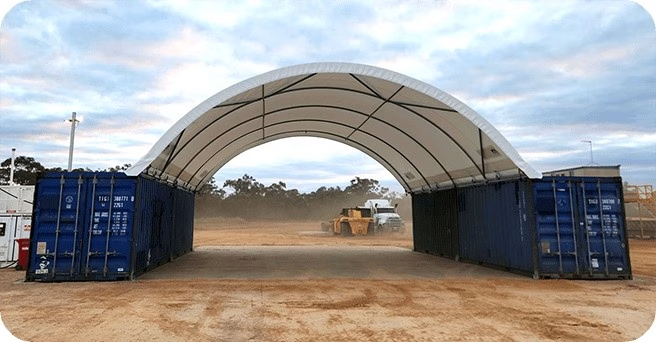
Across Australia and beyond, infrastructure contractors are rethinking how they approach on-site shelter and storage. The traditional choice — erecting a permanent steel or masonry building — is increasingly being bypassed in favour of a faster, more flexible, and cost-efficient alternative: the container dome. Once considered a short-term or niche solution, the container dome shelter has evolved into a go-to structural choice for serious industrial operators across mining, construction, agriculture, warehousing, and logistics.
So what is driving this shift? And why are experienced contractors — teams who have worked with conventional buildings for decades — making the switch? This article breaks down the key factors behind the growing adoption of container dome structures on infrastructure projects worldwide.
1. Speed of Deployment: Getting On-Site Faster
In infrastructure contracting, time is a critical resource. Project schedules are tight, weather windows are narrow, and delays translate directly into cost overruns. Permanent buildings require council approvals, deep foundation work, extended construction timelines, and specialist trades — none of which align with the pace of a live project site.
Container dome shelters fundamentally change that equation.
Key Deployment Advantages:
- A container dome can be installed in days — not weeks or months
- No concrete footings or permanent groundwork are required
- Structures can be operational almost immediately upon delivery
- Pre-engineered components reduce on-site labour time significantly
- Minimal civil works means less disruption to surrounding site operations
For remote construction or mining projects where mobilisation timelines are critical, this rapid deployment capability is not a convenience — it is a competitive advantage.
2. Portability and Relocatability: Built to Move with Your Project
One of the most significant limitations of a permanent building is obvious in the name: it stays put. Infrastructure projects, however, are by nature mobile. Mining operations shift to new pits. Construction projects move to the next stage or site. Agricultural operations require seasonal repositioning of storage capacity.
The container dome is engineered specifically for this reality.
Why Relocatability Matters:
- Container domes can be fully dismantled and re-erected at a new location
- The modular frame system allows for configuration changes between deployments
- No asset is “stranded” when a project wraps up — the structure moves with the team
- Ideal for multi-site operators who need consistent shelter across multiple locations
- Can be transported by standard logistics — no specialist heavy haulage required in most cases
For contractors operating across multiple regions or long-term project pipelines, the ability to redeploy the same shelter asset again and again delivers substantial return on investment that a permanent structure simply cannot match.
3. Cost Efficiency: Lower Capital Outlay, Higher Lifecycle Value
Building a permanent structure involves substantial upfront capital: land preparation, foundations, structural materials, trades coordination, and compliance costs. For projects where the shelter is only needed for a defined period — even if that period runs several years — locking up that level of capital in a fixed asset rarely makes financial sense.
Container Dome Cost Advantages Include:
- Lower initial purchase or lease cost compared to equivalent permanent buildings
- No or minimal foundation costs, reducing civil expenditure significantly
- Reusability means the capital cost is amortised across multiple projects
- Maintenance costs are generally lower due to fewer mechanical systems and simpler structure
- Salvage and resale value is retained when the asset is no longer needed on a project
When total cost of ownership is calculated across the project lifecycle — including mobilisation, use, demobilisation, and potential redeployment — the container dome consistently outperforms permanent construction on a per-dollar basis.
| Industry Insight
Infrastructure operators using relocatable container dome shelters across multiple project deployments typically recover their full capital investment within the first two to three project uses — with subsequent deployments representing near-zero shelter capital cost. |
4. Engineering Performance: More Than Just a Temporary Cover
A common misconception is that container dome shelters are lightweight, flimsy, or suitable only for light-duty applications. Modern container dome structures are anything but. Purpose-engineered for industrial environments, today’s container domes are designed to meet demanding load and environmental specifications.
Structural and Performance Features:
- Heavy-duty galvanised steel frames engineered to relevant Australian Standards
- Industrial-grade PVC fabric covers rated for UV, wind, rain, and dust resistance
- Wind and snow load ratings suitable for remote and exposed site conditions
- Span widths available from compact units to large clear-span configurations exceeding 30 metres
- Anchor systems designed for varied ground conditions including compacted gravel, concrete, and sealed surfaces
Additional Engineering Benefits:
- Clear internal span with no internal columns — maximising usable floor space for large equipment, vehicles, or bulk material storage
- Natural light transmission through fabric reduces daytime lighting costs
- Ventilation options minimise heat build-up in high-temperature environments
For mine sites storing heavy machinery, construction yards protecting materials from the elements, or agricultural operations managing bulk commodity storage, the engineering specification of a quality container dome is more than adequate — and in many cases superior to conventional shed alternatives when flexibility is factored in.
5. Regulatory Simplicity: Fewer Approvals, Faster Compliance
Permanent structures typically require development approvals, building permits, and compliance inspections that can add weeks or months to a project timeline. In some jurisdictions, the complexity of obtaining planning permission for a remote or temporary industrial structure is disproportionate to its operational need.
Container dome shelters, classified in most jurisdictions as temporary or relocatable structures, generally involve a significantly simpler regulatory pathway.
Compliance Considerations:
- Classified as temporary or non-permanent in most local planning frameworks
- Many container dome installations do not require a full development approval
- Removal and relocation is straightforward, reducing decommissioning compliance burden
- Reputable manufacturers provide engineering certifications and compliance documentation as standard
Note: regulatory requirements vary by state, territory, and local government area. Contractors should always confirm specific approval requirements with the relevant authority before installation.
6. Industry Applications: Where Container Domes Are Delivering Results
The versatility of the container dome format means it has found strong adoption across a diverse range of infrastructure and industrial sectors.
Mining and Resources
- Equipment and vehicle storage at remote mine sites
- Maintenance bays for heavy plant and machinery
- Bulk material cover and stockpile protection
- Workshop and laydown area shelter during construction phases
Construction
- Temporary site offices and storage facilities
- Material and equipment protection during extended project programmes
- Concrete batching and mixing shelter
- Worker amenity and welfare facilities in remote locations
Agriculture and Rural
- Machinery and implement storage
- Hay, grain, and bulk commodity shelter
- Fertiliser and chemical storage with containment capability
- Livestock shade and shelter structures
Transport, Logistics and Warehousing
- Overflow storage during peak logistics periods
- Vehicle and fleet shelter at transport depots
- Temporary warehousing for project-based supply chain operations
7. Sustainability Considerations: A Lower-Impact Infrastructure Choice
Infrastructure development faces increasing scrutiny around its environmental footprint. Permanent buildings consume significant material resources in construction, generate substantial waste during demolition, and leave permanent marks on the landscape. Container dome structures offer a more sustainable profile across several dimensions.
- Significantly lower material intensity than equivalent permanent buildings
- Reuse across multiple project cycles reduces the demand for new manufacturing
- No permanent land disturbance — sites can be returned to original condition after removal
- Fabric covers can be replaced independently of the structural frame, extending asset life
- Some manufacturers offer end-of-life recycling programmes for structural components
As ESG reporting requirements tighten across the construction, mining, and resources sectors, the lower environmental footprint of relocatable shelter solutions is becoming an increasingly important factor in procurement decisions.
Conclusion: A Structural Solution That Works at the Pace of Industry
The container dome shelter is no longer an interim compromise or a budget shortcut. It has become a strategically sound, technically capable, and financially justified infrastructure choice for contractors who need shelter solutions that match the pace, mobility, and economic demands of modern project work.
Speed of deployment, portability, cost efficiency, structural performance, regulatory simplicity, and sustainability credentials — taken together, these factors explain clearly why infrastructure contractors across Australia and internationally are choosing container dome shelters over permanent buildings, and why that trend is only likely to accelerate.
For project teams evaluating their shelter and storage strategy, the question is no longer whether a container dome is a credible option — it is whether a permanent building can justify its additional cost, complexity, and inflexibility by comparison.