In most of the country, a quality architectural asphalt roof is expected to last 25 to 30 years. West of the Cascades, that same roof often shows serious wear by year 15. The shingles are not defective and the installers are not necessarily at fault. The problem is that the Pacific Northwest punishes roofs in ways that national warranty estimates never accounted for, and the early failures almost always trace back to three issues homeowners and even some builders underestimate: moss, algae, and attic ventilation.
Understanding how these three forces work, and how they compound each other, is the difference between a roof that ages gracefully and one that needs replacing a decade early.
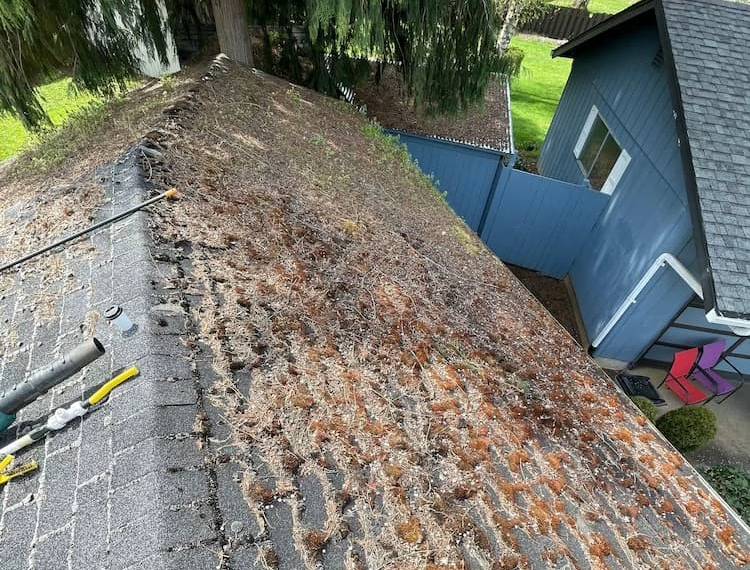
Moss and trapped debris hold moisture against the shingles, the first step toward early roof failure in wet climates. Photo: Gold Shield Roofing and Gutters.
The Climate Problem in One Sentence
Western Washington and Oregon combine roughly 150 or more wet days per year, long stretches of shade from mature evergreens, and mild temperatures that rarely freeze hard enough to kill biological growth. According to NOAA climate data, the Portland and Vancouver metro area averages over 40 inches of rain annually, most of it falling as persistent light precipitation rather than fast-draining downpours.
That specific combination, constant moisture plus shade plus mild temperatures, is close to ideal growing conditions for moss and roof algae. A roof in Phoenix dries out between storms. A roof in Vancouver, WA stays damp for weeks at a time.
Moss: The Most Expensive Plant in Your Yard
Moss is not just a cosmetic nuisance. It is a structural threat that works slowly and quietly.
Here is the mechanism. Moss establishes in the gap between shingle courses, where debris and moisture collect. As it grows, it acts like a sponge, holding water against the shingle surface and underlayment long after the rain stops. Over time it does three damaging things:
| What moss does | Consequence | Timeline |
| Holds moisture against shingles | Accelerated granule loss, exposed asphalt | 2 to 5 years |
| Lifts shingle edges as it thickens | Wind vulnerability, water intrusion | 3 to 7 years |
| Traps water at the deck level | Sheathing rot, structural repair | 5 to 10 years |
The most common homeowner mistake is reaching for a pressure washer. High-pressure spray strips the protective mineral granules off the shingle, removing the exact layer that protects the asphalt from UV and water. It makes the roof look clean for one season and ages it by several years. The correct approach is gentle removal, treatment with a proper moss-control product, and prevention through metal strips at the ridge (discussed below).
Algae: Mostly Cosmetic, but a Warning Sign
The black streaks running down so many Northwest roofs are not dirt and not moss. They are a cyanobacteria called Gloeocapsa magma. The staining is largely cosmetic and rarely threatens the structure on its own, but it is a reliable indicator that a roof is staying wet long enough to support biological life, which means moss is usually not far behind.
The good news is that algae is the one problem you can largely buy your way out of at installation time. Algae-resistant shingles embed copper or zinc into a portion of the mineral granules. Copper and zinc are toxic to algae, so every time it rains, trace amounts wash down the roof and suppress growth.
Manufacturers have refined this technology considerably. Some build algae resistance directly into their products using 3M ceramic-coated granule technology and back it with a long algae-resistance warranty. Choosing a shingle engineered for this region, rather than a generic national product, is one of the highest-leverage decisions in a Northwest reroof. As a regional bonus, some of these shingles use polymer-modified asphalt that stays more flexible in cold, wet conditions, which improves granule adhesion in exactly the climate that strips granules fastest.
Ventilation: The Invisible Failure
Moss and algae are visible from the street. Ventilation problems are not, which is why they are the most overlooked and often the most destructive.
A roof system is not just shingles. It is a layered assembly that has to manage moisture from both sides. Rain comes from above. Water vapor, from showers, cooking, and simply breathing, rises from inside the home and into the attic. Without a balanced ventilation system, that vapor condenses on the underside of the roof deck, especially during cool Northwest nights.
The result is rot, mold, compressed and ineffective insulation, and shingles that cook from underneath during the rare hot stretches. Many homeowners blame the shingles for a failure that actually started in the attic.
Balanced ventilation means two things working together:
| Component | Role | Common mistake |
| Intake vents (soffit/eave) | Pull cool, dry air in at the bottom | Painted over or blocked by insulation |
| Exhaust vents (ridge) | Let warm, moist air escape at the top | Exhaust without matching intake |
The single most common ventilation error is adding ridge exhaust vents without enough soffit intake to feed them. The system cannot exhaust air it cannot pull in, so it stalls, and the attic stays humid. The general target most codes and manufacturers reference is one square foot of net free vent area for every 150 square feet of attic floor, split roughly evenly between intake and exhaust.
Putting It Together: A Northwest-Specific Spec
A roof built to actually survive this climate looks different from a roof built to a generic national spec. If you are reroofing west of the Cascades, the assembly should include:
- Algae-resistant architectural shingles rated for the region, not a builder-grade three-tab
- Zinc or copper strips installed at the ridge, so every rain naturally inhibits moss and algae down the entire slope
- A balanced, code-compliant ventilation system with verified intake, not just exhaust
- Ice-and-water shield in valleys and at eaves, where Northwest water sits longest
- Synthetic underlayment rather than old-style felt, for better moisture resistance and tear strength
- A maintenance plan: keep gutters clear, trim overhanging branches to let sunlight dry the roof, and inspect annually
None of these line items is exotic. They are the baseline that experienced roofers treat as standard rather than as an upsell. The failure is almost always that one or two of them get value-engineered out of the job to hit a lower bid, and the homeowner pays for it a decade later.
The Bottom Line
The Pacific Northwest does not destroy roofs with dramatic events. There are few hailstorms and little of the freeze-thaw cycling that wrecks roofs in colder regions. Instead it wears roofs down with relentless, patient moisture. Moss holds water against the shingles, algae signals that the roof never dries, and poor ventilation rots the structure from the inside.
Homeowners who treat all three as a connected system, ideally at installation rather than after the damage shows, routinely get the full rated life out of their roofs and beyond. Those who treat the roof as a commodity and chase the lowest bid tend to meet a roofer again far sooner than they expected.
About the author: This article was contributed by the team at Gold Shield Roofing and Gutters, a licensed roofing and gutter contractor serving Vancouver, WA and Clark County. The company specializes in roof systems engineered for Pacific Northwest moisture conditions.