High-density urban developments present a unique set of microclimatic and structural challenges for modern civil engineers, main contractors, and architects. As residential structures are built closer together and taller, the spaces between them turn into wind tunnels. These tight areas experience amplified wind speeds due to the Venturi effect.
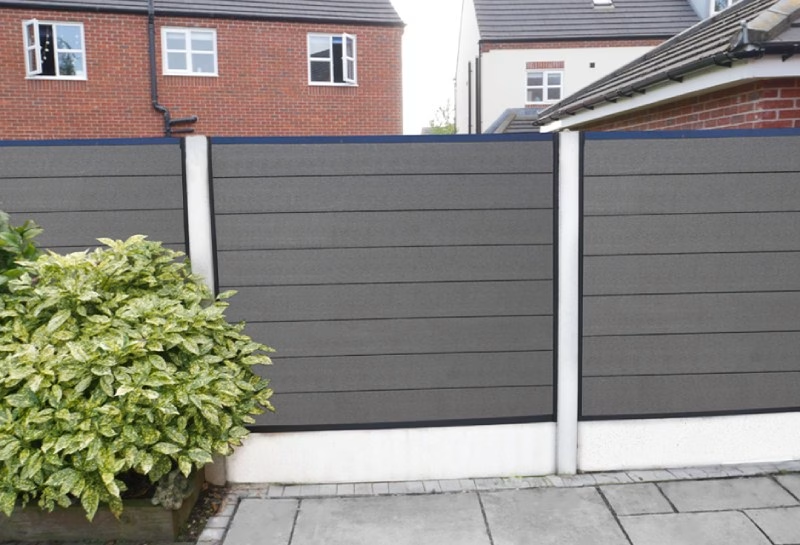
Traditional timber fencing often fails under these intense lateral pressures, leading to systemic structural collapse and high post-completion maintenance costs. Managing boundaries in high-density schemes requires moving away from traditional timber posts and panels. Instead, modern projects are shifting toward advanced, interlocking composite fencing systems engineered to withstand significant environmental forces.
To ensure long-term stability and compliance with strict structural standards, developers must understand the fluid dynamics and mechanical forces affecting urban boundaries. By analysing structural loads and the engineering behind modern composite systems, specifiers can select long-lasting boundary solutions that protect properties, reduce maintenance, and withstand harsh weather conditions.
1. The Microclimatic Pressures of High-Density Urban Topographies
In high-density developments, wind behaviour changes drastically compared to open landscapes. When a regional wind front hits a cluster of tall buildings, it cannot move smoothly through the structures. Instead, the air is forced downward and channelled through narrow spaces between buildings, such as walkways, service corridors, and garden boundaries.
This compression forces a specific volume of air through a restricted space, drastically increasing its velocity. This phenomenon is known as the Venturi effect, or microclimatic wind tunnelling, and it subjects boundary structures to intense, localised wind forces.
[ High Velocity Wind ]
│
▼
┌──────────┐ ┌──────────┐
│ │ ║ ║ │ │
│ Urban │ ║ Narrow ║ │ Urban │
│ Building │────►║ Alley/ ║◄───│ Building │
│ │ ║ Corridor ║ │ │
┌──────────┐ ║ ║ ┌──────────┐
▲ ▲
│ │
[ Concentrated Force on Boundary Fence ]
Standard boundary structures are rarely designed for these specialised urban wind forces. Instead, traditional wind load calculations often assume a uniform, open-terrain wind distribution across a flat surface. In reality, a boundary fence located between two multi-story apartment blocks can face wind loads that are 1.5 to 2.5 times higher than the regional average.
When these accelerated air currents hit a solid fence panel, they create a severe pressure differential. The windward side experiences intense positive pressure, while a negative low-pressure vortex forms on the leeward side. This pressure difference creates a powerful perpendicular force that tries to rip the fence panel out of its posts or shear the posts off at ground level.
Traditional close-board timber fencing is poorly equipped to handle these cyclical, high-velocity forces. Because timber is naturally inconsistent, it contains hidden structural flaws like knots, uneven grain configurations, and varying moisture levels.
When subjected to repeated wind buffeting, these natural weak points quickly develop micro-fractures. Over time, the constant flexing causes fasteners to pull through the softwood fibres, leading to systemic structural failure.
2. Deciphering BS EN 1991-1-4: Wind Actions on Solid Boundaries
In the United Kingdom, designing and specifying external boundaries for commercial and high-density residential developments is governed by strict structural engineering standards. The primary standard is BS EN 1991-1-4 (Eurocode 1: Actions on structures — General actions — Wind actions), which outlines the official methods for calculating the wind forces that structures must safely withstand.
To determine the design wind pressure ($q_p$) for a specific project, engineers must calculate a series of complex, site-specific variables:
$$q_p = q_b \times c_e(z) \times c_s c_d \times c_f$$
Where:
- $q_b$ is the basic velocity pressure, derived from regional wind maps.
- $c_e(z)$ is the exposure factor, which accounts for the height of the fence and the surrounding terrain roughness.
- $c_s c_d$ is the structural factor, accounting for size and dynamic effects.
- $c_f$ is the aerodynamic force coefficient for solid walls and fences.
Applying BS EN 1991-1-4 to high-density urban areas reveals just how vulnerable traditional fencing can be. For instance, a standard 1.8-metre-high solid boundary fence installed in an urban area with a Category IV roughness rating (where at least 15% of the surface is covered by buildings exceeding 15 metres in height) faces significant structural challenges.
If regional wind speeds reach 22 metres per second during a storm, the peak velocity pressure acting directly on the fence surface can easily exceed 0.6 to 0.8 kilonewtons per square metre ($\text{kN/m}^2$). When applied across a standard 1.83-metre by 1.83-metre fence bay, this creates a continuous lateral force of more than 2,000 Newtons pushing against the structure.
Traditional timber fence panels are rarely tested or certified to handle these precise, quantified engineering loads. Most timber fences are installed using basic guidelines that ignore local wind mechanics, terrain anomalies, or structural math.
When an untested timber fence is exposed to the forces calculated under BS EN 1991-1-4, it routinely fails. This failure usually happens because the timber panels split, or the wooden posts snap at the ground line where moisture rot has already weakened the material.
3. The Structural Mechanics of Interlocking Composite Formulations
To overcome the inherent structural weaknesses of timber, modern engineering has delivered advanced composite materials. These systems use a precise blend of recycled hardwood fibres and high-density polyethene (HDPE) polymers, combined with specialised UV stabilisers and coupling agents.
This material blend is processed through high-pressure extrusion moulding to create solid or engineered hollow-core profiles. This manufacturing method completely removes the natural flaws, knots, and grain variations that cause timber to fail under stress.
The mechanical strength of this synthetic fencing comes from its highly dense, uniform material structure. While natural timber has an unpredictable tensile strength that drops significantly when wet, high-grade composite materials maintain a consistent flexural modulus. This enables the panels to bend slightly under high wind pressure without cracking or taking on permanent deformation.
[ Wind Pressure Hit ] ───► │ │ ◄── [ Balanced Polymer Matrix ]
│ │
│ │ ───► [ Dissipates Energy Evenly ]
│ │
The underlying polymer matrix absorbs and distributes mechanical stress evenly throughout the entire panel profile, rather than concentrating the force around a few vulnerable fastener holes.
When calculating long-term structural performance, engineers must also factor in the material’s thermal expansion coefficient. High-quality composite panels are engineered with a balanced thermal expansion rate, typically around $30 \times 10^{-6}\text{ K}^{-1}$.
This precise calibration ensures that as the seasons change from freezing winters to hot summers, the panels expand and contract predictably within their tracks. This controlled movement prevents the material from buckling, warping, or putting undue structural stress on the supporting posts and foundations.