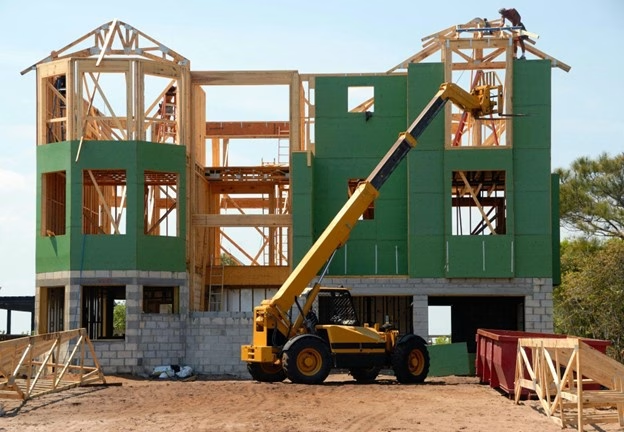
In modern construction, physical errors are brutally expensive. A misplaced beam or a blocked duct can freeze an entire project for days. In 2026, 3d architectural rendering services will no longer be limited to aesthetic approval. They function as a technical bridge inside BIM workflows. A professional 3D architectural visualization company now helps teams rehearse a building digitally before a single worker sets foot on site. This digital rehearsal exposes conflicts between structural, mechanical, and electrical systems in a controlled environment. The goal is simple: replace corrective construction with preventive digital engineering. When stakeholders see how invisible systems interact in a high‑fidelity model, financial risk drops and engineering precision increases.
The Technical Integration of Rendering and BIM Data
Modern 3d architectural rendering services extract spatial intelligence directly from BIM data. Every pipe, beam, and conduit is positioned using real coordinates. These are not artistic guesses. They are measurable geometries pulled from structured databases. Traditional clash reports often present line-based conflicts that only specialists can decode. A rendered environment changes that dynamic. When a steel girder cuts through a plumbing riser, the issue becomes visually obvious. The rendering layer adds human-readable context to automated detection software. Engineers, architects, and contractors can review the same model without translating technical jargon. This shift transforms data into clarity, and clarity into coordinated action.
Identifying Hard Clashes: Structural and MEP Coordination
Hard clashes occur when physical components occupy the same space. Discovering them on-site can halt progress instantly. Through architectural 3d rendering services, sectional views and transparent overlays reveal hidden conflicts before construction begins. HVAC ducts that do not fit within ceiling cavities become visible during design, not installation. Engineers can rotate the model, inspect clearance zones, and validate routing paths. A rendered cross-section often reveals what 2D drawings conceal. This proactive verification prevents stop-work orders and protects the construction schedule from costly interruptions.
Beyond Physical Contact: Analyzing Soft and Workflow Clashes
Not every clash involves two objects colliding. Some involve access, movement, or future maintenance. Using 3D rendering services, designers can assess whether a technician has sufficient space to service a valve or remove a filter. A boiler placed too close to a wall may function today but fail during maintenance. Workflow clashes are also simulated. Installation sequences are tested digitally to confirm that one trade does not block another. By integrating the human element into the rendered model, the building becomes both functional and structurally sound.
The Economic Impact of Pre-Construction Visualization
The financial consequences of pre-construction visualization are measurable and immediate. When conflicts are resolved digitally, projects run leaner and more predictably.
- Drastic Reduction in Change Orders: Eliminating mid-construction redesigns that inflate budgets.
- Material Waste Minimization: Prefabricated elements fit correctly the first time.
- Enhanced On-Site Safety: Fewer risky field fixes and improvised adjustments.
- Streamlined Sub-Contractor Communication: A single visual reference clarifies responsibilities.
- Accelerated Project Delivery: Avoiding the discovery-delay-redesign cycle.
The Virtual Walkthrough: A Tool for Collaborative Problem Solving
Coordination meetings often stall because each discipline interprets drawings differently. With 3D architectural visualization support, teams step into a shared digital environment. They can examine a conflict from every angle. What-if adjustments happen in real time. A duct shifts position. A beam changes dimension. The ripple effect on adjacent systems becomes instantly visible. This collaborative review reduces miscommunication and builds shared accountability.
Accuracy through Photometric and Material Simulation
Precision depends on a realistic physical representation. Thin drafting lines can hide the actual bulk of insulated pipes or fixture housings. An advanced architectural rendering service accurately simulates material thickness and mounting hardware. Photometric lighting calculations also influence spatial planning. By rendering true physical volume, designers reduce false negatives in clash detection. The visualization stage becomes the final filter before construction begins.
Long-Term Benefits: The Verified Digital Record
Once clashes are resolved, the rendered BIM model becomes a long-term asset. A qualified 3d architectural rendering company delivers an as-built visual record that future teams can trust. This archive shows what lies behind walls and ceilings without destructive exploration. Facility managers rely on these models for renovations and system upgrades. Integrated architectural visualization services preserve coordination history and structural intent. The result is spatial insurance that protects the owner’s investment across decades.
Conclusion
The construction industry has shifted from reactive correction to preventive digital validation. High-precision 3d architectural rendering services provide the clarity required to eliminate on-site errors. While the upfront modeling effort may seem like an added expense, it prevents cascading costs later. Integrated 3D rendering company workflows and coordinated 3D architectural services to transform complex projects into controlled processes. In 2026, digital rehearsal is mandatory. It is the only reliable path to a precise, conflict-free physical result delivered through disciplined 3D architectural rendering services.