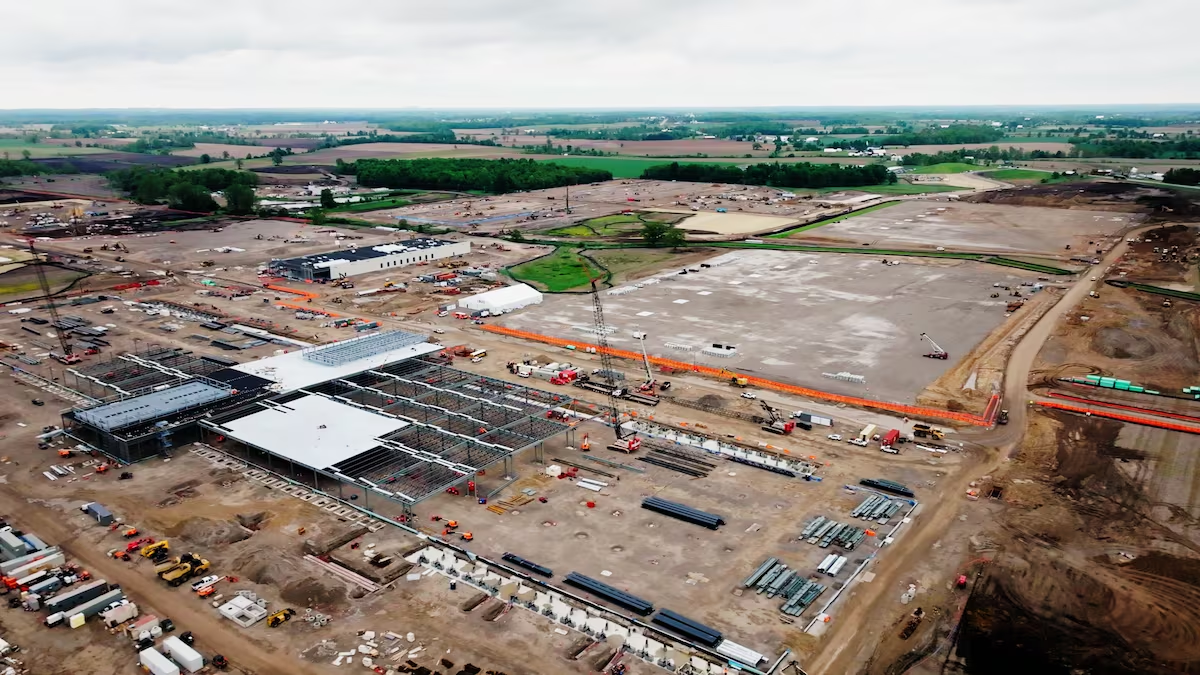
In a high-stakes meeting defined by intense public scrutiny, local political upheaval, and billions of dollars on the line, the Saline Township Board of Trustees has officially approved a 12-year, 50% property tax abatement for a massive data center campus spearheaded by tech giants Oracle Corporation and OpenAI.
However, the approval comes with a massive catch for the developers. In a decisive move to protect local revenue, township officials heavily restricted the financial incentive. While Oracle had sought to apply the 50% tax reduction to the project’s newly escalated and staggering $43 billion valuation, the board voted unanimously to cap the tax break strictly at the project’s original $4.81 billion baseline valuation. Any infrastructure, hardware, or property value exceeding that initial $4.81 billion mark will be taxed at the full, standard rate.
The compromised vote represents a historic standoff between a rural community of roughly 2,300 residents and some of the world’s most powerful tech corporations. It also marks a pivotal moment in the national debate over how much local governments should subsidize the rapidly expanding infrastructure required to power artificial intelligence.
The Standoff Over “The Barn”
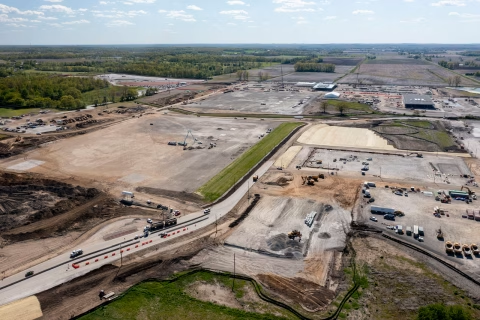
Developers call the project “The Barn,” while technology circles often associate it with OpenAI’s ambitious “Stargate” infrastructure initiative. The planned 2.2-million-square-foot campus near Ann Arbor aims to become a major hub for AI computing. The facility will house thousands of high-density liquid-cooled servers and draw up to 1 gigawatt (1,000 megawatts) of power to support the training of next-generation conversational and analytical artificial intelligence models for ChatGPT.
The project’s path to approval has faced legal and political challenges. In 2025, a court-ordered consent judgment established the framework for the development and set its projected value at $4.81 billion. Under that agreement, the township had to vote on an Industrial Facilities Tax Exemption before a state-mandated mid-July deadline.
However, when Oracle and its development partners—including Related Digital, Blackstone, and general contractor Walbridge—recently revealed that advanced AI hardware and structural expansions had ballooned the project’s true valuation to $43 billion, they requested that the 50% tax break scale upward to match the new figure.
Local residents were furious. The prospect of granting a multi-billion-dollar tax write-off to tech conglomerates triggered fierce community pushback. Citizens packed public meetings to voice concerns over the massive strain a 1-gigawatt facility would place on the local power grid, the millions of gallons of water required for cooling, and the perceived unfairness of corporate tax hand-outs. The political pressure grew so intense that multiple township trustees resigned from the board in the weeks leading up to the final vote.
Protecting the Local Tax Base
Faced with a legal mandate to vote but refusing to capitulate to the tech giants, the newly configured Board of Trustees found a loophole by anchoring their decision strictly to the 2025 consent judgment. By capping the tax break at $4.81 billion, the board ensured that Saline Township, local schools, and Washtenaw County would not lose out on a massive windfall of tax revenue.
Additionally, Township officials estimate that by taxing the remaining $38+ billion of the project’s valuation at 100%, the development will yield a minimum of $10 million in annual property taxes directly to the local community. Had the board granted the full abatement on the $43 billion scale, it would have cost local public services hundreds of millions of dollars over the 12-year timeline.
While local activist groups remain wary of the environmental footprint of the massive data halls—which will feature three distinct 550,000-square-foot structures—proponents of the project point to its massive economic stimulus. The development is projected to generate roughly 2,500 union construction jobs during its peak building phases and establish at least 450 permanent, high-paying technical and operational roles in the region.
With the tax incentive finalized and legally capped, the project is cleared to move forward, positioning Washtenaw County as a major hub for global AI infrastructure, though under much stricter local financial terms than the tech industry originally anticipated.
National trend
The Saline Township vote comes as companies race to secure land, power and long-term operating agreements for next-generation computing facilities. Recently, Sandersville data center campus in Georgia signed a 20-year infrastructure lease with a confidential global technology company that could generate up to $11.6 billion in revenue over its full term, underscoring the growing competition among states to attract large-scale AI and cloud infrastructure projects, similar projects are emerging in communities such as Salem, Oregon, where Verrus has proposed the $5.1 billion Oakline at Mill Creek AI data center campus.
Fact Sheet: Saline Township Data Center Project
- Project Code Names: “The Barn” / Stargate Infrastructure Initiative
- Key Corporate Entities: Oracle Corporation, OpenAI, Related Digital, Blackstone, Walbridge
- Location: Saline Township, Washtenaw County, Michigan (near Ann Arbor)
- Physical Footprint: 2.2 million square feet total (Three 550,000-sq-ft data halls)
- Power Allocation: 1 Gigawatt (1,000 Megawatts) of dedicated electrical capacity
- Original Valuation Baseline: $4.81 billion (Established via 2025 Consent Judgment)
- Updated Valuation Scope: $43 billion (Revealed in 2026 due to advanced AI hardware integration)
- Approved Incentive Structure: 12-year, 50% Industrial Facilities Tax Exemption
- The Valuation Cap: Tax discount applies only to the first $4.81B; all value above this is taxed at 100%
- Projected Local Tax Yield: Estimated minimum of $10 million annually to the local municipality
- Labor and Employment Impact: 2,500 union construction roles; 450 permanent technical positions
- Primary Utility Function: High-density cloud hosting and advanced AI model training for OpenAI

Leave a Reply