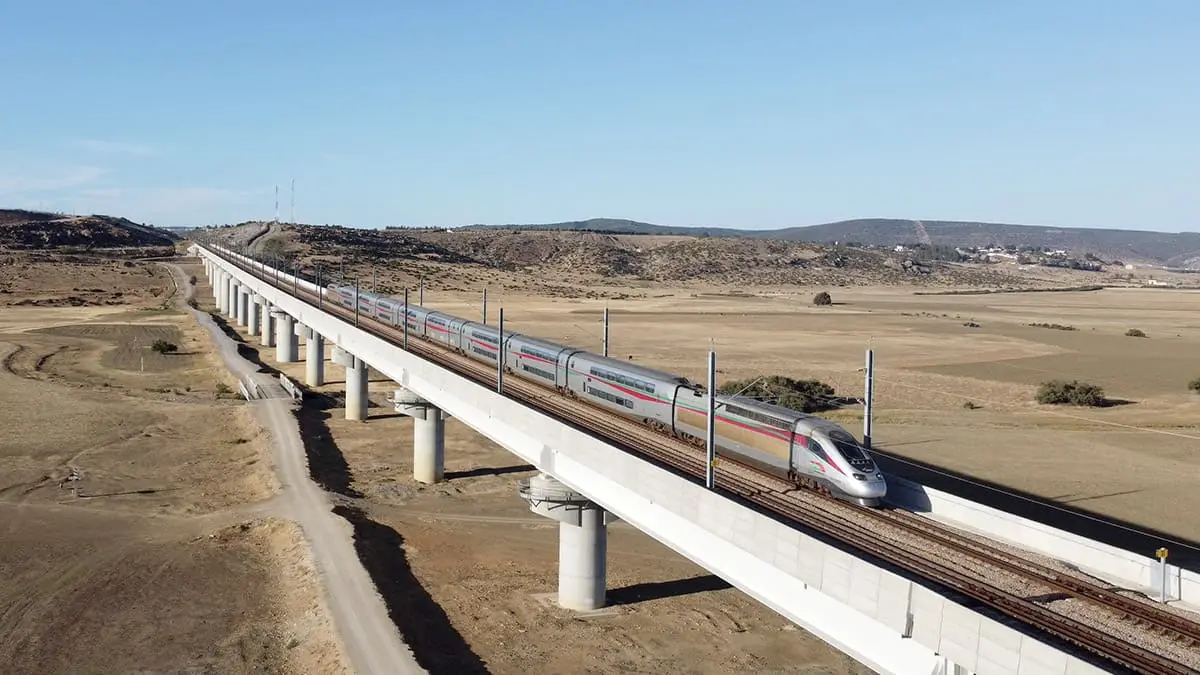
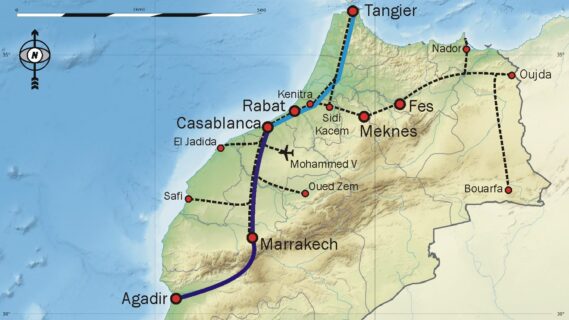
Kenitra–Marrakech rail construction in Morocco continues to progress as the country strengthens its national rail expansion strategy under a broader $10.3 billion investment programme. The planned 430-kilometre corridor links Kenitra, Rabat, Casablanca, and Marrakech, forming a critical backbone of Morocco’s high-speed rail ambitions. Authorities approved the project as part of a long-term transport modernization drive aimed at improving intercity connectivity, boosting logistics efficiency, and supporting economic integration ahead of future national development milestones. Consequently, the scheme positions Morocco as a continental leader in high-speed rail development.
The rail project forms part of Morocco’s national railway expansion led by the Office National des Chemins de Fer (ONCF), with backing for major infrastructure upgrades and rolling stock procurement. Once completed, the line will extend the existing Al Boraq high-speed service and significantly reduce travel times between key urban and tourism hubs. The programme also includes upgraded stations, electrified tracks, tunnels, and modern signaling systems designed for speeds of up to 320–350 km/h.
Kenitra–Marrakech Rail Construction Strengthens Corridor Integration
The Kenitra–Marrakech construction has moved beyond early approval stages into active multi-package implementation, with land acquisition and preparatory works already completed across most sections. Construction activity is progressing in phases, with different contractors handling civil works, track installation, and system integration. Consequently, Morocco is coordinating simultaneous delivery across multiple segments to meet long-term operational targets.
As of 2026, the project remains under full-scale execution, with major infrastructure components such as bridges, electrification systems, and signaling networks advancing steadily. In addition, ONCF has confirmed that construction will proceed through staged development phases to minimize disruption along the existing rail corridor. Recent updates indicate strong momentum, with groundwork, foundations, and structural works completed on key sections, supporting the planned completion timeline toward the end of the decade.
Furthermore, the project is closely aligned with Morocco’s broader rail modernization agenda, which includes procurement of 168 new trains and expansion of network capacity to serve more than 40 cities nationwide. Therefore, the Kenitra–Marrakech line is not an isolated investment but part of a systemic national rail transformation strategy.
Kenitra–Marrakech Construction Aligns with National Mobility Expansion
The Kenitra–Marrakech construction also supports Morocco’s long-term objective of expanding sustainable transport infrastructure ahead of rising passenger demand and major international events, including the 2030 FIFA World Cup. The new corridor is expected to significantly cut travel times across the Casablanca–Rabat–Marrakech axis while improving freight and passenger efficiency across western Morocco.
Additionally, the project reinforces Morocco’s ambition to build a fully integrated high-speed rail network exceeding 1,000 kilometers in future phases. This expansion strategy includes planned extensions toward Agadir, Fez, and other regional hubs. As a result, the Kenitra–Marrakech line serves as a foundational link for a larger national and regional rail system.
Linking this development to wider African rail trends, similar large-scale modernization efforts are underway across the continent, including Egypt’s Cairo-Alexandria Trade Logistics Development Project (CATLDP), which focuses on advanced signaling and logistics optimization for a 370-kilometre freight corridor. Together, these projects highlight a growing continental shift toward high-capacity, digitally controlled rail infrastructure designed to improve trade and mobility efficiency.
Also read:
Morocco’s 450 Kilometer Kentira-Marrakech High Speed Rail Contract Awarded
Significance of Morocco’s Kentira-Marrakech Rail project

The Kentira-Marrakech rail project upholds more than improving rail transportation in the country. It is also a symbol of the nation’s ambitions. The new trains will help to double the number of cities reached by 2040, ONCF stated. As a result, 87 percent of Moroccans will be within railway reach. The development will also help to support the country’s growing rail industry. The recent deals with France, Spain, and South Korea also foster international cooperation. This is a turning point for connectivity and economic growth,” said an ONCF official. In addition, the high-speed line will increase tourism since it will facilitate access to Marrakesh. Effective transport is important with the World Cup approaching in the future. Moreover, Morocco sees the Kentira-Marrakech rail project as a sustainable development investment in the long run.
Also read:
French-based Colas Inks $445 Million Contract for Morocco’s High-Speed Rail Extension
Spanish Firm Awarded Contract to Conduct Morocco-Spain Undersea Rail Line Study
Project Fact Sheet
Project name: Kenitra–Marrakech High-Speed Rail Construction Project
Country: Morocco
Corridor length: Approximately 430 km
Investment value: Around $10 billion (national rail modernization programme)
Implementing authority: Office National des Chemins de Fer (ONCF)
Project scope:
- High-speed rail line construction
- Electrified double-track infrastructure
- Advanced signaling and train control systems
- Station construction and upgrades
- Tunnels, bridges, and civil works
- Maintenance and operational facilities
Design speed: Up to 320–350 km/h
Key cities served: Kenitra, Rabat, Casablanca, Marrakech
Project objectives:
- Reduce intercity travel times
- Improve national logistics and mobility
- Expand high-speed rail network coverage
- Support economic and tourism growth
Implementation status (2026): Under active phased construction
Expected completion: Around 2029–2030 (phased commissioning)
Strategic drivers:
- National transport modernization plan
- World Cup 2030 infrastructure preparation
- Expansion of Al Boraq high-speed rail network
Project Team
Project owner: Office National des Chemins de Fer (ONCF), Morocco
National authority: Government of Morocco – Ministry of Transport and Logistics
Funding framework:
- State-backed national rail investment programme
- Estimated overall investment of approximately $10 billion covering high-speed rail expansion, infrastructure upgrades, and rolling stock procurement
- Co-financing and technical support aligned with international development and export-credit frameworks
Main civil works contractors:
- Moroccan public works and infrastructure firms engaged through ONCF tenders
- International construction consortia selected via lot-based procurement packages
- Engineering–procurement–construction (EPC) contractors handling earthworks, viaducts, bridges, and tunnel sections
Rail systems integrators:
- International rail signaling and systems providers appointed through ONCF procurement programmes
- Technology suppliers responsible for integrated train control systems, communications networks, and operational control centers
- Firms delivering European-standard high-speed rail interoperability systems
Rolling stock suppliers:
- Alstom – supplying Avelia Horizon high-speed trainsets under Morocco’s Al Boraq expansion programme
- Infrastructure scope partners:
- Civil engineering contractors: responsible for bridges, elevated structures, earthworks, and station civil works
- Electrification and power systems providers: delivering overhead catenary systems, substations, and energy distribution infrastructure
- Signaling and telecom systems suppliers: implementing ETCS-compatible or equivalent advanced train control, fiber-optic communications, and railway safety systems
Supporting financial institutions:
- European financing institutions supporting rail infrastructure development
- Bilateral export credit agencies financing rolling stock and systems procurement
- Multilateral development-linked financing mechanisms supporting long-term transport infrastructure expansion
Strategic partners:
- International rail engineering and manufacturing firms participating in ONCF modernization tenders
- Technology partners supporting high-speed rail expansion, interoperability upgrades, and network integration
- Industrial suppliers aligned with Morocco’s national mobility and logistics transformation strategy
Leave a Reply