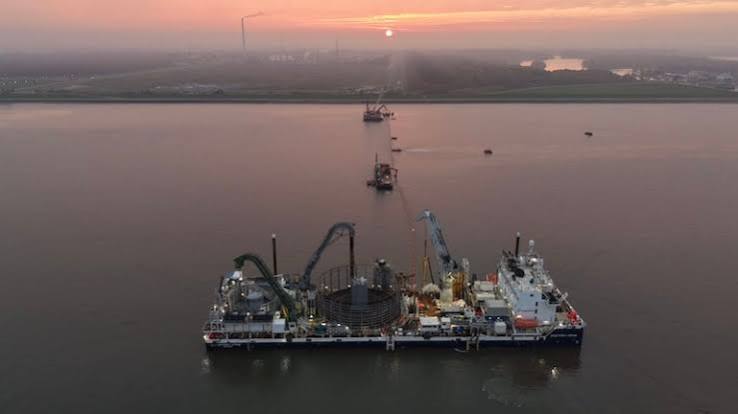
The NeuConnect cable landing in Germany has begun. On November 23, Prysmian’s shallow-water vessel Ulisse started laying 30 kilometres of cable off the coast at Wilhelmshaven. The work is a milestone for the £2.4 billion (€2.8 billion) interconnector, which will give the UK and Germany their first direct power link.
What the NeuConnect cable landing involves
The offshore cable will come ashore at Hooksiel. A 12-kilometre onshore cable section is already in place there. It connects to the new converter station that Siemens Energy is building near Wilhelmshaven. The Ulisse was designed for shallow waters. Therefore, it can handle the nearshore stretch that larger vessels cannot reach. The landing follows more than 350 kilometres of cable that Prysmian had already laid on land and at sea.
In addition, the landing marks a change of location. Until now, most of the subsea work took place in UK waters. Prysmian completed all its cabling there earlier this year, then moved on through Dutch waters toward Germany.
How far the NeuConnect project has come
The whole link is about 725 kilometres of land and subsea cable, running from the Isle of Grain in Kent to Wilhelmshaven in Lower Saxony. Prysmian began the subsea work at the end of 2024, and the cabling programme passed its halfway point in July. Construction started earlier than that. Work began on the UK side in 2023, and ministers marked the start of work in Wilhelmshaven in May 2024. Prysmian won its €1.2 billion cable contract in 2022, and the project reached financial close that July.
NeuConnect’s chief executive, Arnaud Grévoz, said the subsea programme is well over the halfway point. He added that the project remains fully on schedule.

Capacity, backers, and what happens next
The link will carry 1.4 GW in either direction, enough to power about 1.5 million homes. Meridiam, Allianz, Kansai Electric Power, and TEPCO lead the project, which is privately financed. Siemens Energy is building the converter stations at both ends, one on the Isle of Grain and one near Wilhelmshaven. These stations turn the direct current from the cable into the alternating current that each grid uses.
The next steps are finishing the German landing, laying the remaining subsea sections and completing the two converter stations. After that, testing must prove the link can trade power in both directions. Operation is expected in 2028.
Other projects
Energiequelle GmbH has commenced construction of the Lüben Wind Farm in the Gifhorn district of Lower Saxony, Germany, marking the company’s second wind energy project in the municipality of Wittingen within a single year. Comprising five state-of-the-art Enercon turbines, the facility will generate enough renewable electricity to power approximately 22,000 local households and deliver a sustained stream of financial benefits directly to the community it serves.

Leave a Reply