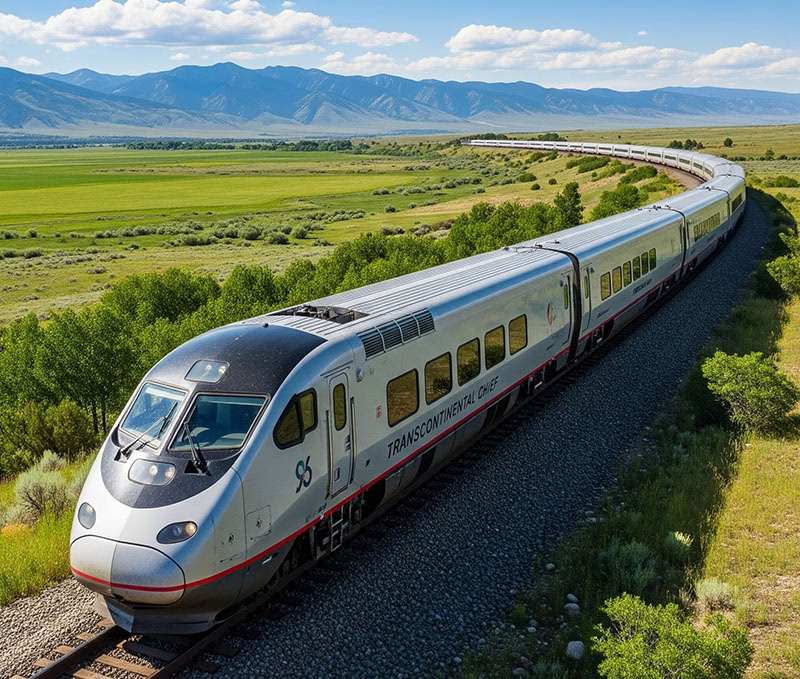
The ambitious proposal for a coast-to-coast high-speed passenger rail line connecting Los Angeles to the New York metropolitan area has hit a major roadblock. The project, centered on AmeriStarRail’s pitched “Transcontinental Chief” route, had targeted an aspirational launch date. However, Amtrak formally confirmed it will not move forward with the plan, stating that the proposal lacked a fundamental business case. Amtrak additionally rejected the hybrid operating model that aimed to transport both passengers and long-haul freight vehicles simultaneously over existing track infrastructure.
Despite this setback, the project’s backers have shifted their strategy toward federal lobbying rather than abandoning the concept entirely. Instead of relying on an immediate partnership with Amtrak, representatives are actively engaging with Congress and the U.S. Department of Transportation to reopen negotiations and secure federal backing. Proponents are now re-aligning their vision toward a new timeline, eyeing the 2028 Los Angeles Olympics as a premier global milestone to potentially debut portions of a unified, high-speed transcontinental service that could cross the country in under 72 hours. Also, the US is gaining momentum on the development of other high-speed railways in the country. This is evident with the recent award of contracts worth $3.5 billion for the California High-Speed Rail.
August 29, 2025
A proposed high-speed rail project could connect Los Angeles to New York in under 72 hours, transforming the future of cross-country travel. AmeriStarRail, a Delaware-based private transportation firm, has submitted a formal pitch to Amtrak for a joint venture to launch what it’s calling the “Transcontinental Chief.”
Using a blend of passenger comfort and freight-hauling efficiency, the new line would make dozens of stops across the country, leveraging existing infrastructure and requiring no new federal funding. The company hopes to begin service by May 10, 2026, just in time for America’s 250th anniversary and the FIFA World Cup.
Proposed Route Highlights Major American Cities
The Transcontinental Chief would link the East and West Coasts through a series of well-known destinations:
Los Angeles
San Bernardino
Victorville
Grand Canyon
Kansas City
Chicago
Harrisburg
New York City
According to Newsweek, AmeriStarRail’s model involves collaboration with freight operators like BNSF and Norfolk Southern, and could support both passengers and vehicle transport on the Los Angeles to New York rail project. U.S. passenger rail is entering an era of unprecedented modernization, with billions of dollars invested in rebuilding aging infrastructure, expanding capacity, and introducing high-speed service.
Local Leaders Cautiously Optimistic
Victorville Mayor Elizabeth Becerra welcomed the idea but emphasized the many challenges ahead. “It sounds like a great idea, but they’ll have to deal with things like train schedules, permission to use BNSF tracks, funding, construction of a new station, and a mountain of regulations,” she noted.
Privately Funded, Publicly Accessible
Unlike other struggling rail projects in the U.S. hampered by threats of federal fuding cuts, AmeriStarRail’s proposal claims it can launch without additional federal investment or new congressional approval. The plan calls for using Amtrak’s existing assets—passenger cars, locomotives, and compatible track—to keep costs manageable.
Also Read: Brightline West Las Vegas to Southern California to begin construction
Key Project Highlights
- Travel Time: Under 72 hours from Los Angeles to New York
- Stops Include: Grand Canyon, Chicago, Victorville, and more
- Public-Private Partnership: Proposed as a joint venture with Amtrak
- Target Launch Date: May 10, 2026
- Infrastructure: Utilizes existing freight and commuter rail networks
- Funding: Entirely privately financed—no new federal spending required
If successful, the Transcontinental Chief could usher in a golden age of high-speed rail in the United States, offering travelers a new alternative to cross-country flights and long-haul trucking. This is an intriguing project with a lot to offer, and all eyes are on Amtrak to see whether it will become part of their broader efforts to modernize and upgrade their infrastructure, especially following the recent reveal of their $7 billion Redevelopment Plan and timeline for New York Penn Station.
Project Factsheet
Project Developer: AmeriStarRail
Proposed Operator: Joint-venture concept operating under Amtrak branding, utilizing Amtrak ticketing networks and union crews.
Project Status: Re-development and Federal Lobbying Phase. Amtrak officially declined the immediate proposal, stating it “lacked a fundamental business case.” Proponents have pivoted away from an immediate Amtrak deal to seek direct congressional and U.S. Department of Transportation (USDOT) backing.
Core Specifications and Routing
- Total Route Distance: Approximately 2,800 miles.
- Target Transit Time: Under 72 hours coast-to-coast.
- Target Speed Profile: 79–90 mph.
- Revised Launch Timeline: 2028 (Aspirational milestone strategically re-aligned to coincide with the Los Angeles Olympic Games; the original May 2026 launch target was pushed back following Amtrak’s refusal).
Key Operational Features and Fleet Infrastructure
- Line Consolidation: Designed to eliminate inefficient terminal operations by unifying and replacing overlapping portions of Amtrak’s existing long-distance Southwest Chief (Chicago to L.A.) and Pennsylvanian (NYC to Pittsburgh) lines into a single continuous journey.
- The Intermodal “Rolling Rest Stop”: Uses an open roll-on, roll-off system allowing long-haul truckers to load full tractor-trailers onto specialized freight segments. This lets commercial drivers log their federally mandated 10-hour rest periods while remaining in transit across the country.
- Transcontinental Auto Train: Includes dedicated vehicle carrier segments for passenger cars, vans, motorcycles, RVs, and charter motorcoaches.
- Proposed “AmeriStarliner” Fleet: A bi-level car design complying fully with the Americans with Disabilities Act (ADA) that shifts all passenger and crew walking traffic to the lower level (contrasting with legacy Amtrak Superliners). The modular trainsets are engineered to scale flexibly from 300 to 600 passenger capacities.
Northeast Corridor Distinction: While the coast-to-coast Transcontinental Chief relies on conventional tracks and speeds under 100 mph, AmeriStarRail pitches a separate, simultaneous $20 billion private investment for the Northeast Corridor (NEC). That distinct segment features the “Libertyliner 250”, a rebranded version of NextGen Acela trainsets designed to achieve true high-speed operations exceeding 160–200 mph between Boston, New York, and Washington, D.C.




Leave a Reply