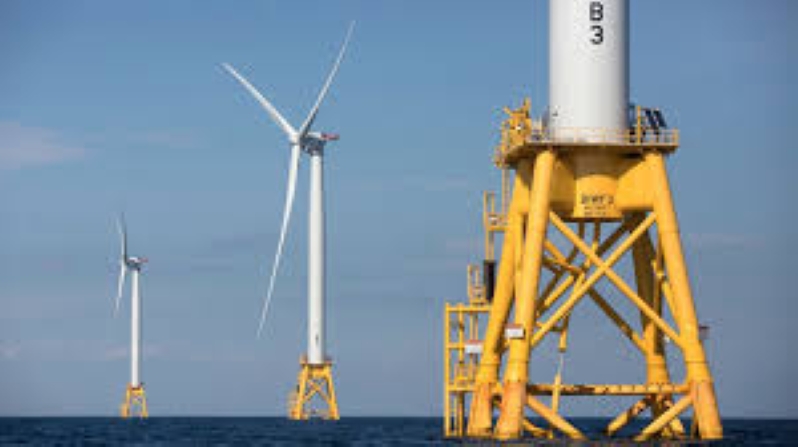
Updated June 29, 2026 – The proposed Carolina Long Bay Offshore Wind Project has now been officially abandoned after Duke Energy agreed with the U.S. Department of the Interior to voluntarily terminate its lease for the North Carolina offshore wind area, marking another major reversal for the U.S. offshore wind sector in 2026.
The lease, awarded in 2022 for approximately US$155 million, covered a site capable of supporting up to 1.6 GW of offshore wind capacity. This would have been enough to power more than 500,000 homes. Commercial operations were originally targeted for 2030-2032.
Under the settlement, Duke Energy will receive a partial reimbursement and reinvest nearly US$129 million in additional power generation and grid infrastructure across the Carolinas. This also includes potential investments in advanced nuclear and natural gas-fired generation. Transmission upgrades also feature in the reinvestment plan.
The Department of Interior agreement forms part of the Trump administration’s broader strategy of negotiating the cancellation of offshore wind leases in exchange for investments in nuclear energy and non-renewables.
Duke Energy’s agreement brings the total value of offshore wind lease buyout in the U.S. to more than US$2.7 billion. The decision also leaves North Carolina with only the remaining Kitty Hawk offshore wind lease area under development after TotalEnergies earlier terminated its neighboring Carolina Long Bay lease.
Duke Energy’s Axed Carolina Long Bay Offshore Wind Project: How it Happened
Reported March 27, 2026 – In August 2025, Duke Energy formally announced that it would stop pursuing offshore wind procurement and development off the coast of North Carolina. The developer concluded that large‑scale marine wind projects are not cost‑competitive. The comparison was made to alternative clean resources such as solar and battery storage under current market conditions and expected construction costs.
This decision followed an Acquisition Request for Information (ARFI) process. The initiative was mandated by the North Carolina Utilities Commission (NCUC). It also underscores a broader pivot in utility planning. Intensifying debates over ratepayer costs, energy reliability and decarbonization pathways for the Carolinas also factor in. Duke’s choice effectively halted near‑term offshore wind buildout in the region. It also signals a potential strategic shift toward other generation sources, notably natural gas and possibly nuclear, to meet future demand.
How Cost Concerns, Policy Shifts Reshaped Duke Energy’s Halted Offshore Wind Plans Off North Carolina
North Carolina’s electricity system and Duke’s long‑term planning have been shaped by state and federal goals to reduce carbon emissions and expand renewables. In 2020, Duke filed its Carolinas Integrated Resource Plan (IRP). This envisioned substantial future energy resource mixes that included renewable and fossil generation. The ARFI – an industry information‑gathering exercise rather than a binding procurement process – aimed to quantify realistic costs, risk profiles, and customer impacts for up to 2,400 MW of offshore wind by 2035 using available lease areas off the North Carolina coast. This included those held by Duke’s own subsidiary as well as other developers such as Avangrid Renewables and TotalEnergies.
After evaluating eight proposals from multiple leaseholders and consulting with an independent evaluator (Power Advisory, LLC), Duke ultimately concluded that offshore wind is currently more expensive. This was compared to equivalent solar plus battery storage options. It was therefore decided as not the least‑cost-option for its customers. The ARFI analysis also informed Duke that solar and storage could meet energy needs at lower overall system costs. This lead the utility to not issue a binding request for proposals (RFP) for wind projects off North Carolina’s coast.
This assessment occurred against a backdrop of federal policy changes that have introduced regulatory uncertainty for U.S. offshore wind projects. It features high‑profile pauses and lease cancellations such as the $1 billion TotalEnergies payout by the Trump administration to stop its U.S. wind development plans.
Duke Energy Halts Offshore Wind Plans Off North Carolina
Reported August 21, 2025 – Duke Energy has decided against pursuing offshore wind development along North Carolina’s coast. The decision came after an independent review concluded the project was not economically competitive at the time. Duke Energy is the largest electric utility in North Carolina and one of the biggest in the United States.
The move comes at a time when offshore wind projects are facing significant headwinds. A week ago Atlantic Shores Offshore wind power project was terminated. New Jersey’s regulator cancelled the preliminary approval following a request from the developers.
The review stemmed from an Acquisition Request for Information (ARFI). This is a regulator-ordered process designed to collect confidential project details and pricing from leaseholders. Duke Energy stated that “offshore wind is not cost-competitive at this time, so no RFP will be issued.”
An RFP (Request for Proposal) is a formal process where companies are invited to submit competitive bids for a project. Unlike an ARFI, which is used only to gather information and pricing details, an RFP signals that the project will move forward. It also signals that the developers can compete to be selected. In this case, because offshore wind proposals were found to be too costly, Duke Energy decided not to issue an RFP. This effectively stopped the competitive bidding process.
Despite the decision, the utility noted that the process provided valuable cost and scheduling data that will inform its upcoming Carolinas Resource Plan.
Results of the ARFI
Launched in January, the ARFI invited confidential submissions from three leaseholders:
- Avangrid – controlling the Kitty Hawk lease area.
- TotalEnergies – leaseholder of part of the Carolina Long Bay tract.
- Cinergy (Duke Energy subsidiary) – controlling the other portion of Carolina Long Bay.
The ARFI sought bids for up to 2,400 megawatts of offshore wind capacity by 2035, which would have been enough to power approximately 1.5 million homes.
When the results were filed with the North Carolina Utilities Commission on August 11, all bids came in above the established “reference price”. This price was based on the cost of solar paired with battery storage. Independent Evaluator Power Advisory also validated the findings.
Critics Support the Move
Opponents of offshore wind projects welcomed Duke’s decision. Jon Sanders, director of the Center for Food, Power and Life at the John Locke Foundation, argued that the state must prioritize affordability and reliability.
“Even if climate change projections are taken at their strongest, North Carolina is too small to make a measurable global impact,” Sanders said. “But residents could face higher power bills without meaningful environmental benefits.”
Sanders added that while future technological advances could change the outlook, he does not expect offshore wind to become viable in the near term.
Fact Sheet: Duke Energy Carolina Long Bay Offshore Wind Farm
- Process: Acquisition Request for Information (ARFI)
- Purpose: Assess cost and project feasibility for offshore wind in NC
- Timeline: ARFI launched in January, results filed August 11, 2025
- Leaseholders Involved: Avangrid (Kitty Hawk), TotalEnergies & Cinergy (Carolina Long Bay)
- Capacity Considered: 2,400 MW by 2035
- Homes Powered: 1.5 million
- Outcome: All bids exceeded solar plus battery storage benchmark price
- Evaluator: Power Advisory (independent)
- Decision: No RFP issued; data will inform future Carolinas Resource Plan
Project Partners and Stakeholders
Regulatory and Utilities
- Owner: Duke Energy
- North Carolina Utilities Commission (NCUC): Directed the ARFI and oversaw regulatory mandates
- Independent Evaluator: Power Advisory, LLC (conducted the cost and competitive analysis)
Leaseholders
- Duke Energy Renewables (Cinergy Corp): Holder of part of the Carolina Long Bay lease area for offshore wind potential
- Avangrid Renewables, LLC: Holder of the Kitty Hawk South offshore lease
- TotalEnergies Carolina Long Bay, LLC: Holder of adjacent Carolina Long Bay lease (subject to federal lease cancellation agreements)
Consultants and Technical Advisors
- Power Advisory, LLC: Independent cost and analysis consultant to the ARFI process
- DNV (GL Group): Technical advisor supporting ARFI evaluations



Leave a Reply