t
Oklahoma City’s downtown landscape is rapidly shifting as heavy machinery dominates the site of the former Myriad/Cox Convention Center, signaling the active construction phase of the city’s new $1 billion NBA venue. Following months of intensive site clearing, crews from the Flintco-Mortenson joint venture have transitioned into foundational site work. The 750,000-square-foot project represents the largest single public infrastructure undertaking in the history of Oklahoma City, designed to serve as a modern architectural anchor for the downtown district.
The most recent major milestone for the project occurred on March 24, 2026, when the Oklahoma City Thunder and local energy giant Continental Resources finalized a 15-year naming rights partnership. Moving forward, the facility will officially be known as the Continental Coliseum. Notably, the agreement establishes a unique branding identity within the National Basketball Association, as the venue will stand as the only current stadium in the entire league to utilize the word “Coliseum” in its official name.
Groundbreaking
This naming milestone was immediately followed by a formal groundbreaking ceremony on March 26, 2026. The event drew a crowd of more than 300 civic leaders, team executives, architects, and fans who gathered to celebrate the official transition from demolition to active vertical development. During the ceremony, city officials and Thunder Chairman Clay Bennett emphasized that the commencement of construction represents a generational investment in the city’s status as a major league sports market.
The civic momentum powering the construction stems back to December 12, 2023, when Oklahoma City voters overwhelmingly approved a temporary 1-cent sales tax extension by a 71% margin to fund the venue. The financial framework for the $900 million to $1 billion development relies heavily on this public funding mechanism, supplemented by $78 million from dedicated MAPS 4 capital improvement funds. Additionally, the Thunder’s ownership group is contributing a contractually mandated $50 million toward the total construction costs.
Architectural designs
Architectural designs finalized by MANICA Architecture showcase a facility tailored specifically to maximize team revenue while enhancing the spectator experience. The exterior will feature a prominent, curved design highlighted by a grand 360-degree glass window wall that provides panoramic views of the surrounding downtown skyline. On the interior, the city’s “1% for Art” ordinance has already been triggered, securing local artist Matt Goad to design expansive, custom terrazzo flooring that will run throughout the arena’s primary public concourses.
As the physical structure begins to take shape, operational management is also falling into place. The city has officially retained Legends Global to oversee stadium operations, event booking, and venue management. Concurrently, the Thunder organization is preparing to launch its New Arena Preview Center. This center will manage an exclusive, 18-month seat-selection and relocation process for current full- and half-season ticket account holders, prioritizing seat selection based on established organizational priority points.
The project remains strictly on schedule to meet its provisional completion target of late summer 2028, well ahead of its absolute contractual deadline of June 2029. The Thunder will continue to play all home games at the adjacent Paycom Center until the new facility is ready. Upon the official ribbon-cutting for the 2028–2029 NBA season, a new 25-year lease agreement will be triggered, legally binding the franchise to Oklahoma City through at least the year 2053.
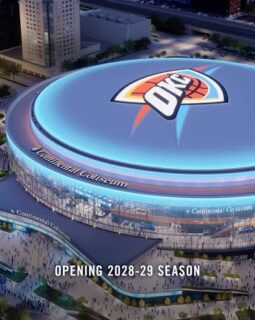
Continental Coliseum Arena design
Atlanta-based TVS collaborated with Kansas City-based Manica Architecture to supply the design of the OKC Thunder Arena project. In October, the City Council approved a $61.6 million design contract for the design firm and design renderings are anticipated this summer. Additionally, the new arena will cover over 750,000 square feet to sit as a superior NBA and multi-purpose entertainment facility in the region.
Funding for the project will be secured through a 72-month one-cent sales tax after the MAPS 4 taxing period and $70 million of MAPS 4 money and $50 million from the Oklahoma City Thunder ownership group. Paycom Center remains the Thunder home venue to 2048 when the conclusion of the 25-year obligation occurs. The Thunder’s Western Conference dominance creates buzz for the future projects in Oklahoma City sports.
Additionally, the project aligns with a broader wave of large-scale sports and entertainment venue development across the United States, including Las Vegas Diamond Arena, which recently secured full site control as it advances its bid for a future NBA franchise. Both developments reflect continued investment in modern, purpose-built sports infrastructure designed to support long-term league expansion and city-scale redevelopment.
Project team
A collaborative group of civic, architectural, and construction partners leads delivery of the Continental Coliseum, with owner’s representatives CAA ICON and local project managers ADG Blatt overseeing execution. MANICA Architecture leads the design, working alongside TVS as the Architect of Record, while Design Workshop shapes the surrounding public realm and local artist Matt Goad develops custom interior installations. The Flintco–Mortenson construction joint venture builds the physical structure, and Legends Global will handle day-to-day operations and stadium hospitality following its planned 2028 completion.
Read also: Churchill Downs Announces $920M Expansion to Enhance Kentucky Derby Experience
Read also: Raj Sports to Build $150M Dual Practice Facility for Portland Thorns and WNBA Expansion Team
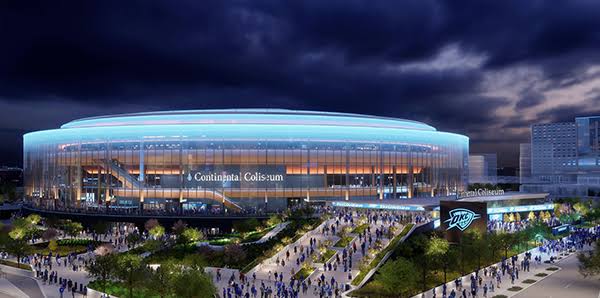
Continental Coliseum Arena: Factsheet
Project Description
New downtown Oklahoma City $1 billion NBA arena and entertainment facility
Minimum 750,000 square foot building
Address: Existing site of Cox Convention Center (previous Myriad/Prairie Surf Studios)
New OKC Thunder Continental Coliseum Arena: Key Dates
Demolition bids due: March 5, 2025
Contractor selection (Mortenson–Flintco): March 11, 2025
Contractor award finalized: March 25, 2025
Demolition begins: March 31, 2025
Initial renderings: Summer 2025
Concept designs unveiled: July 16, 2025
Demolition completion deadline: September 30, 2025
Secondary demolition phase: December 2025
Site cleared and turnover: February 12, 2026
Naming rights finalized (Continental Coliseum): March 24, 2026
Groundbreaking ceremony: March 26, 2026
Public art partner approved: June 2026
Final structural design deadline: Mid-2027
Substantial completion target: Late summer 2028
Opening target: October–November 2028
Operations backstop deadline: June 2029
Design Team
Lead Architects: TVS (Atlanta) & Manica Architecture (Kansas City)
Design contract value: $61.6 million
Read also: The FC Dallas Toyota Stadium: History and upcoming renovation
Funding Sources
Lead: 72-month, one-cent sales tax (post MAPS 4)
MAPS 4 contribution: $70 million
Thunder ownership contribution: $50 million
Impact
Thunder committed 25-year lease tenancy in Oklahoma City
Will be premier NBA and entertainment destination
Temporary home: Team continues to play at Paycom Center
Read also: New Renderings Reveal Ambitious Capital One Arena Renovations
Read also: Construction Begins on New York City’s First-Ever Professional Soccer-Specific Stadium, Etihad Park

Leave a Reply