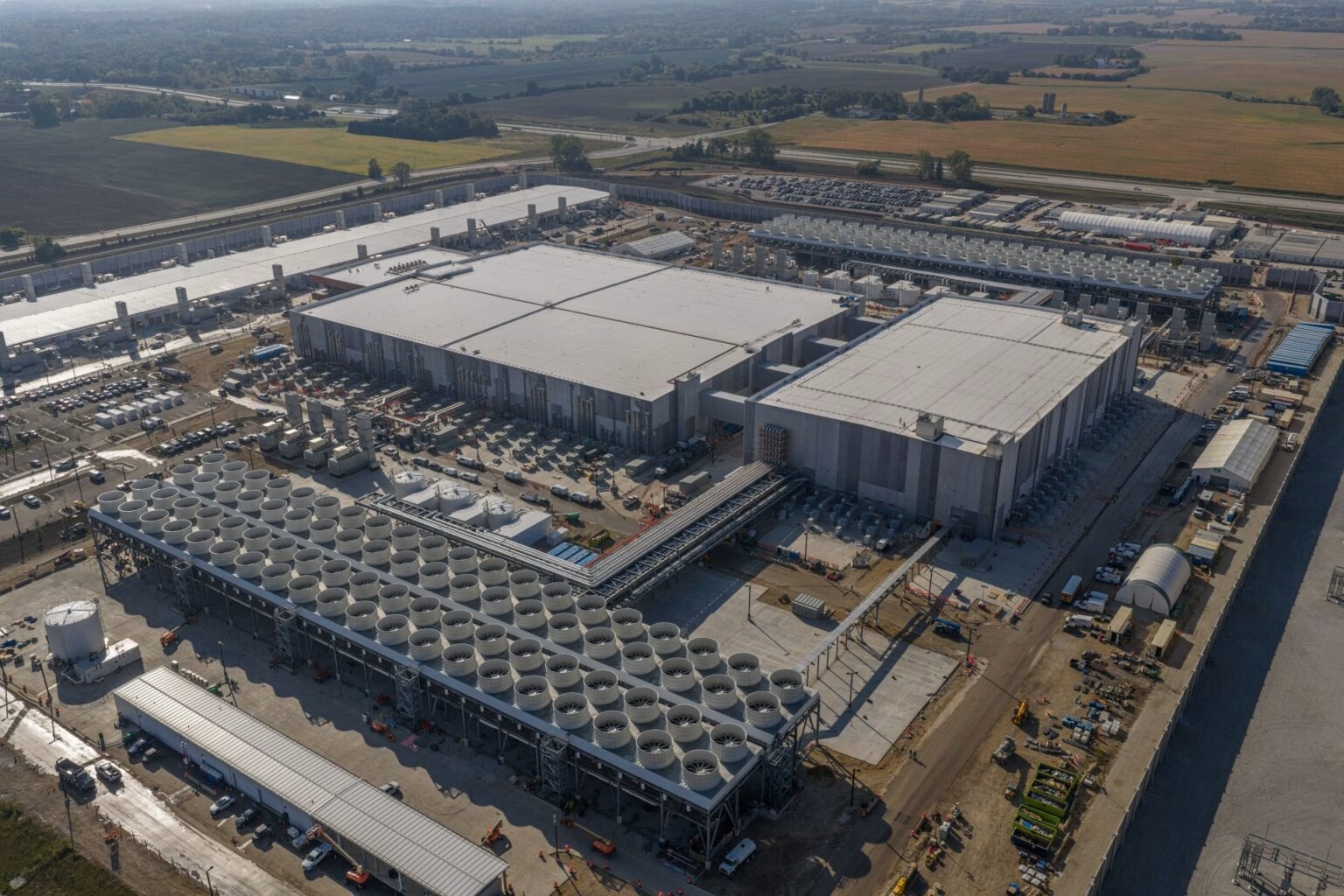
Microsoft’s Fairwater data center campus in Mount Pleasant, Wisconsin, is expanding well beyond its original scale, solidifying the state as a hub for advanced AI infrastructure. Initially announced in 2024 with a $3.3 billion investment, the company added an additional $4 billion in 2025 for a second facility. The latest approvals for 15 new buildings increase the total campus footprint to nearly 9 million square feet, and the total taxable value of the development may exceed $13 billion. The company recently announced a series of purpose-built datacenters and infrastructure investments worldwide to accelerate the adoption of advanced AI workloads and cloud services.
Campus Expansion and Investment
The original Fairwater campus spanned 315 acres with 1.2 million square feet across three buildings, featuring deep foundation piles, structural steel, underground cables, and mechanical piping to support AI supercomputing workloads. The recent approvals significantly enlarge the campus, increasing the footprint to nearly 9 million square feet with multiple new buildings.
While Microsoft’s direct capital investment remains over $7 billion, local authorities estimate the taxable value of the fully built campus could exceed $13 billion, including land, structures, and associated infrastructure.
Technology
Unlike traditional cloud facilities that host smaller, independent applications, Fairwater is designed as a single, unified AI supercomputer. It will interconnect hundreds of thousands of NVIDIA GPUs using advanced networking to deliver computing power 10 times greater than today’s fastest supercomputer. Data center projects by various companies across the US are gradually taking shape as Amazon pulls out of the Project Blue data center. Pima County Supervisor Matt Heinz and Tucson City Councilman Paul Cunningham noted their remarks. Heinz noted he heard rom multiple sources that Amazon will no longer be the end user. However, he confirms that there are now potentially seven or eight different end-user tenants. Developer Beale Infrastructure, which was set to lead the project to build the facility near the Pima County Fairgrounds, said Tuesday that while Amazon showed interest, it never had an agreement in place.
Construction highlights for Phase 1 included:
46.6 miles of foundation piles
26.5 million pounds of structural steel
120 miles of underground medium-voltage cable
72.6 miles of mechanical piping
The ongoing expansion will add significant additional materials and construction work, increasing the scale of excavation, structural steel, cabling, and piping across the nearly 9 million sq ft campus.
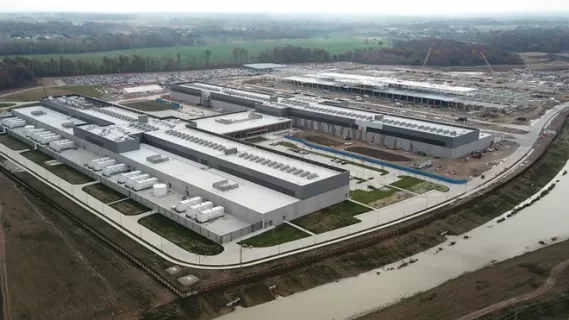
“We’re in the final phases of building Fairwater in Mount Pleasant, and today we’re committing even more to ensure Wisconsin becomes a hub for advanced AI innovation,” said Brad Smith, Microsoft vice chair and president.
Jobs, Skills and Local Partnerships
Construction of the first facility has already employed more than 3,000 workers. Once operational, Fairwater will create about 500 full-time positions, a number expected to grow to 800 with the second facility.
Microsoft is also building a pipeline of local talent through Wisconsin’s first Datacenter Academy, launched in partnership with Gateway Technical College in Racine. The program will train over 1,000 students in the next five years for careers in operations, IT, and other high-demand fields.
Environmental Footprint and Energy
The datacenter will use a closed-loop liquid cooling system, limiting water consumption by continuously recirculating supply and switching to air cooling on most days. At peak, water use is projected at about 234,000 gallons per day when Fairwater is fully online, with long-term expansion pushing totals higher.
To offset environmental impacts, Microsoft will pre-pay for energy and infrastructure upgrades, while also investing in renewables. A 250-megawatt solar project in Portage County will help power the datacenter campus, part of Microsoft’s pledge to match its energy use with clean sources.
Wisconsin on the AI Map
State leaders hailed the investment as a transformative moment for Wisconsin. “Microsoft’s investment puts Wisconsin on the cutting edge of AI power, not just in the U.S. but across the globe,” said Gov. Tony Evers. “This project is creating good, family-supporting jobs, strengthening our economy, and ensuring our communities are part of the future of technology.”
Fairwater is expected to come online in early 2026, positioning Mount Pleasant — once known for its stalled Foxconn project — as home to the world’s most advanced AI datacenter. Additionally, With the latest expansion bringing the Fairwater campus to nearly 9 million square feet, Microsoft’s Mount Pleasant facility now joins the ranks of some of the largest and most advanced data centers in the United States, cementing its role as a major hub for AI and cloud infrastructure.
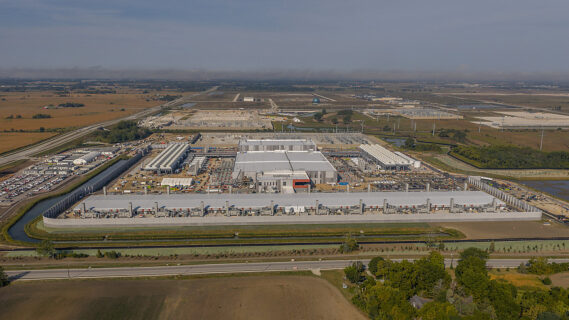
Project Factsheet: Microsoft Fairwater AI Data center – Wisconsin
Project Overview
Name: Fairwater
Type: Artificial Intelligence Data center / AI Supercomputer
Owner/Developer: Microsoft
Location: Mount Pleasant, Racine County, Wisconsin, USA
Scale: Microsoft’s largest and most advanced AI datacenter in the world
Investment & Timeline
Initial Investment (2024): $3.3 billion
Additional Investment (2025): $4.0 billion (for second datacenter)
Total Commitment: $7.3+ billion
Construction Start: 2024
Expected Completion (Phase 1): Early 2026
Size & Engineering
Site Area: 315 acres
Initial Facility Size: 1.2 million square feet (three buildings),
Key Materials:
46.6 miles of deep foundation piles
26.5 million pounds of structural steel
120 miles of underground medium-voltage cable
72.6 miles of mechanical piping
Technology & Capacity
Design: Single flat networking system linking all GPUs
Hardware: Hundreds of thousands of NVIDIA GPUs
Performance: 10x faster than the world’s current most powerful supercomputer
Purpose: AI training and inference at unprecedented scale
Jobs & Workforce Development
Construction Jobs (Peak): 3,000+
Permanent Jobs (First Datacenter): 500
Permanent Jobs (Two Datacenters): 800
Workforce Training:
Partnership with Gateway Technical College
Wisconsin’s first Datacenter Academy
Goal: train 1,000+ students in five years
Cooling & Sustainability
Cooling System:
90% closed-loop liquid cooling (filled once, continuously recirculated)
Remaining portion uses outside air most of the year, switching to water only on hot days
Projected Water Use:
234,000 gallons per day (Phase 1, 2026)
Up to 702,000 gallons per day at full buildout
8.4 million gallons annually
Leave a Reply