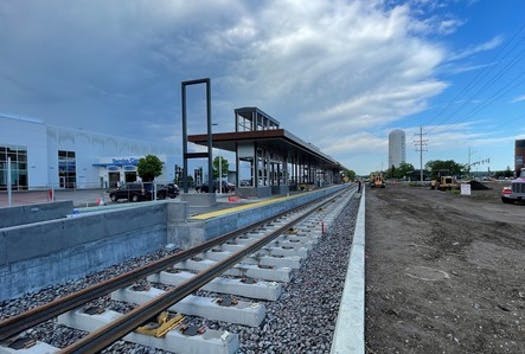
Minnesota’s Southwest Light Rail project now officially branded the METRO Green Line Extension has crossed a landmark threshold after years of construction battles, cost overruns, and delays that made it one of the most controversial public infrastructure undertakings in the state’s history.
The 14.5-mile extension of the existing METRO Green Line links downtown Minneapolis to Eden Prairie through St. Louis Park, Hopkins, and Minnetonka, with 16 new light rail stations, 29 new bridges, and two cut-and-cover tunnels forming the backbone of the civil works program.
Construction workers began installing track in Hopkins as far back as 2021, a milestone project director Jim Alexander called a “major step” that would “set the stage for everything else.” Nevertheless, the road from that early milestone to project completion has been anything but straightforward. The project cost alone represents a 232 percent increase from when it was originally proposed, exposing the immense difficulty of delivering large-scale urban light rail infrastructure in the United States.
Green Line Extension Track Installation and Testing Mark Construction Milestone
Testing of the Green Line Extension began in July 2025 and will continue until the line opens in 2027, with over 1,500 runs of light rail vehicles planned to cover the different components of the LRT operating systems. Moreover, more than 11.5 contiguous miles of light rail track guideway have been laid between Eden Prairie and Minneapolis near the West Lake Street Station area.
Additionally, Metro Transit has begun testing light rail vehicles in Hopkins, with light rail vehicles traveling through Hopkins between stations as the Green Line Extension project nears completion. Furthermore, testing on the Minneapolis segment of the alignment is following on from the St. Louis Park and Eden Prairie testing phase, with light rail vehicles moving slowly to verify that all mechanical and electrical components are ready. Consequently, the project is firmly in its final commissioning phase ahead of passenger service.
Southwest Light Rail, Green Line Extension Cost Overruns Reshape Minnesota Transit Debate
The original project budget for the Southwest LRT was $1.25 billion, but as of January 2024 the project budget had ballooned to $2.86 billion. Specifically, the Met Council awarded the civil construction contract to a joint venture for $799.5 million, but issues arose after breaking ground in 2019, causing costly change orders and delays that pushed the contract budget up to $1.065 billion. Similarly, from March 2019 to October 2022 alone, the project processed 658 civil construction change orders, an extraordinary volume that drained contingency reserves and triggered legislative audits.
The budget for the light rail line more than doubled to about $3 billion amid disputes and cost overruns. Therefore, the Southwest experience now casts a long shadow over its successor. Indeed, Minnesota’s Blue Line light rail extension now estimated at $3.6 billion faces its own deepening cost crisis, with critics pointing to the Southwest project as proof that Twin Cities light rail costs are structurally uncontrollable. The Green Line Extension is opening in 2027, almost a decade later than initially anticipated.
Also Read: New Solar farm to be constructed in Eden Prairie, Minnesota
Project fact sheet
Project name: METRO Green Line Extension (also known as Southwest Light Rail Transit / SWLRT)
Location: Hennepin County, Minnesota, USA
Route: 14.5 miles from Target Field Station in downtown Minneapolis through St. Louis Park, Hopkins, and Minnetonka to SouthWest Station in Eden Prairie
Total stations: 16 new light rail stations
Structures: 29 new bridges, modifications to 7 existing bridges, 2 cut-and-cover tunnels, 5 miles of freight rail relocation
Track: 14.5 miles of twin-track light rail guideway; standard gauge 4 ft 8½ in (1,435 mm); overhead line electrification
Original projected cost: $1.25 billion (2011 estimate)
Cost at 2021 reset: approximately $2.74 billion
Cost at January 2024: approximately $2.86 billion
Current total budget: approximately $3 billion
Original civil construction contract: $799.5 million (awarded 2018)
Revised civil construction contract: approximately $1.065 billion after change orders
Change orders processed (March 2019–October 2022): 658 civil construction change orders
Original planned opening: 2018
Revised opening: 2027 (approximately nine years behind original schedule)
Federal funding: approximately $929 million Full Funding Grant Agreement (FFGA) from the Federal Transit Administration
Testing phase: began July 2025; continues through 2027; over 1,500 light rail vehicle test runs planned
Track installed: more than 11.5 contiguous miles of guideway laid between Eden Prairie and Minneapolis as of 2025
Projected daily ridership: 34,000 (upon opening)
Connections: METRO Blue Line, METRO Orange Line, Northstar Commuter Rail at Target Field Station; one-seat rides to University of Minnesota, State Capitol area, and downtown St. Paul via the existing Green Line
Key communities served: Minneapolis, St. Louis Park, Hopkins, Minnetonka, Eden Prairie
Population within 10-minute walk of corridor: approximately 56,000 residents
Jobs accessible from the corridor: approximately 81,000 along the extension, plus 145,000 in downtown Minneapolis
Project Team
Owner and project lead: Metropolitan Council (Met Council), St. Paul, Minnesota
Co-funding partner: Hennepin County
Project operator: Metro Transit, a division of the Metropolitan Council
Project director (construction phase): Jim Alexander, Southwest Project Office, and Metropolitan Council
Met Council Chair (oversight): Charlie Zelle, Metropolitan Council
Primary civil construction contractor: Lunda Construction Company / C.S. McCrossan Joint Venture
Parent company of Lunda Construction: Tutor Perini Corporation (NYSE: TPC), Fort Worth, Texas
Primary design and engineering contractor: AECOM Technical Services, Inc.
Additional design consultants: Kimley-Horn and Associates; WSP Global
Systems infrastructure contractor: Aldridge/Parsons Joint Venture
Track specialty contractor: RailWorks / Delta Joint Venture
Specialty subcontractor: Becho, Inc.
Federal oversight: Federal Transit Administration (FTA)
Legislative auditor: Minnesota Office of the Legislative Auditor (OLA) — conducted multiple special reviews and programme evaluations of project budget and timeline from 2021 onward
Project office location: Park Place West Building, St. Louis Park, Minnesota

Leave a Reply