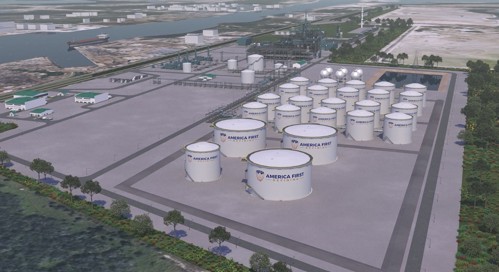
A proposed multi-billion-dollar oil refinery on the U.S. Gulf Coast advanced into a new phase of development on April 7 after Fluor Corporation said it had been selected to carry out early engineering work for the America First Refining (AFR) project in Brownsville, Texas.
In a statement released the same day, Fluor said it had been awarded a Front-End Engineering and Design (FEED) contract for the planned facility, a step that typically precedes a final investment decision on large industrial projects.
Engineering Contract Signals Progress Toward Construction
According to Fluor, the FEED scope will define the refinery’s technical design, cost estimates, and execution plan, forming the basis for whether the project proceeds to construction. The company described the project as a “grassroots refinery”, built from the ground up, rather than an expansion of an existing facility.
Pierre Bechelany, Fluor’s Business Group President of Energy Solutions, said in the press release:
“We are honored to partner with America First Refining on this landmark U.S. project. Together, AFR and Fluor bring deep technical expertise and proven project‑delivery capabilities, positioning the project for successful execution.”
The award is the most concrete development disclosed by the company since the project was introduced earlier in this year.
Project Details From Developer and Port Authorities
The America First Refining project was first outlined in March through announcements by the developer and the Port of Brownsville, which said the refinery would be built on approximately 240 acres within the port’s industrial complex.
According to the port authority, the proposed facility is expected to:
- Process up to 168,000 barrels of crude oil per day
- Operate using 100% U.S.-produced light crude
- Produce transportation fuels including gasoline, diesel and jet fuel
The port has said the project could generate hundreds of permanent jobs and thousands during construction, while noting that final figures depend on project approval and execution.
One of the First New U.S. Refineries in Decades
If completed, AFR would represent a rare addition to U.S. refining capacity.
According to Reuters, the United States has not built a major grassroots refinery in decades, with most capacity additions coming from expansions of existing facilities rather than new builds.
That context has drawn attention to the Brownsville proposal, particularly as U.S. crude production—largely from shale formations—has increased significantly over the past decade.
Supply Strategy and Market Positioning
Project materials released by the developer indicate the refinery would be configured to process light, sweet crude oil, aligning with the dominant type produced in U.S. shale basins.
Earlier project disclosures reported by industry media indicate AFR is tied to a long-term crude supply and refined product offtake structure, though full contractual details and counterparties have not been publicly disclosed.
Economic and Strategic Context
The Port of Brownsville has promoted the refinery as a potential economic driver for South Texas, citing:
- Job creation during construction and operations
- Increased industrial activity at the port
- Expanded energy export capabilities
The port’s location near the Gulf of Mexico, combined with rail and pipeline connectivity, has made it a focal point for energy and industrial development.
Uncertainties Remain Ahead of Final Investment Decision
Despite the April 7 engineering milestone, the project still faces several hurdles before construction can begin.
Fluor’s announcement confirms that AFR has entered the pre-construction engineering phase, but a final investment decision (FID)—which would commit full project funding—has not been announced.
Outstanding factors include:
- Securing financing and investment partners
- Completing environmental and regulatory approvals
- Finalizing detailed engineering and cost estimates
What Comes Next
Completion of the FEED phase is expected to inform whether the project proceeds to a final investment decision. If approved, the project would move into permitting and construction, which could begin as early as 2026.
Large-scale refinery projects typically take several years to complete.
The April 7 contract award does not guarantee construction of the America First Refining facility, but it marks a defined step forward in the project’s development as it moves through engineering and evaluation stages.
Additionally, The refinery is part of a broader U.S. effort to strengthen energy infrastructure, which includes proposals such as the $2 billion US-Canada oil pipeline by Bridger, intended to replace the terminated Keystone XL project and improve crude transport to domestic refineries
On April 7, 2026, the U.S. Gulf Coast saw multiple major energy infrastructure milestones. The America First Refining project in Brownsville, Texas advanced into early engineering with Fluor Corporation selected for initial work, while the $12.5B Commonwealth LNG Export Terminal in Louisiana achieved full commercialization and moved Phase 1 toward construction. Together, these developments highlight the region’s growing role in energy production and infrastructure investment, spanning both LNG exports and domestic refining.
America First Refining (AFR) – Brownsville, Texas: Factsheet
Project Type: Oil refinery – new grassroots facility
Location: Port of Brownsville, Texas, USA
Developer: America First Refining (AFR)
Engineering Partner: Fluor Corporation (FEED contract)
Capacity:
- 168,000 barrels per day (60 million barrels/year)
- Feedstock: 100% U.S.-produced light crude
Products: Gasoline, diesel, jet fuel
Project Size / Cost:
- Estimated construction cost: $6–7 billion (Reuters)
- $300B figure refers to long-term economic/trade value, not construction
Employment:
- Hundreds of permanent jobs
- Thousands during construction (exact numbers depend on approvals)
Key Milestones:
- April 7, 2026: FEED contract awarded to Fluor
- Pending: Final Investment Decision, permitting, construction
Significance:
- First new U.S. refinery in more than 50 years (Fluor press release)
- Supports domestic energy resilience and refining capacity
Technology: Commercially proven refining technologies for clean and efficient processing of shale oil
Timeline:
- FEED phase: underway (April 2026)
- Potential construction start: 2026+
- Completion: multi-year build typical of large-scale refineries


Leave a Reply