RDU Airport Expansion continues to accelerate at Raleigh-Durham International Airport (RDU) as $2.5 billion in capital works approach critical delivery milestones in 2026. The stakes are high at the airport this summer as runway, terminal, parking, and road infrastructure works progress simultaneously. Additionally, rising passenger volumes continue to push capacity limits, forcing accelerated execution across multiple construction packages.
Moreover, airport leadership confirms that the program is designed to transform RDU into a higher-capacity international gateway, supporting long-haul routes including transatlantic operations to destinations such as Paris and Frankfurt. However, delivery challenges remain significant as earthworks scale up and sequencing becomes more complex across active airside and landside environments. Consequently, the airport is balancing aggressive timelines with strict operational safety requirements.
RDU Airport Expansion runway construction moves through large-scale earthworks phase
The runway remains the most critical component of the RDU Airport Expansion program as it underpins future international and long-haul operations. Furthermore, the project involves extensive earthmoving, with approximately one million cubic yards already completed and roughly four million still remaining.
According to airport development leadership, crews will continue earthworks for approximately two and a half years. Additionally, a $361 million earthworks contract recently advanced as the next major delivery package. This package supports grading, embankment formation, and foundational runway shaping required for the new international-standard airstrip.
Meanwhile, infrastructure relocation works also progress in parallel. A nearly $50 million contract is advancing to relocate Lumley Road, creating required buffer space for the runway footprint. Construction is expected to begin within 30 days, with completion targeted for 2028.
Consequently, the existing road will be removed later to enable full runway completion by June 2029. In addition, RDU is preparing future contracts for runway paving and electrical systems, alongside navigational aid installations that will guide aircraft approach and landing systems.
Airport officials continue to monitor contractor performance closely. Moreover, incentive-based contract structures are being used to maintain schedule discipline across all runway packages. Therefore, the airfield program remains tightly controlled to reduce risk of delay.
RDU Airport Expansion terminal and parking works reshape passenger operations
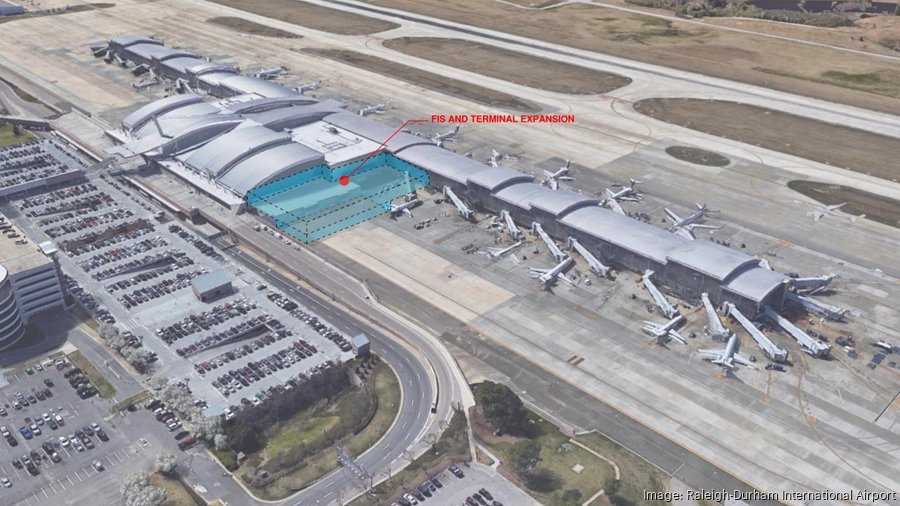
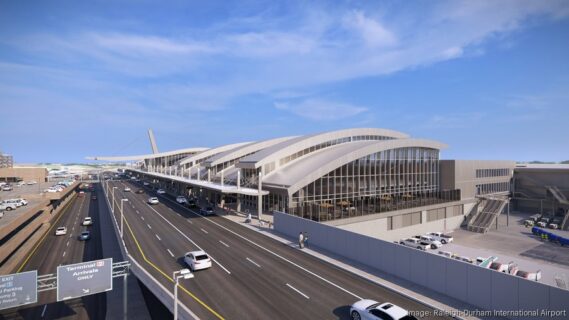
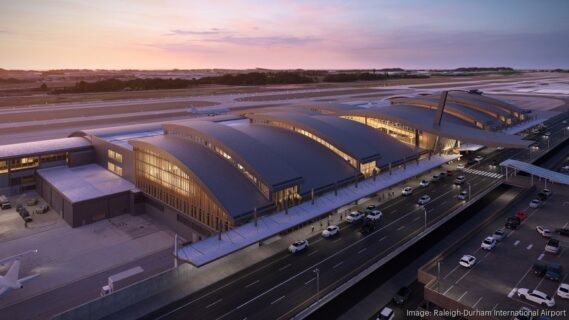
Terminal 2 is undergoing major landside expansion as part of the broader RDU Airport Expansion strategy. Currently, demolition and phased reconstruction works are underway behind temporary barriers within the terminal complex.
Furthermore, the expansion will shift terminal boundaries approximately 400 feet north over the next two years. This will allow Customs and border processing facilities to expand significantly, improving international processing capacity. Additionally, the ticketing lobby will see a major redesign, including a doubling of the existing 13-lane security checkpoint.
Once the first phase is completed, construction will move to the opposite side of the terminal, repeating similar expansion works. Consequently, full terminal completion is scheduled for 2032, aligning with long-term capacity growth plans.
Meanwhile, parking infrastructure upgrades are nearing completion. Approximately 5,000 parking spaces are already open, with the full 11,000-space Economy 3 expansion expected by year-end. Additionally, the upgraded facility includes covered walkways, solar integration, and EV charging stations. A new customer amenity building is also expected to open by the end of summer.
Therefore, passenger access and ground mobility are improving even while construction continues across the airport footprint.
RDU Airport Expansion roadworks and circulation upgrades target congestion relief
John Brantley Boulevard is undergoing major redesign as part of the RDU Airport Expansion landside improvement program. This roadway functions as the airport’s primary circulation spine and has long been a congestion point during peak travel periods.
Moreover, the redesign includes lane expansion and removal of a heavily congested intersection. The upper-level bridge serving Terminal 2 will also be fully rebuilt to improve traffic flow and safety.
Currently, the project is in its initial phase, focusing on utility relocation works including sewer, gas, and fiber optic infrastructure. Additionally, widening and curb construction will begin next summer, marking the start of visible traffic impacts for road users.
Consequently, the roadworks are expected to significantly improve vehicle circulation once completed, reducing bottlenecks around terminal access points and improving overall airport efficiency.
The RDU Airport expansion project aligns with broader US airport modernization efforts, including the Hollywood Burbank Airport development, which is also advancing through major terminal and airfield upgrades. While Burbank focuses on delivering a new consolidated terminal under its Elevate BUR program, RDU is executing a larger $2.5 billion infrastructure build spanning runway construction, Terminal 2 expansion, parking upgrades, and landside improvements.
Both projects are being delivered in active airport environments using phased construction to maintain operations. However, RDU places stronger emphasis on runway capacity to enable long-haul international flights, positioning it as a more airfield-driven expansion compared to Burbank’s terminal-centric redevelopment.
Project Fact Sheet
Project name: RDU Airport Expansion Program
Location: Raleigh-Durham International Airport, North Carolina, United States
Project value: $2.5 billion
Sector: Aviation infrastructure expansion and airport construction
Scope: Runway construction, terminal expansion, parking facilities, and road network upgrades
Focus key outcome: Capacity expansion for international and long-haul operations
Current status (2026): Active multi-package construction across airside and landside works
Runway earthworks: 1 million cubic yards completed; 4 million remaining
Major runway package: $361 million earthworks contract recently awarded
Road relocation works: Lumley Road relocation valued at approximately $50 million
Terminal program: Terminal 2 landside expansion and Customs capacity upgrade
Parking expansion: Economy 3 facility with 11,000 total spaces planned
Completed parking phase: 5,000 spaces already operational
Key infrastructure additions: EV charging, solar systems, covered walkways, amenity building
Completion timeline: Phased delivery through 2028–2032 depending on package
Runway completion target: June 2029 (current program schedule)
Funding model: Airport capital program and bond-financed infrastructure investment
Regulatory oversight: Federal Aviation Administration (FAA) compliance framework
Project Team
Project owner: Raleigh-Durham Airport Authority (RDUAA)
Executive leadership: RDU Airport Authority senior management and development division
Project oversight: RDU Airport Authority Board
Chief development officer: Bill Sandifer (program delivery oversight)
Terminal project management: RDU Buildings and Building Systems division
Road infrastructure lead: RDU Facilities and Asset Management leadership team
Design consultants: Aviation planning and civil engineering consultants
Earthworks contractors: Heavy civil contractors delivering runway grading and excavation works
Terminal contractors: Building contractors handling phased Terminal 2 expansion works
Parking contractors: Civil infrastructure firms delivering Economy 3 parking expansion
Roadworks contractors: Highway and utility contractors managing John Brantley Boulevard works
Utility relocation teams: Specialist subcontractors handling sewer, gas, and fiber relocation
Navigational systems contractors: Aviation systems engineers for runway guidance infrastructure
Regulatory authority: Federal Aviation Administration (FAA)
State transport agency: North Carolina Department of Transportation (NCDOT)
Airline stakeholders: Commercial carriers operating at RDU coordinating operational requirements
Construction monitoring: RDU project controls and performance management teams
Funding sources: Airport bonds, passenger facility charges, and airport revenue streams
Community stakeholders: Local governments, businesses, and regional mobility authorities

Leave a Reply