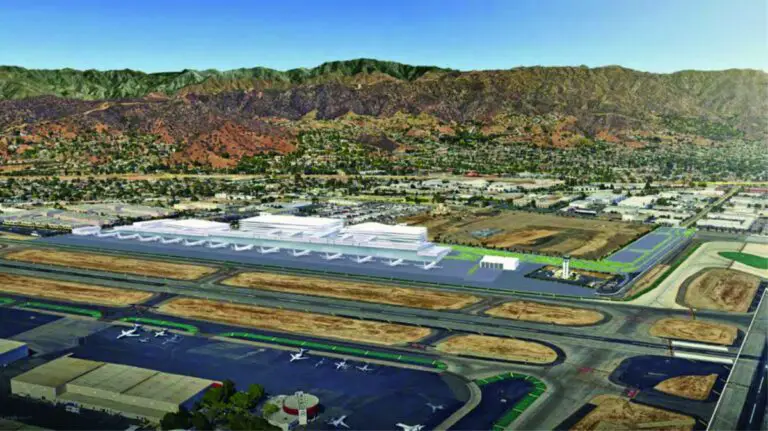
Hollywood Burbank Airport continues to advance as construction activity intensifies on the $1.2 billion replacement passenger terminal in California. The project, which began in 2024, is now in its final delivery phase as structural works transition into systems installation and interior completion. Additionally, airport authorities maintain focus on operational continuity while delivering a fully modernized terminal designed to replace the aging facility. Consequently, the redevelopment remains one of the most significant airport infrastructure upgrades in Southern California.
Moreover, the project aligns with broader US airport modernization programs, including large-scale expansions such as the RDU Airport Expansion in North Carolina, which is simultaneously upgrading runway, terminal, and landside systems under a $2.5 billion investment program.
Hollywood Burbank Airport nears final construction phase
Construction on the new 355,000-square-foot terminal is now largely focused on interior completion, mechanical systems integration, and operational readiness testing. Furthermore, the 14-gate facility is designed to replace the existing terminal and resolve long-standing capacity and safety constraints.
According to project updates, structural works were substantially completed earlier, allowing contractors to shift toward finishing trades and systems commissioning. Additionally, the project includes upgraded TSA screening areas, expanded baggage handling systems, and improved passenger circulation zones.
Meanwhile, supporting infrastructure such as parking facilities and airside adjustments continues to progress. Consequently, the airport is preparing for a staged transition into the new terminal while maintaining full operations at the existing facility. However, construction-related traffic management measures remain in place to support ongoing works around Hollywood Way and adjacent access roads.
Therefore, the project remains on track for its targeted operational opening in 2026, subject to final systems testing and regulatory approvals.
Hollywood Burbank Airport strengthens regional aviation capacity
The redevelopment is expected to significantly improve passenger experience by replacing outdated infrastructure with a modern, higher-capacity terminal. Furthermore, the new facility introduces improved accessibility standards, seismic resilience, and enhanced operational efficiency.
Additionally, airport planners designed the project to maintain separation between airfield operations and passenger processing areas, addressing long-standing spatial constraints at the site. Consequently, the upgraded layout improves both safety compliance and operational flow.
However, the project also reflects broader infrastructure pressures facing US airports, where demand growth continues to outpace legacy terminal capacity. In this context, Elevate BUR forms part of a national wave of airport redevelopment initiatives focused on modernization and efficiency improvements.
Outlook for Hollywood Burbank Airport development program
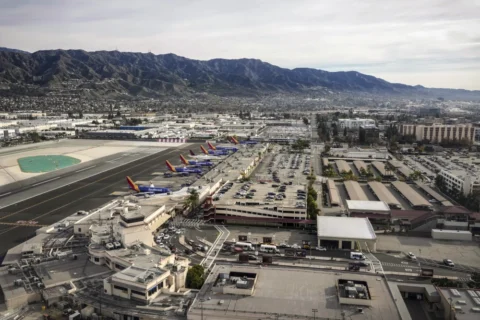
Looking ahead, the project is expected to reach full completion in 2026, followed by phased operational integration. Moreover, demolition of the existing terminal will proceed after transition, enabling full consolidation of passenger services into the new facility.
Additionally, long-term planning includes potential future airfield and landside enhancements aligned with regional demand growth and regulatory requirements. Therefore, Elevate BUR establishes a foundation for sustained airport modernization in the Los Angeles metropolitan region.
Also Read: Plans underway for construction of 200-apartment complex at Del Amo Fashion Center. California
On the north side of the east-west runway, across from the current terminal, is where the new terminal will be situated. It will take the place of a structure that was first built there in 1930. It will have 14 gates, which is the same number as the airport has now now. Modern Federal Aviation Administration rules will be included in the relocation and new building. Energy-efficient fixtures and wastewater collection, for instance, could serve as examples of these objectives.
The current structure will have one year to be demolished once the new terminal opened in October 2026. The Covid-19 pandemic, which caused the project to be put on hold for about 18 months, had an effect on this schedule.
More on the Hollywood Burbank Airport renovations
The Burbank-Glendale-Pasadena Airport Authority Commission selected a joint venture organization in December. They gave them the design build contract for the airport’s new terminal.
The terminal will eventually replace a structure that is almost a century old with a modern structure. The structure complies with contemporary safety regulations and has a more effective design.
Project Fact Sheet
Project name: Hollywood Burbank Airport Elevate BUR Terminal Replacement Project
Location: Hollywood Burbank Airport, California, United States
Project value: $1.2–1.3 billion (reported range across approvals and delivery updates)
Sector: Airport terminal redevelopment and aviation infrastructure upgrade
Scope: New passenger terminal, airfield adjustments, parking facilities, and access road improvements
Size: Approximately 355,000 square feet
Capacity: 14 passenger gates
Primary objective: Replace aging terminal and improve safety, capacity, and passenger experience
Current status (2026): Final construction phase with systems installation and commissioning underway
Construction start: 2024
Expected completion: October 2026 (target operational opening)
Delivery model: Design-build project delivery
Key features: Expanded TSA checkpoints, improved baggage handling, modernized passenger amenities
Accessibility upgrades: ADA compliance improvements and seismic resilience design
Operational strategy: Phased construction with continued airport operations
Regulatory oversight: Federal Aviation Administration (FAA) and state building authorities
Environmental scope: Terminal relocation to improve runway separation and safety compliance
Funding structure: Airport authority bonds and financing program
Project Team
Project owner: Burbank-Glendale-Pasadena Airport Authority (BGPAA)
Operator: Hollywood Burbank Airport (BUR) management team
Executive leadership: Airport Authority Board and executive management
Project delivery model: Design-build joint venture consortium
Design lead:
Construction joint venture: Holder Construction, Pankow Builders, TEC Management
Engineering support: Burns & McDonnell
Architectural contributors: CannonDesign (project association)
Project management consultant: Jacobs Project Management
Financial advisors: Airport bond and financing advisory consortium (Authority-appointed)
Regulatory authority: Federal Aviation Administration (FAA)
State and local oversight: California state building and safety authorities; City of Burbank agencies
Airline stakeholders: Commercial carriers operating at BUR coordinating transition planning
Systems contractors: Airport technology and baggage systems providers (commissioning phase)
Construction coordination: Airport Authority capital programmes division
Community stakeholders: Local residents, businesses, and regional transport authorities

Leave a Reply