
The extensive renovation of the Federal Reserve’s historic headquarters in Washington, D.C. has become a focal point of political controversy, with the project’s escalating cost drawing criticism from the Trump administration. Originally budgeted at about $1.88 billion, the estimated cost has risen to roughly $2.46 billion as of mid-2025, a roughly $580 million overrun attributed to higher labor and material costs, efforts to preserve historic building features, and unforeseen issues such as lead and asbestos remediation. To rein in spending, renovation of a third building was canceled, saving about $510 million, and the Fed has emphasized that the work — including upgrades to plumbing, electrical, heating and other essential infrastructure — remains focused on necessary modernization.
The tussle between the White House and the Central Bank is clear as they dispute over the project’s price tag. Fed Chair Jerome Powell has noted that the Justice Department has issued subpoenas in advance of possible criminal indictment on the work. The cost of the work has ballooned to $2.5 billion.
Furthermore, allies of President Donald Trump have previously pressed for an investigation into the matter. Powell described the DOJ inquiry as a pressure campaign led by the White House. Any evidence of mismanagement or fraud, as Trump administration officials have suggested, could prove a useful pretext for removing Powell. Conversely, the president has repeatedly lambasted for interest rates higher than he would like.
Powell’s critics have pointed to certain features of the building plans as unnecessary to some extent. These include vegetated roofs and changes to the elevator. However, the Fed has fired back as it noted the price tag for the renovation has more to do with the challenges of building. This is particularly underground, in what was once a swamp near the Tidal Basin along the Potomac River.
Challenges Facing the U.S. Federal Reserve Headquarters Renovation
One of the factors causing the ballooning price of the Federal Reserve headquarters renovation is the adversity of the project. Foundation work for the Fed expansion was so difficult that contractors responsible for the job received a 2025 award. They were awarded for excellence in the face of adversity category from the Washington Building Congress, a monumental feat.
Furthermore, the ongoing renovation and expansion include historic 1937 building that houses the Fed. It also entails an adjacent 1931 federal building, in which both have faced setbacks. Costs for the long-overdue rehab have climbed more than 30% since 2023. Officials from the Trump administration blame wasteful spending for the cost overruns. However, the White House is currently engaged in a costly development project of its own, Trump’s 90,000-square-foot ballroom.
The scale of the $2.5 billion renovation of the Federal Reserve’s Washington campus reflects a broader resurgence in headquarters investment across the United States, with both public institutions and private-sector corporations committing significant capital to flagship office developments — including American Express’s planned 2 million-square-foot tower at 2 World Trade Center in Lower Manhattan.
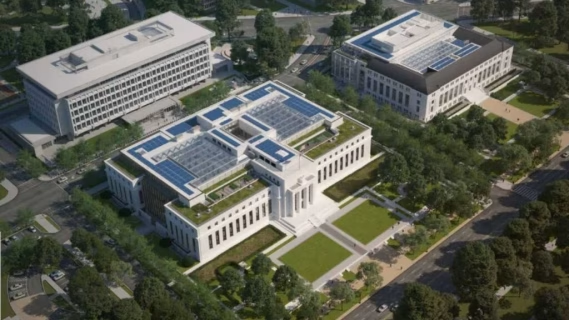
Although it is being funded with donor rather than taxpayer money. Trump first teased the project in last year February as a $100 million expansion, an estimate that has more than tripled since. Powell has defended the renovation of the Federal Reserve headquarters as transparent. Construction on the Marriner S. Eccles Federal Reserve Board Building and the adjacent Federal Reserve East Building involves adding new office space. It also includes removing asbestos and lead, and replacing antiquated mechanical systems.
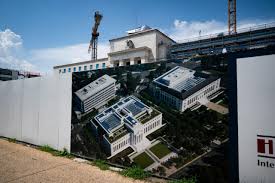
Project Factsheet:
- Project: U.S. Federal Reserve Headquarters Renovation
• Location: Washington, D.C
• Buildings involved:
– Marriner S. Eccles Federal Reserve Board Building (1937)
– Federal Reserve East Building (1931) - Total renovation cost: $2.5 billion
• Cost increase: over 30% since 2023 - Project scope:
– Major structural renovation and expansion
– Addition of new office space
– Removal of asbestos and lead
– Replacement of outdated mechanical and electrical systems
– Extensive underground construction - Key cost drivers:
– Complex foundation and underground work
– Construction on historically protected buildings
– Difficult soil conditions near the Potomac River and Tidal Basin
– Inflation and construction material costs - Construction challenges:
– High water table and former swamp conditions
– Engineering complexity below ground level
– Preservation requirements for historic structures - Industry recognition:
– Contractors received a 2025 Washington Building Congress award
– Category: excellence in the face of adversity - Points of criticism:
– Vegetated roof design
– Elevator system modifications
– Overall budget escalation - Federal Reserve position:
– Cost driven by engineering complexity, not design luxury
– Project managed under standard federal transparency rules
Project Team
Owner: Federal Reserve (Board of Governors)
Lead Design Architect: HOK
Design & Planning Partner: Skidmore, Owings & Merrill (SOM)
Construction Manager / General Contractor: Turner Construction Company
Independent Oversight: Federal Reserve Office of Inspector General
Federal Planning Review: National Capital Planning Commission
Architectural & Historic Review: U.S. Commission of Fine Arts
Status:
– Renovation and expansion ongoing
– Subject to government and legal scrutiny
Leave a Reply