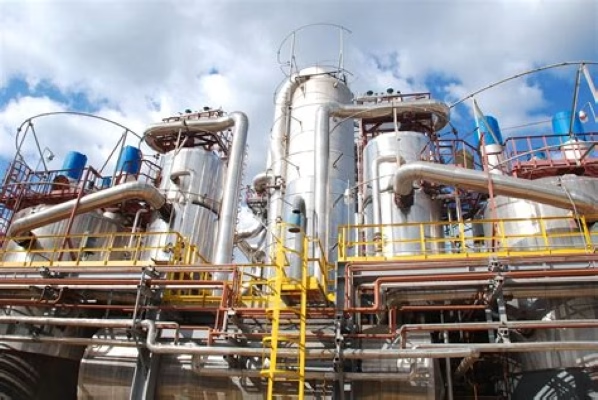
The Wabash Valley Resources Low-Carbon Ammonia Project is a clean energy and agricultural facility in West Terre Haute, Indiana, designed to supply fertilizer to farmers across the Midwest while capturing and permanently storing carbon dioxide from the production process.
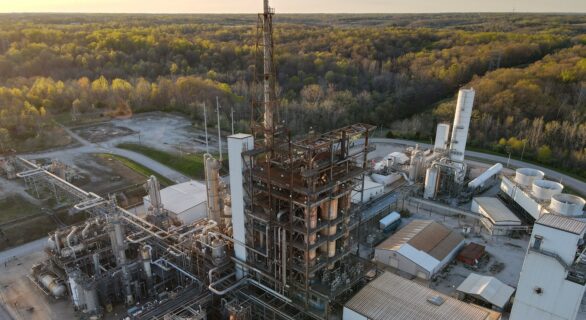
Wabash Valley Resources is developing the project by repurposing a former coal gasification facility that has been idle since 2016. The redevelopment will combine the existing gasification infrastructure with new hydrogen production, carbon capture and ammonia synthesis facilities.
The ammonia facility is designed to produce approximately 500,000 metric tons of anhydrous ammonia annually. Samsung E&A is carrying out the engineering, procurement and fabrication work under a contract valued at about $475 million, with a 30-month contract period.
Construction officially moved into the next phase with a groundbreaking ceremony on January 5, 2026. The project is targeting completion in 2029.
Turning an idle industrial site into an ammonia facility
The project’s starting point is different from a conventional greenfield ammonia development.
Rather than constructing an entirely new industrial complex, Wabash Valley Resources is bringing an existing gasification facility back into use and adapting it for ammonia production.
The broader development includes a refurbished gasification plant, a new hydrogen production system, carbon capture equipment and an ammonia synthesis facility. It will also include ammonia and CO₂ storage and transportation infrastructure.
That approach gives the project an industrial foundation that was already established at the West Terre Haute site while creating a new use for infrastructure that has been largely idle for years.
The location is also strategically important. The plant is being developed close to the Corn Belt, allowing the ammonia to serve Midwest agricultural markets rather than relying entirely on supplies shipped from distant production centers.
A 500,000-ton annual ammonia facility
The central component of the development is the new ammonia production facility.
Samsung E&A says the plant will produce approximately 500,000 metric tons of ammonia each year, with the output intended primarily for fertilizer used on farmland in the Midwest.
That capacity would make the project a substantial new source of domestic ammonia for the region.
The facility is also designed around a hydrogen production system that will supply the feedstock needed for ammonia synthesis. Federal environmental documents describe a planned hydrogen facility capable of producing approximately 14,100 kilograms of hydrogen per hour, alongside an ammonia synthesis plant capable of producing about 1,630 metric tons of ammonia per day.
Carbon capture is a core part of the design
The project’s low-carbon designation comes from its planned carbon-management system.
The facility is designed to capture approximately 1.67 million metric tons of CO₂ annually, according to Samsung E&A. The captured carbon is intended for permanent underground storage at injection sites in the surrounding region.
Federal environmental documents describe two planned CO₂ injection facilities and associated monitoring wells in Vigo and Vermillion counties. The broader project therefore extends beyond the West Terre Haute production site to include the infrastructure needed to store the captured carbon.
DOE previously characterized the development as a commercial-scale waste-to-ammonia project incorporating carbon capture and sequestration, with the potential to produce low-carbon ammonia for Corn Belt farmers.
Samsung E&A takes a major construction role
Samsung E&A’s involvement gives the project an international engineering and construction component.
The company secured the approximately $475 million EPF contract from Wabash Valley Resources in 2025. The agreement covers engineering, procurement and fabrication for the ammonia facility and has a scheduled duration of 30 months.
Samsung E&A subsequently marked the project’s construction launch in January 2026.
The contract is also significant for Samsung E&A because the company described it as its first low-carbon ammonia plant contract in the United States.
Federal financing supports the redevelopment
The project has received substantial federal financial backing.
The U.S. Department of Energy closed a loan of approximately $1.56 billion to Wabash Valley Resources in October 2025. The financing is intended to help restart and repurpose the existing gasification facility for ammonia fertilizer production.
DOE says the project could support up to 500 construction positions during development and up to 125 operational positions, alongside additional maintenance, services and transportation jobs.
The federal financing also reflects the project’s broader objective of strengthening domestic fertilizer supply. Midwest farmers currently rely in part on imported ammonia and other fertilizer products, making a large regional production facility strategically important to the agricultural supply chain.
Honeywell technology supports the process
Honeywell UOP is also involved in the project as a technology partner.
Its technology is intended to support the hydrogen and ammonia production process, complementing the project’s carbon-capture and storage infrastructure.
The combination of existing gasification assets, new hydrogen production, ammonia synthesis and carbon storage makes the development considerably broader than a standalone fertilizer plant.
Why the Wabash project matters
The Wabash Low-Carbon Ammonia Project is significant for two reasons.
First, it adds a large new source of ammonia production close to the agricultural markets that consume it. That could help reduce reliance on imported fertilizer and shorten parts of the regional supply chain.
Second, the project demonstrates a different approach to lower-carbon ammonia production. Instead of building an entirely new facility, Wabash Valley Resources is attempting to convert an existing industrial asset into a new ammonia and hydrogen production complex while incorporating carbon capture and permanent storage.
That makes the project an important test of whether aging industrial infrastructure can be repurposed for new low-carbon manufacturing.
Construction is now underway, with the project targeting completion in 2029.
Factsheet for the Samsung E&A Low-Carbon Ammonia Plant Project in Indiana
• Broader development: Wabash Hydrogen Energy Center Project
• Location: West Terre Haute, Indiana
• Developer: Wabash Valley Resources
• Major contractor: Samsung E&A
• EPF contract: Approximately $475 million
• Annual ammonia capacity: Approximately 500,000 metric tons
• CO₂ capture capacity: Approximately 1.67 million metric tons annually
• Groundbreaking: January 5, 2026
• Target completion: 2029
• Primary market: Midwest agricultural fertilizer
• Technology partner: Honeywell UOP
• Federal financing: Approximately $1.56 billion DOE loan
• Site strategy: Repurposing an existing coal gasification facility
• Carbon management: CO₂ capture, transportation and permanent underground storage
Outlook on the Samsung E&A Low-Carbon Ammonia Plant in Indiana
Once complete, Samsung E&A’s plant build-out in Indiana will become a major source of domestic low-carbon ammonia, with strong demand from U.S. agriculture, particularly in the Corn Belt.
The 1.67 Mt of CO2 sequestered annually could also possibly position the facility as a leading industrial carbon-capture project. Samsung’s role could also deepen in the WVR project, and others, once this one is complete.
The Wabash project is part of a broader push to expand lower-carbon ammonia production in the United States. In Louisiana, the $3.7 billion Blue Point One ammonia plant is taking a different route, with CF Industries, JERA and Mitsui developing a new 1.4-million-ton-per-year facility at the Blue Point Complex. While both projects incorporate carbon capture and target 2029 production, Wabash is repurposing an existing gasification site, while Blue Point One is expanding an established ammonia manufacturing complex with new production and supporting infrastructure.
A Look at the U.S. Low-Carbon Chemical Sector
The low-carbon ammonia facility project in Indiana sits at the intersection of industrial decarbonization and fertilizer production. It also reflects the broader expansion of the low-carbon chemical sector in the U.S. Complementing this, Duke Energy Indiana’s launch of the US$3.3 billion Cayuga Station conversion project signals a massive wave of infrastructure demand tied to clean energy transitions, reinforcing how U.S. utilities are investing heavily to modernize power generation and industrial systems for a lower-carbon future.
The ammonia facility will convert an existing gas plant into a low-carbon, carbon-capture-enabled production plant for Wabash Valley Resources (WVR). WVR has also already secured a conditional DOE loan guarantee. This is expected to foster confidence in the project’s financial and environmental viability.

Leave a Reply