
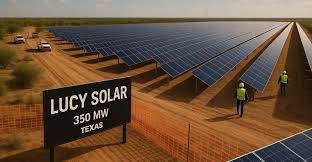
Deep in the ranchlands of Concho County, roughly 150 miles northwest of Austin, a $524 million solar farm is taking shape on nearly 2,900 acres of West Texas terrain. The Lucy Solar Project — one of the largest Korean-led renewable energy investments in the United States — will deliver 350 megawatts of clean electricity to the Texas grid and fundamentally change what international energy investment looks like in rural America.
A Team Effort Built Across Two Countries
The project draws its nickname, “Team Korea,” from the South Korean consortium driving it. Hyundai Engineering & Construction (Hyundai E&C) leads the charge alongside Korea Midland Power (KOMIPO), the Korea Overseas Infrastructure & Urban Development Corporation (KIND), PIS Fund, solar specialist Topsun, and investment manager EIP Asset Management. Texas-based High Road Energy Marketing serves as co-developer, bridging the international partnership with local expertise — a relationship formalised through a Membership Interest Purchase Agreement (MIPA) that gave the Korean consortium its formal stake in the venture.
The project’s roots stretch back to 2023, when the original consortium — which also included SK Ecoplant — announced an ambitious 459MW facility valued at 600 billion won, capable of generating 852 GWh annually and powering up to 240,000 households. By the time shovels hit the ground in January 2026, the project had been refined to 350MW, with a revised investment of $524 million. The restructuring reflects the kind of careful recalibration that complex multi-partner international projects often undergo between announcement and execution.
Hyundai E&C supplies the solar modules in partnership with Topsun, while Dallas-based Primoris Renewable Energy handles engineering, procurement, and construction. KOMIPO will take over long-term operations and maintenance once the plant goes live — and will remain actively engaged for the full 35-year operational lifespan of the facility.
For both anchor partners, Lucy Solar carries historic weight. It marks Hyundai E&C’s largest solar project outside Asia and KOMIPO’s third greenfield renewable energy development in the United States.
What the Plant Will Do
Equipped with hundreds of thousands of single-axis tracking photovoltaic panels — technology that follows the arc of the sun from east to west to maximise output — the facility will generate an estimated 926 GWh of clean electricity annually. That is enough to power approximately 65,000 Texas homes every year.
None of that power sits unspoken for. The plant’s entire output sells through long-term virtual power purchase agreements with major global corporations, including Starbucks and Workday, both committed to sourcing 100% renewable energy under the RE100 initiative. The arrangement gives corporate buyers a reliable clean energy supply while giving the project the financial certainty needed to build.
Why Texas, Why Now
The timing is deliberate. Texas faces one of the steepest electricity demand curves in the country, driven by rapid population growth, the spread of data centres, and an expanding manufacturing base. Forecasts at the time of the project’s groundbreaking pointed to a further 14% rise in statewide demand by mid-2026 unless significant new capacity came online. Lucy Solar adds directly to that supply, feeding power into ERCOT — the grid that serves most of Texas — at precisely the moment the state needs it most.
KIND’s President and CEO, Lee Kang-hoon, framed the project’s significance in broader strategic terms at the time of the announcement. “Participating in the U.S. renewable energy power generation project allows us to bolster our project development capabilities and augment our track record,” he said. “Our aspirations align with environmentally conscious, socially beneficial, and corporate governance-focused business expansion and investment.” That philosophy runs through every layer of how the project has been structured.
Beyond the Grid: What Lucy Solar Means for Concho County
The project’s impact extends well beyond kilowatt-hours. Construction creates approximately 500 jobs, injecting wages and activity into a rural county that rarely attracts investment at this scale. Once operational, Lucy Solar contributes an estimated $5 million annually in local property tax revenue, funding schools, roads, and essential public services in Concho County for the next 35 years.
The consortium has also launched the RAIN-UP programme, which channels a portion of the project’s revenues directly to socially disadvantaged farmers, ranchers, and nearby communities. The initiative reflects a deliberate effort to ensure that the economic benefits of large-scale energy development reach beyond landowners and investors — and into the hands of the people living closest to the project.
A Blueprint for What Comes Next
Lucy Solar does not exist in isolation. It arrives as part of a broader and accelerating wave of South Korean capital flowing into American renewable energy infrastructure. Hyundai E&C has described the project as a landmark entry into the North American renewable energy market — a signal that its ambitions on this continent stretch well beyond a single county in West Texas.
For Concho County, for Texas, and for the growing list of international investors looking to plant their flag in the American clean energy transition, Lucy Solar offers a compelling proof of concept: that global partnerships, carefully structured, can deliver clean power, local jobs, and lasting economic value — all at once, and for generations to come.
The success of the Lucy Solar Project has helped pave the way for a new wave of Korean-led solar development across Texas. Most recently, Hyundai Engineering Co., Ltd. secured $310 million in financing for the Hillsboro Solar Power Plant in Hill County — a 200MW facility that builds on the trail blazed by Team Korea in Concho County, further cementing Texas as South Korea’s preferred destination for renewable energy investment in the United States.
Fact Sheet: Lucy Solar Project
Overview
- Project Name: Lucy Solar Project
- Location: Concho County, Texas, USA (approx. 150 miles northwest of Austin)
- Site Address: 6455 County Road 1644, Paint Rock, TX
- Project Type: Utility-scale solar / Investment Development
- Site Area: Nearly 2,900 acres of ranchland
- Operational Lifespan: 35 years
Capacity & Output
- Generation Capacity: 350 MW
- Annual Electricity Output: ~926 GWh
- Households Powered: 65,000 Texas homes
Timeline
- Original Announcement: 2023
- Construction Start: January 27, 2026
- Target Commercial Operation: Mid-2027
Financing
- Total Project Investment: $524 million (600 billion Korean Won)
- EPC Contractor: Primoris Renewable Energy
- Power Offtakers: Starbucks, Workday (via long-term VPPAs)
The Consortium — “Team Korea”
- Hyundai Engineering & Construction (Hyundai E&C) — South Korea
- Korea Midland Power (KOMIPO) — South Korea
- Korea Overseas Infrastructure & Urban Development Corporation (KIND) — South Korea
- PIS Fund — South Korea
- Topsun — South Korea
- EIP Asset Management — South Korea
- High Road Energy Marketing — Texas, USA (co-developer)
Community Impact
- Construction jobs: 500
- Annual property tax revenue: $5 million
- RAIN-UP programme: Directs a portion of revenues to socially disadvantaged farmers, ranchers and local communities
Read also: Construction of Springwater Solar plant in Ohio approved

Leave a Reply