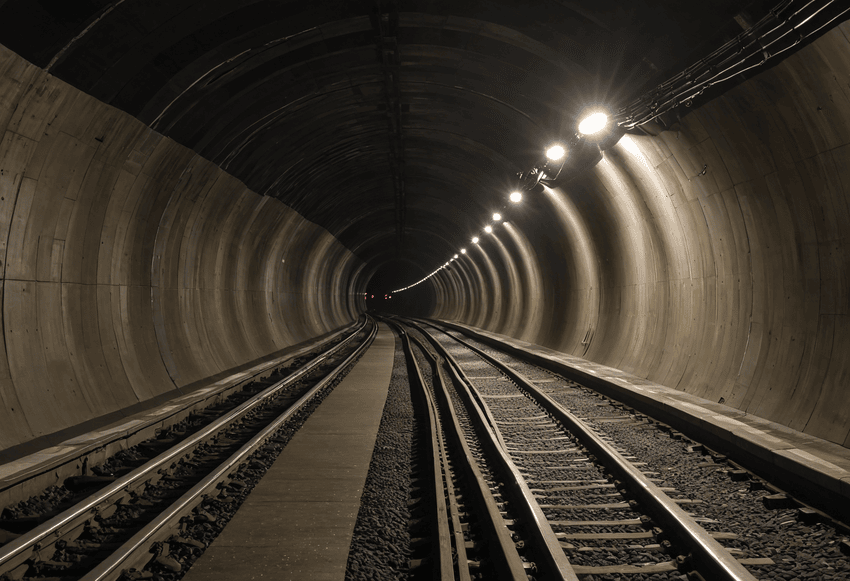
The Transatlantic Tunnel Project remains a long-term conceptual infrastructure proposal rather than an active construction project in 2026. Although the idea continues to generate interest among engineers, researchers, and transport analysts, no government has approved the project, no funding has been secured, and no formal development program has begun. Instead, advances in high-speed rail, immersed tunnel technology, magnetic levitation systems, and underground engineering continue to inform discussions about the concept’s future feasibility.
The proposal envisions a fixed transport link between the United Kingdom and North America, typically connecting London and New York through a tunnel spanning more than 5,000 kilometers beneath the Atlantic Ocean. Most modern concepts rely on evacuated tubes and magnetic levitation trains capable of travelling at several thousand kilometers per hour. However, engineers continue to identify enormous technical, financial and geological challenges that prevent the concept from progressing beyond the research stage.
Transatlantic Tunnel Project remains a long-term engineering vision
As of 2026, the Transatlantic Tunnel Project has not entered planning, procurement or construction. No national government or international consortium has adopted the proposal as an official infrastructure program. Instead, it continues to exist as a theoretical engineering concept discussed within academic literature and infrastructure forums.
Recent developments in global tunneling demonstrate how rapidly underground construction technology continues to evolve. Major projects such as the Fehmarnbelt Tunnel, the Lower Thames Crossing and several high-speed rail tunnels are advancing engineering methods that could eventually influence future megaproject concepts. Nevertheless, experts agree that the Transatlantic Tunnel remains well beyond current technical and economic capabilities.
Current estimates place the theoretical investment at between US$10 trillion and US$20 trillion, depending on the proposed alignment, construction method and transport technology. The concept would also require breakthroughs in materials science, pressure management, maintenance systems and international governance before construction could begin.
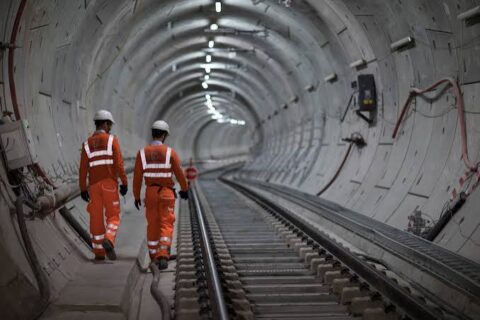
Transatlantic Tunnel Project reflects future transport ambitions
Despite its conceptual status, the proposal continues to influence discussions about next-generation transport infrastructure. Researchers frequently compare it with advances in submerged floating tunnels, vacuum transport systems and ultra-high-speed rail technologies. These innovations could gradually reduce some engineering barriers over the coming decades.
At present, governments continue to prioritize regional tunnel programs with immediate economic value. Projects such as the George Massey Tunnel Replacement in Canada illustrate how modern tunnel construction addresses current freight, commuter and resilience needs while applying technologies that may inform future global megaprojects.
The George Massey Tunnel Replacement Project demonstrates how today’s immersed tunnel construction is delivering practical transport improvements while advancing engineering expertise that could support future long-distance underground infrastructure concepts.
Also read: Morocco-Spain High-Speed Rail Route Set to Link Madrid to Casablanca
Elon Musk’s Proposal on the $20 Trillion Transatlantic Tunnel Project
Talks about the Transatlantic Tunnel project have gained much more significant traction from Elon Musk’s proposal. In a recent tweet, Elon Musk proposed that his company, the Boring Company, could construct the tunnel for $20 billion. Previous estimates of the project place the cost of the Transatlantic tunnel at $20 trillion. Musk’s statement has drawn significant attention, as his budget is a small fraction of the previous estimates. According to him, cost reduction could be achieved through innovative tunneling techniques, automation, and scalability. The Boring Company has already shown its reputation as a company that delivers, with its latest construction on the Las Vegas Convention Center Loop.
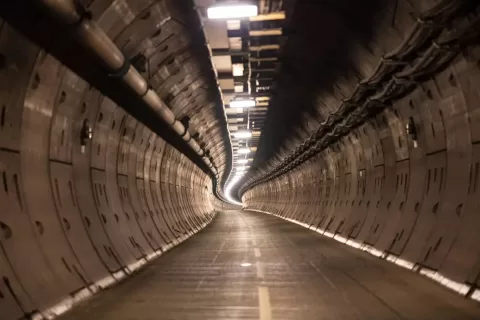
The company’s CEO has proposed that they would integrate the Hyperloop technology in implementing the project. It is a concept he introduced in 2013, which involves pressurized vehicles traveling through vacuum-sealed tunnels. Musk’s vision is to integrate the hyperloop technology into the project, allowing trains to reach speeds of upto 4,800 kilometers per hour. His technological proposition entails maintaining a near-vacuum environment inside the tunnel. The expected result is that trains would glide with minimal friction. The idealistic proposition by Elon Musk integrates a futuristic transportation model with innovative tunneling solutions, placing it as a feasible option that could bring the Transatlantic tunnel to a reality.
Cost of the Project
This ambitious tunnel project is anticipated to cost a whopping £15.6 trillion. Moreover, it is set to alter forever the way these two countries are connected. The tunnel project will also offer an unprecedented opportunity, which is set to significantly break down the existing vast 3,400-mile geographic barrier that exists between them.
This ambitious Transatlantic Tunnel project, even though it is still in the realm of speculative thinking, has drawn the interest of a number of stakeholders. This is simply because of its immense potential to significantly redefine international travel. This project is expected to reduce significantly the travel time from London to New York to a mere 54 minutes. According to the project’s advocates, this ambitious tunnel project will revolutionize global travel. This will be facilitated by the bringing together of the two continents in ways that were once thought to be possible.
Scope of the Project
This tunnel project will extend beneath the massive Atlantic Ocean, passing through some of its deepest regions. Just putting to scale, the Channel Tunnel which extends 23.5 miles beneath the English tunnel that runs between the UK and France, took 6 years to construct. The Transatlantic Tunnel project would surely dwarf this undertaking, with its construction extending for thousands of miles. This will be inclusive of the parts of the journey many miles beneath the ocean floor.
In the previous years, quite a number of proposals have bee brought forward on how this tunnel project would be made feasible. Among the more daring proposals includes embedding this tunnel solely beneath the floor of the ocean. However, in another concepts entail the establishment of a hybrid tunnel. A hybrid one entails construction of the tunnel both above and below the ocean surface.
Additionally, some proposals have presented the idea of constructing a floating tunnel. Moreover, this would also entail submerging some 49 meters under the surface of water, assembled from the pre-fabricated sections and anchored by strong cables.
Also read: The Channel Tunnel: The Longest Underwater Tunnel in the World
Significance/Benefits of the Project
If this ambitious project comes to life, the benefits to the global travellers would be quite revolutionary. This proposal entails utilizing high speed trains, possibly powered by Vactrains (vacuum powered trains). These trains will have the potential of reaching an impressive 5,000mph. This would therefore significantly reduce the travel time between London and New York. It will be reduced from the current eight-hour flight to a mere 54 minutes train journey. This project will therefore significantly reduce travel time between Europe and North America. This will eventually bring forth both efficiency and convenience to both tourists and business travellers.
Challenges Facing the Project
Though Elon Musk’s optimism has revived the hopes of many, the project faces challenges that cannot be overlooked. These include:
- Technical Feasibility: Implementing a 3,000-mile tunnel under the Atlantic Ocean would require overcoming engineering hurdles. These include oceanic pressure, underwater topography, and environmental risks the project may pose. Moreover, this project would need to withstand harsh underwater conditions and potential seismic activity.
- Cost and Funding: Despite Musk’s $20 billion estimate, securing funds for the project may still be challenging. Private-public partnerships and international cooperation would be integral to ensure the project’s delivery.
- Technological Capability: While the Hyperloop technology holds prospects, it still has loopholes. It is one that remains largely unproven on the scale required for the Transatlantic tunnel. Ensuring safety and efficiency at such high speeds remains a challenge
Moreover, as a result of the rapid travel intervals some challenges would be experienced. The jet propulsion systems, which have been proposed as a transportation method in the tunnel, will surely require significant engineering innovations. The trains will have the ability of reaching 5,000mph. However, decelerating them in time for a safe stop would take approximately 18 minutes. Such high speeds will make the journey faster than anything currently. Furthermore, this will call for new safety measures and infrastructure in order to ensure a smooth and safe experience for passengers. Indeed, it is not doubtful that development of such a tunnel project would require highly advanced engineering feats. This is simply because that it will have to withstand very high underwater pressure while at the same time allowing smooth train transportation between the two continents.
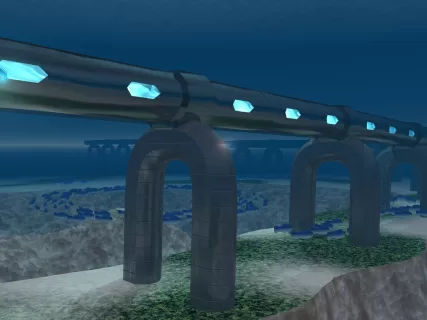
Project fact sheet
Project: Transatlantic Tunnel Project
Location: Proposed connection between the United Kingdom and North America
Project type: Conceptual ultra-long undersea transport tunnel
Status (2026): Concept only; no approved development programme
Estimated cost: $20 trillion
Estimated length: More than 5,000 km
Proposed transport: Magnetic levitation (Maglev) or vacuum train system
Proposed travel time: Less than one hour between London and New York under some concepts
Current phase: Engineering research and conceptual studies
Key challenges: Funding, geology, materials technology, safety systems, international governance and construction feasibility
Construction start: Not scheduled
Project team
Original concept proposer: Michel Verne
Early engineering patent holder: Robert H. Goddard
Modern concept developer: Frank P. Davidson
Tunnel construction proposal: The Boring Company
Concept advocate: Elon Musk
Engineering research institution: Massachusetts Institute of Technology (MIT)
Technical assessment and industry engagement: Institution of Civil Engineers (ICE)
Transport technology research: Maglev and Vactrain engineering research community
Engineering concept evaluation: Discovery Channel (Extreme Engineering)
Also read:
World’s first undersea rail tunnel to connect in the middle, China



Leave a Reply