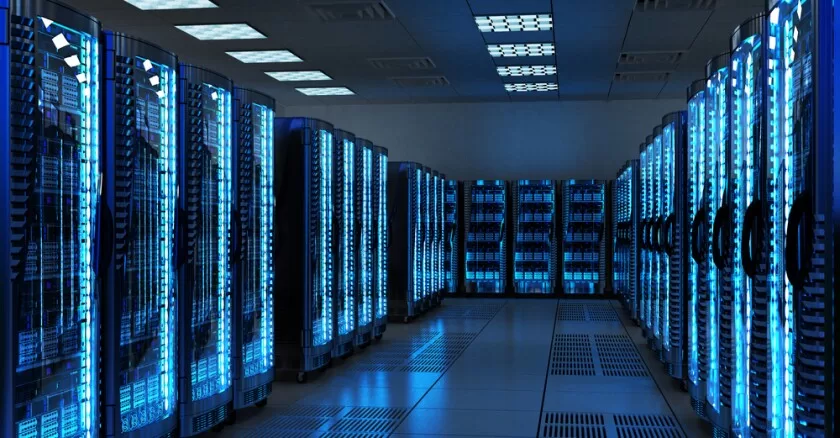
As the world becomes increasingly digital, the demand for data centers has surged—but so has the power demand needed to keep them running. From artificial intelligence (AI) to streaming services and cloud computing, data centers now consume enormous amounts of electricity, raising urgent questions about power availability, sustainability, and infrastructure resilience.
The scale of what is coming is striking. According to Bloomberg, the market for generative AI is expected to reach USD 1.3 trillion by 2032, while PwC projects AI could contribute up to USD 15.7 trillion to the global economy by 2030. By that point, however, data centres could consume nearly 1,000 TWh per year — about three percent of total global electricity demand. That tension frames the five challenges below, and increasingly it is reshaping how the industry thinks about power itself.
1. Growing Demand, Limited Supply
Data centers are energy-hungry facilities with huge power demand. In 2025, it’s estimated that global data centers will consume over 239 terawatt-hours (TWh) of electricity annually—more than many small countries. AI workloads alone, particularly large language models and real-time processing, are responsible for a sharp rise in energy consumption.
However, utility companies are struggling to keep pace. In the U.S., especially in high-growth tech hubs like Northern Virginia and Texas, power grids are stretched thin. The situation is even more challenging in parts of Europe and Africa, where infrastructure development lags behind digital expansion.
According to Steven Santini, Secure Power Vice President at Schneider Electric Sub-Saharan Africa, the answer cannot simply be more supply. “Simply increasing power supply is not a viable solution,” he argues, warning that doing so without addressing inefficiencies risks waste and rising emissions. In his view, the relationship between AI and energy has become two-way: data centres must deliver the power to sustain AI, while AI itself can optimise energy use. “It’s a two-way energy conversation — energy for AI, and AI for energy,” Santini says.
2. Grid Congestion and Permitting Delays
One of the biggest challenges is grid congestion. In regions with high data center density, power infrastructure—like substations and transmission lines—is nearing capacity. This leads to delays in connecting new data centers to the grid and limits the scale of expansion.
Lengthy permitting processes and local opposition add another layer of complexity. It can take years to secure approvals for power connections, land use, and environmental compliance.
Here too, Santini sees intelligence as part of the fix. AI training racks can draw between 100 and 140 kilowatts each, creating unpredictable, high-density loads that strain already congested networks. He points to predictive algorithms that allow operators to forecast energy spikes, adjust dynamically and smooth out load variability to protect grid stability — easing pressure on the grid rather than simply demanding more from it.
3. Dirty Power and Sustainability Concerns
Many data centers rely on fossil-fuel-based grids, which contradict efforts to reduce carbon emissions. In places where clean energy isn’t readily available, the carbon footprint of data processing becomes a public concern.
Communities and regulators are increasingly demanding that tech companies:
– Transition to renewable energy
– Report on energy usage and emissions
– Minimize impact on local water and air quality
Some companies are taking the lead by investing in on-site solar, wind, and battery storage. Others are exploring small modular nuclear reactors (SMRs) and natural gas as backup energy sources.
In Doña Ana County, New Mexico, a proposed $165 billion hyperscale artificial intelligence data center campus known as Project Jupiter intends to use a closed-loop water recycling system to minimize water usage and have on-site power generation, battery storage, and a microgrid to supply its own electricity.
In Minnesota Amazon recently cancelled plans for a data center project in Becker. Part of the reason is the fact that the company lost a battle before the Minnesota Public Utilities Commission over installing 250 diesel backup generators to power the center. In addition to this, legislative changes in Minnesota had voted to roll back tax incentives previously granted to data center developments.
The push for use of clean energy has also become a game changer. Recently Google signed the largest hydroelectric power purchase agreement amounting to US$3 billion. AWS has also reached power purchase agreements with renewable energy producers to support their cloud infrastructure.
Santini argues this is where smart scheduling earns its place: timing energy-intensive AI training to run when renewable supply is abundant reduces both emissions and operational costs. Guided by AI, he says, data centres can evolve “from energy-hungry to energy-aware ecosystems,” balancing performance, resilience and responsibility — a shift Schneider Electric explores in its “AI for Energy Transition” Guide.
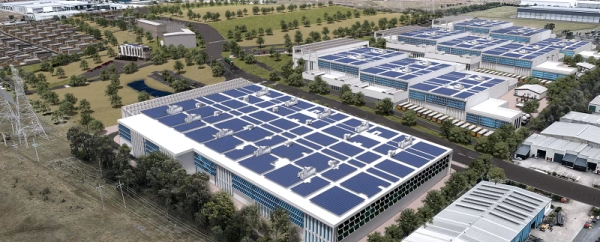
AirTrunk’s in Western Sydney Australia is going against the grain and will leverage the use of diesel generators. It will also have battery storage units to provide power. The AirTrunk data center campus in Australia is expected to host various amenities to ensure its operations. It includes 936 cooling units and 852 diesel back-up generators. Documents also suggest the site would feature 7,488 cabinets for lithium-ion battery storage. Furthermore, at least one on-site substation is planned and the potential for three others.
All this signals a change in attitude towards power hungry data centers in spite of the potential billions of dollars in investment.
4. The Rise of Private Power Generation
To overcome these challenges, some hyperscale data center operators are moving toward private power generation. This includes:
– Building microgrids
– Partnering with renewable energy providers
– Securing long-term Power Purchase Agreements (PPAs)
By decoupling from strained public grids, companies gain more control over energy costs, reliability, and carbon footprint.
For instance Google is investing in clean energy for its plants and has partnered with energyRe in which the South Carolina deal involves the investment in and purchase of Renewable Energy Credits (RECs) from over 600 megawatts (MW) of new solar and solar-plus-storage projects being developed in the state. In addition, in Taiwan Google has entered into a power purchase agreement in its drive towards net-zero. In Virginia Google’s $9 billion expansion announced in August 2025 raises concerns over water and power use. The company has agreed to cap water consumption in Chesterfield, funding new infrastructure if usage exceeds limits, while deploying advanced cooling to reduce demand. On power, it will connect to Dominion Energy’s expanding grid and pursue efficiency and renewable energy to manage the massive electricity needs.
Microsoft, in May 2023, signed what it called the world’s first nuclear fusion power purchase agreement (PPA). Under the deal, the company will offtake up to 50 MW of capacity from the Orion Nuclear Fusion Power Plant currently under development in Washington. Entergy Louisiana on the other hand wants to install three natural gas-powered turbine generators that would provide 2,250 megawatts of electricity for Meta’s facility.
5. Innovation in Energy Efficiency
Beyond sourcing power, efficiency is a critical piece of the puzzle. Innovations such as:
– Liquid cooling systems
– High-density racks using 400V direct current (DC)
– AI-optimized energy management systems
are helping reduce power usage effectiveness (PUE) ratios and shrink overall energy demand per server.
The need for adequate cooling has also put constraints on efficiency; for instance, a report released by the City of Racine indicates Microsoft’s Mount Pleasant Data Center will require 8.4 million gallons a day, putting pressure on local water resources.
Santini sees cooling not just as a cost but as an opportunity. As power densities climb, he notes, traditional air systems are reaching their limits, driving a shift toward liquid cooling that removes heat directly at the chip level. Done well, that rethink can turn an energy cost into a resource: “Waste heat can be repurposed for nearby industrial or agricultural use, while closed-loop systems minimise water consumption and ensure operational continuity in regions facing resource constraints,” he explains — a point with particular weight for water-stressed markets.
He frames the end goal as integrated design “from grid to chip to chiller.” Reference designs co-engineered by Schneider Electric and NVIDIA, he notes, combine liquid cooling with advanced power management to support racks of up to 142 kilowatts without sacrificing efficiency. The payoff can be measured: Schneider Electric’s White Paper 212, “Bending the Energy Curve,” finds that even modest gains in PUE and compute efficiency can collectively bend the industry’s energy growth curve by up to 17%, decoupling digitalisation from exponential energy demand.
The Expert View: Data Centres as Energy Ecosystems
For Santini, the data centre of the future “will not be defined merely by its computing capacity, but by how it contributes to broader energy ecosystems.” He envisions AI-ready facilities that partner with the grid through flexible operations and load shifting, support communities through waste-heat reuse, and use AI itself to optimise energy and accelerate electrification. The leaders, he argues, will be those who “align energy for AI with AI for energy, achieving competitiveness, sustainability, and resilience together.”
Conclusion
Power challenges are no longer just a technical issue for data centers—they are a strategic business concern with environmental, regulatory, and societal implications. As digital infrastructure continues to expand, the pressure is on to build smarter, cleaner, and more energy-resilient data centers. The winners in this race will be those who can combine growth with sustainability and long-term energy planning.


Leave a Reply