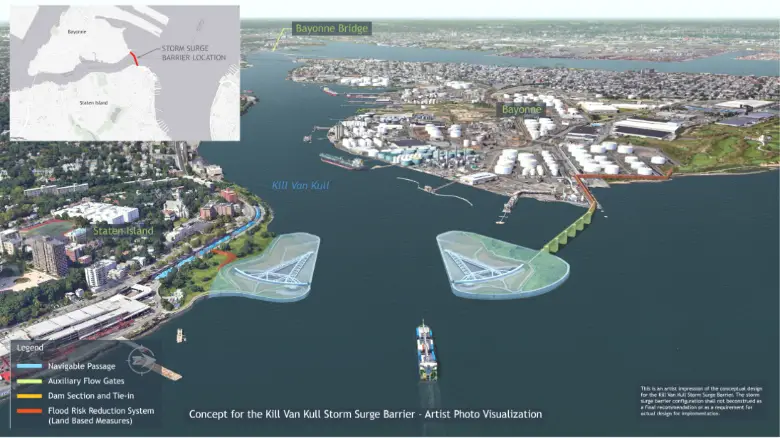
NY-NJ Harbor resilience project has reached a major planning milestone after the U.S. Army Corps completed its final feasibility report. The report evaluates long-term coastal storm risks across New York and New Jersey’s harbor region. However, construction still requires authorization, funding and further project development.
The update significantly changes the status reported in the original 2022 story. The Army Corps signed the Final Chief of Engineers report on July 6, 2026. It now provides a framework for coordinated coastal resilience rather than simply advancing the earlier construction timetable.
NY-NJ Harbor resilience project enters a new construction planning phase
The NY-NJ Harbor and Tributaries Study covers a vast network of waterways and shorelines. It includes New York City, the Hudson River and several major New Jersey tributaries.
The study also covers Newark Bay, Jamaica Bay, Raritan Bay and Sandy Hook Bay. Additionally, it examines the Kill Van Kull, Arthur Kill, East River and western Long Island Sound.
The Army Corps began the study following Hurricane Sandy’s devastating impact in October 2012. The federal agency sought a comprehensive strategy for managing future coastal storm risks.
The 2022 plan carried an estimated cost of $52.6 billion at fiscal 2022 price levels. It proposed a combination of storm surge barriers, levees, floodwalls and shoreline measures.
That earlier proposal included 12 movable storm barriers and extensive land-based protection. It also envisioned approximately 31 miles of levees, elevated shorelines and seawalls.
However, the programme has since evolved through additional analysis and stakeholder engagement. The Army Corps approved $4 million in additional study funding in January 2025.
The funding supported actionable elements and development of a broader regional coastal resilience framework.
NY-NJ Harbor resilience project shifts toward actionable protection
The Army Corps released its Draft Integrated Interim Response Feasibility Report in 2025. That report examined specific projects capable of delivering earlier localized flood protection.
The final 2026 study now provides a broader framework for long-term resilience. It addresses storm surge, rising sea levels and increasingly severe weather across the harbor region.
Meanwhile, the Army Corps has identified actionable elements that could move ahead within the wider programme. These elements focus on locations where earlier protection could reduce immediate flood risks.
The March 2026 final interim response report examined sites including the Harlem River and East Riser. It also assessed the Oakwood Beach area and potential shoreline protection measures.
The Harlem River element includes potential floodwalls, deployable barriers, elevated promenades and seawalls. Engineers also evaluated alternative alignments before recommending further development.
At East Riser, the study assessed flood conditions and potential protective measures. Oakwood Beach also received detailed engineering and environmental analysis.
The broader $52 billion programme remains financially challenging. New York City officials recently said federal funding will determine how quickly regional projects reach construction.
City officials continue working with federal and state partners on the wider resilience programme. They also emphasise long-term maintenance and sustainable financing for completed infrastructure.
The revised trajectory makes the programme less about one massive barrier system. Instead, authorities are developing layered and phased protection across vulnerable communities.
The scale also places the project among America’s largest proposed coastal resilience programmes. Its implementation will require coordination between federal agencies, states and local authorities.
As this enormous flood-protection programme moves through its next stage, another major US construction initiative is reshaping Baltimore’s industrial landscape. The $3.7 billion Arsenal-2 development will establish a 2-million-square-foot shipyard at Sparrows Point, creating more than 3,100 direct jobs and supporting the nation’s submarine industrial base.
Also Read U.S. Army Corps to begin planning the Ike Dike barrier project in Texas
Development plans for the NY-NJ waterway project
Critics have said this new NY-NJ waterway project plan was a major improvement over the previous one. But they appealed to the Corps to further reduce their reliance on built structures, which may pose risks to coastal ecosystems. They also pointed out that the structures should be able to withstand the forces of nature.
The NY-NJ waterway project plan takes into account two expert opinions from a broader resiliency debate and public concerns. Although the project’s main focus is still the sea barriers and walls, it will implement something from both expert views. One approach involves using engineered solutions, intended to control water flows, while also relying on walls and levees to defend coastlines. Meanwhile, the second approach is leaning towards rebuilding waterfront areas to make them compatible with rising seas and intensifying weather.
New York and New Jersey State officials have to approve the NY-NJ waterway project before it moves forward. The state Department of Environmental Conservation and the city Department of Environmental Protection will also review the report as well.
If all goes as planned, the Corps estimates that the project would be completed by 2044. Additionally, the development is expected to save $6.2 billion in flood damage each year for the next five decades. The public will be given an opportunity to comment and give feedback on the project’s design. This design is expected to be finalized in 2025, and afterward the construction phase will commence in 2030.
Project Fact Sheet
Name: New York-New Jersey Harbor and Tributaries Study.
Type: Coastal storm risk management and flood resilience programme.
Location: New York and New Jersey harbor region, United States.
Original estimated programme cost: $52.6 billion.
Cost basis: Fiscal 2022 price levels.
Lead federal agency: U.S. Army Corps of Engineers.
Study area: New York City, Hudson River and major regional tributaries.
Key waterways: Newark Bay, Jamaica Bay, Raritan Bay and Sandy Hook Bay.
Additional waterways: Kill Van Kull, Arthur Kill, East River and western Long Island Sound.
Original comprehensive plan: Alternative 3B.
Earlier proposed infrastructure: Storm surge barriers, levees, floodwalls and shoreline measures.
Earlier barrier proposal: 12 movable storm barriers.
Shoreline protection: Approximately 31 miles under the earlier proposal.
Final Chief of Engineers report: Signed July 6, 2026.
2025 interim response: Developed actionable elements for earlier localized protection.
2026 focus: Long-term regional coastal storm risk management.
Construction status: Not yet fully authorized or funded for the entire programme.
Current priority: Advancing actionable elements and a comprehensive regional resilience framework.
Primary risks addressed: Storm surge, sea-level rise and future extreme weather.
Key challenge: Securing federal and non-federal funding for implementation.
Project Team
Federal lead agency: U.S. Army Corps of Engineers, New York District.
Federal study authority: U.S. Army Corps of Engineers.
New York non-federal sponsor: New York State Department of Environmental Conservation.
New Jersey non-federal sponsor: New Jersey Department of Environmental Protection.
Local partner: New York City.
Regional stakeholder: U.S. Environmental Protection Agency.
Federal stakeholder: U.S. Fish and Wildlife Service.
Maritime stakeholder: U.S. Coast Guard.
Fisheries stakeholder: National Oceanic and Atmospheric Administration.
Federal emergency stakeholder: Federal Emergency Management Agency.
Study contact: Bethany McClanahan, P.E., U.S. Army Corps of Engineers.

Leave a Reply