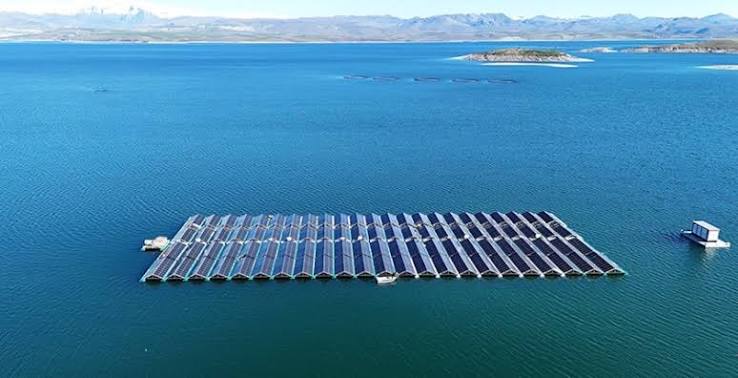
Turkey’s first floating solar power plant under the Renewable Energy Resource Areas (YEKA) programme is advancing towards phased commissioning in 2027. The Turkey Floating Solar Plant is being developed on the reservoir of Demirköprü Dam in Salihli, Manisa. The project represents an estimated investment of €41 million.The development adds to Türkiye’s growing YEKA solar portfolio, which also includes the 130MWp Niğde Bor-2 Solar Power Plant.
The facility will have an installed solar capacity of 50.25MWp and a grid export capacity of 35MW. Initially, the first 9MW is expected to begin generating electricity between late January and mid-February 2027. Meanwhile, full commissioning is targeted for the end of May 2027.
The Turkey Floating Solar Plant project will occupy approximately 500 decares of the reservoir surface. Once operational, it is expected to generate around 77.6 million kilowatt-hours of electricity annually. This output will be sufficient to meet the estimated electricity needs of approximately 20,000 households.
Additionally, the floating solar installation will expand Türkiye’s renewable energy capacity while demonstrating the potential of using existing water reservoirs for large-scale solar power generation.
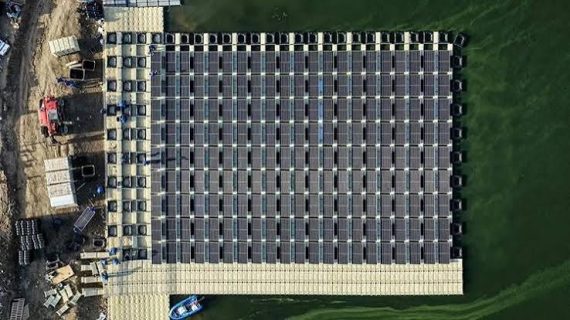
Demirköprü Floating Solar Plant to Install More Than 91,000 Panels
The project will comprise 91,368 solar panels, each rated at 550 watts. These will be assembled into floating platforms onshore before being transported by boats to designated sections of the reservoir.
The floating installation is expected to weigh approximately 8,000 tonnes. Its platforms, mooring systems and cable connections have been designed to accommodate fluctuations in the dam’s water levels. Engineers have also considered the reservoir’s underwater structure, wind conditions and wave movements when designing the anchoring arrangements.
The solar panels are selected to withstand prolonged exposure to sunlight and high moisture levels. Once operational, the facility will use remote monitoring systems to track wind conditions, water levels and platform movements. The mooring lines and floating structures will also undergo regular inspections.
Project Construction and Environmental Considerations
Fieldwork began in 2026 after the project received its preliminary licence on July 23. Subsequently, installation of the floating solar system commenced in October, with the first solar panels placed on the reservoir.
Meanwhile, the project’s Environmental Impact Assessment (EIA) report received approval from Turkey’s Ministry of Environment, Urbanization and Climate Change. Environmental monitoring will continue throughout construction and operation. This will include water sampling and monitoring of fish populations to assess potential environmental impacts.
The use of the reservoir for solar power generation is also expected to reduce the need for additional land. Consequently, Turkey Floating Solar Plant the project will avoid occupying agricultural and forest areas. Instead, it will make use of an existing water body to support renewable electricity generation.
The floating platforms may also help reduce water evaporation from the covered sections of the reservoir. However, the project’s environmental monitoring programme will be important in assessing its effects on water quality and aquatic ecosystems.
YEKA Programme and Turkey’s Floating Solar Development
The Demirköprü project represents an expansion of Türkiye’s renewable energy development strategy through the use of floating solar technology. The YEKA framework supports the development of renewable energy resources and associated infrastructure.
Floating solar installations can make productive use of reservoirs and other suitable water surfaces. They can also complement existing hydropower infrastructure by adding solar generation to sites that already have grid connections.
For Demirköprü, the project will demonstrate the technical and operational requirements of deploying a large floating solar installation on a reservoir with changing water levels. Its commissioning will also provide experience that could inform further floating solar developments in Türkiye.
Additionally, initial electricity generation is planned for early 2027, with full commissioning targeted for May. Once operational, the project is expected to add 35MW of export capacity to Türkiye’s renewable energy supply.
Source: constructionreviewonline.com All rights reserved. Unauthorized reproduction prohibited.
Also Read

Featured Companies
 European Energy FeaturedEuropean Energy is a renewable energy company developing, constructing, and operating wind, solar, and Power-to-X projects across Europe and internationally.…
- Port of Long Beach FeaturedThe Port of Long Beach is building the Port of the FutureTM, guided by its 2050…
- Tokamak Energy FeaturedTokamak Energy is a leading fusion and superconducting technology company, founded in 2009 as a spin-out…
- Alliant Energy CorporationAlliant Energy Corporation (NASDAQ: LNT) provides regulated energy service to approximately 1 million electric and 430,000…
- ARISE IIPARISE Integrated Industrial Platforms (ARISE IIP) is a pan-African developer and operator of world-class integrated industrial zones. Active…
Leave a Reply